Laboratory of Rare Human Circulating Cells (LCCRH), University Medical Centre of Montpellier, CEDEX 5, 34295 Montpellier, France.
CREEC/CANECEV, MIVEGEC (CREES), Université de Montpellier, CNRS, IRD, 34000 Montpellier, France.
Cells. 2021 Aug 27;10(9):2221. doi: 10.3390/cells10092221.
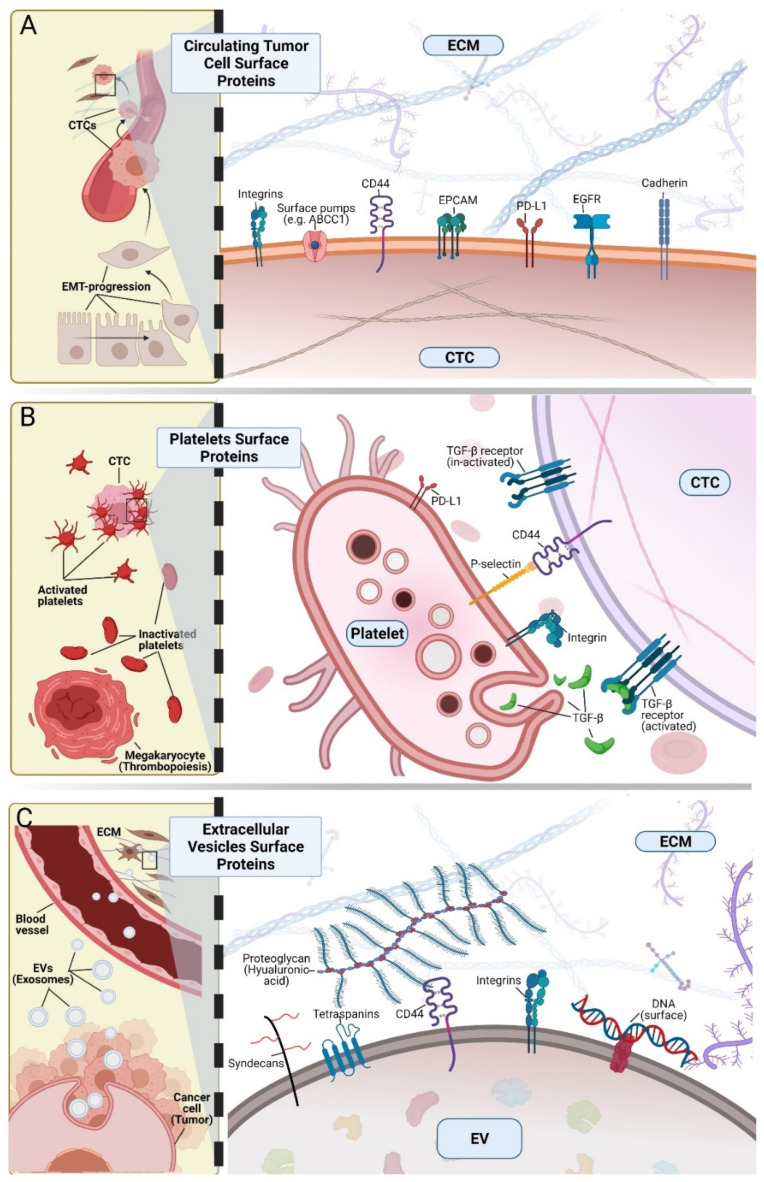
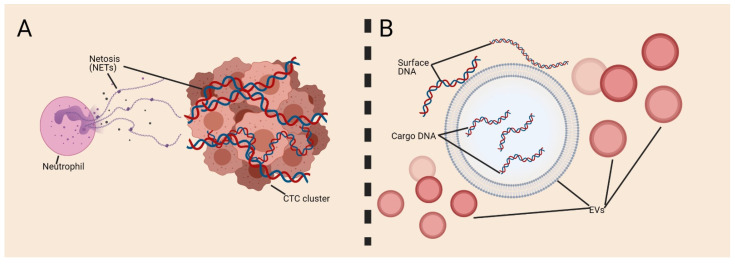
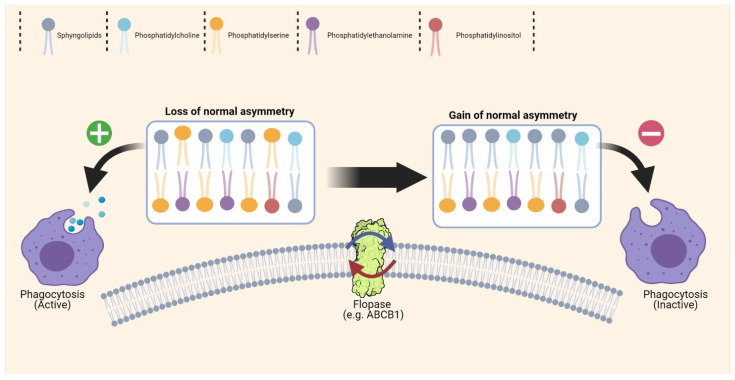
In cancer, many analytes can be investigated through liquid biopsy. They play fundamental roles in the biological mechanisms underpinning the metastatic cascade and provide clinical information that can be monitored in real time during the natural course of cancer. Some of these analytes (circulating tumor cells and extracellular vesicles) share a key feature: the presence of a phospholipid membrane that includes proteins, lipids and possibly nucleic acids. Most cell-to-cell and cell-to-matrix interactions are modulated by the cell membrane composition. To understand cancer progression, it is essential to describe how proteins, lipids and nucleic acids in the membrane influence these interactions in cancer cells. Therefore, assessing such interactions and the phospholipid membrane composition in different liquid biopsy analytes might be important for future diagnostic and therapeutic strategies. In this review, we briefly describe some of the most important surface components of circulating tumor cells and extracellular vesicles as well as their interactions, putting an emphasis on how they are involved in the different steps of the metastatic cascade and how they can be exploited by the different liquid biopsy technologies.
在癌症中,可以通过液体活检来研究许多分析物。它们在支持转移级联的生物学机制中发挥着重要作用,并提供了可以在癌症自然病程中实时监测的临床信息。其中一些分析物(循环肿瘤细胞和细胞外囊泡)具有一个关键特征:存在磷脂膜,其中包含蛋白质、脂质,并且可能还包含核酸。大多数细胞间和细胞与基质的相互作用都受到细胞膜组成的调节。为了了解癌症的进展,必须描述细胞膜中的蛋白质、脂质和核酸如何影响癌细胞中的这些相互作用。因此,评估不同液体活检分析物中的这些相互作用和磷脂膜组成可能对未来的诊断和治疗策略很重要。在这篇综述中,我们简要描述了循环肿瘤细胞和细胞外囊泡的一些最重要的表面成分及其相互作用,并特别强调了它们如何参与转移级联的不同步骤,以及它们如何被不同的液体活检技术所利用。