Fels Cancer Institute for Personalized Medicine, Lewis Katz School of Medicine at Temple University, Philadelphia, PA, USA.
Research, Coriell Institute for Medical Research, Camden, NJ, USA.
Gut Microbes. 2024 Jan-Dec;16(1):2363012. doi: 10.1080/19490976.2024.2363012. Epub 2024 Jun 11.
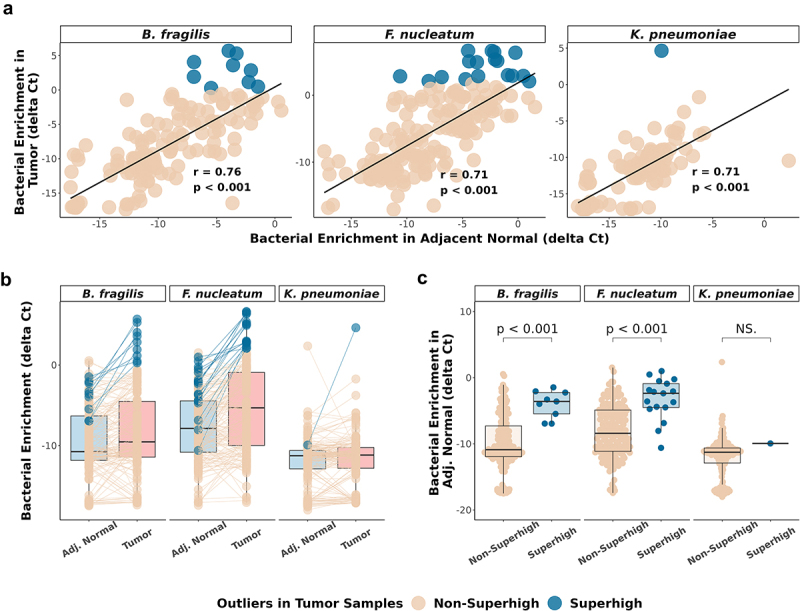
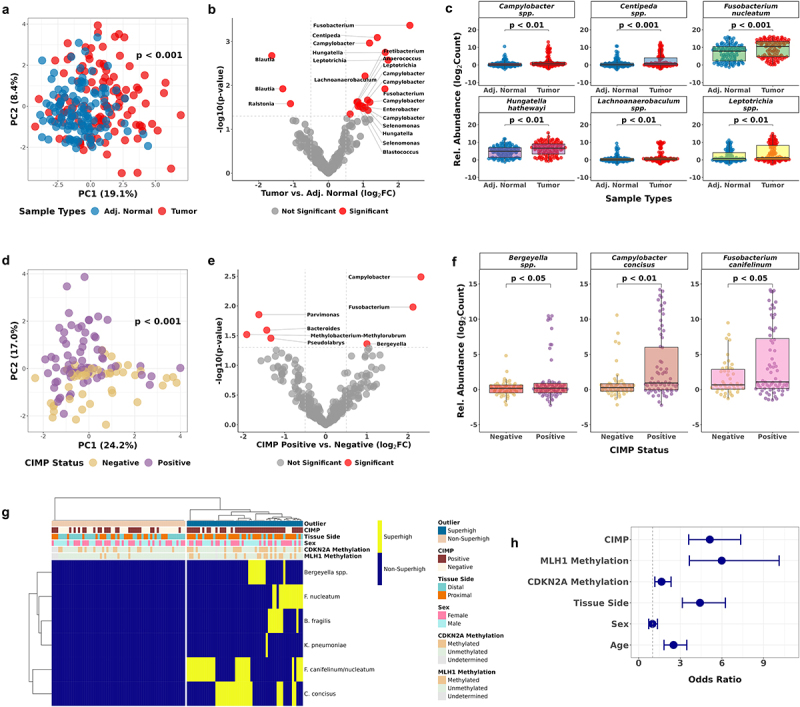
The intestinal microbiota is an important environmental factor implicated in CRC development. Intriguingly, modulation of DNA methylation by gut microbiota has been reported in preclinical models, although the relationship between tumor-infiltrating bacteria and CIMP status is currently unexplored. In this study, we investigated tumor-associated bacteria in 203 CRC tumor cases and validated the findings using The Cancer Genome Atlas datasets. We assessed the abundance of , , , and through qPCR analysis and observed enrichment of all four bacterial species in CRC samples. Notably, except for , all exhibited significant enrichment in cases of CIMP. This enrichment was primarily driven by a subset of cases distinguished by high levels of these bacteria, which we labeled as "Superhigh". The bacterial Superhigh status showed a significant association with CIMP (odds ratio 3.1, p-value = 0.013) and with methylation (odds ratio 4.2, p-value = 0.0025). In TCGA CRC cases (393 tumor and 45 adj. normal), bacterial taxa information was extracted from non-human whole exome sequencing reads, and the bacterial Superhigh status was similarly associated with CIMP (odds ratio 2.9, < 0.001) and methylation (odds ratio 3.5, < 0.001). Finally, 16S ribosomal RNA gene sequencing revealed high enrichment of . , and in CIMP-Positive tumor cases. Our findings highlight that specific bacterial taxa may influence DNA methylation, particularly in CpG islands, and contribute to the development and progression of CIMP in colorectal cancer.
肠道微生物群是与 CRC 发展相关的重要环境因素。有趣的是,虽然肠道菌群对 DNA 甲基化的调节已在临床前模型中得到报道,但肿瘤浸润细菌与 CIMP 状态之间的关系目前尚未得到探索。在本研究中,我们调查了 203 例 CRC 肿瘤病例中的肿瘤相关细菌,并使用癌症基因组图谱数据集验证了研究结果。我们通过 qPCR 分析评估了 、 、 和 的丰度,观察到所有四种细菌在 CRC 样本中均丰富存在。值得注意的是,除了 之外,所有细菌在 CIMP 病例中均显著富集。这种富集主要是由这些细菌高水平的亚组病例驱动的,我们将其标记为“Superhigh”。细菌 Superhigh 状态与 CIMP(优势比 3.1,p 值 = 0.013)和 甲基化(优势比 4.2,p 值 = 0.0025)显著相关。在 TCGA CRC 病例(393 例肿瘤和 45 例对照正常)中,从非人类全外显子测序读取中提取了细菌分类群信息,细菌 Superhigh 状态与 CIMP(优势比 2.9,<0.001)和 甲基化(优势比 3.5,<0.001)也显著相关。最后,16S 核糖体 RNA 基因测序显示 CIMP-Positive 肿瘤病例中 、 和 高度富集。我们的研究结果强调了特定的细菌分类群可能影响 DNA 甲基化,特别是在 CpG 岛,并且有助于结直肠癌中 CIMP 的发生和发展。