Department of Agricultural, Food and Nutritional Science, University of Alberta, Edmonton, Canada.
Department of Food Science and Technology, University of Nebraska, Lincoln, NE, USA.
Gut Microbes. 2024 Jan-Dec;16(1):2363021. doi: 10.1080/19490976.2024.2363021. Epub 2024 Jun 11.
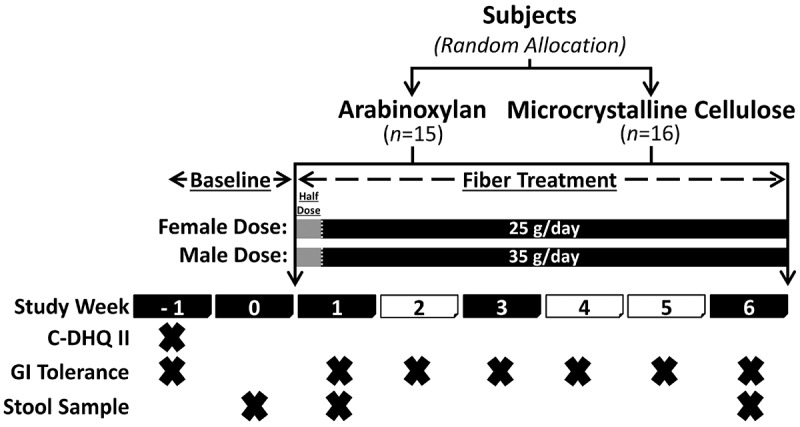
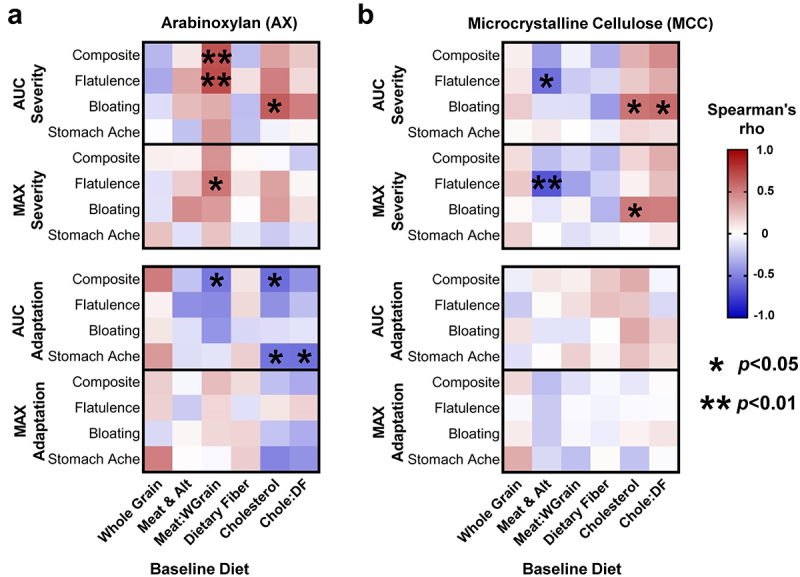
Dietary fiber supplements are a strategy to close the 'fiber gap' and induce targeted modulations of the gut microbiota. However, higher doses of fiber supplements cause gastrointestinal (GI) symptoms that differ among individuals. What determines these inter-individual differences is insufficiently understood. Here we analyzed findings from a six-week randomized controlled trial that evaluated GI symptoms to corn bran arabinoxylan (AX; = 15) relative to non-fermentable microcrystalline cellulose (MCC; = 16) at efficacious supplement doses of 25 g/day (females) or 35 g/day (males) in adults with excess weight. Self-reported flatulence, bloating, and stomach aches were evaluated weekly. Bacterial taxa involved in AX fermentation were identified by bioorthogonal non-canonical amino acid tagging. Associations between GI symptoms, fecal microbiota features, and diet history were systematically investigated. AX supplementation increased symptoms during the first three weeks relative to MCC ( < 0.05, Mann-Whitney tests), but subjects 'adapted' with symptoms reverting to baseline levels toward the end of treatment. Symptom adaptations were individualized and correlated with the relative abundance of at baseline (r = 0.74, = 0.002), within the bacterial community that utilized AX (r = 0.69, = 0.006), and AX-induced shifts in acetate (r = 0.54, = 0.039). Lower baseline consumption of animal-based foods and higher whole grains associated with less severity and better adaptation. These findings suggest that humans do 'adapt' to tolerate efficacious fiber doses, and this process is linked to their microbiome and dietary factors known to interact with gut microbes, providing a basis for the development of strategies for improved tolerance of dietary fibers.
膳食纤维补充剂是一种缩小“膳食纤维差距”并诱导靶向肠道微生物群调节的策略。然而,膳食纤维补充剂的较高剂量会引起个体间不同的胃肠道(GI)症状。这些个体间差异的决定因素尚未充分了解。在这里,我们分析了一项为期六周的随机对照试验的结果,该试验评估了玉米麸阿拉伯木聚糖(AX;= 15)相对于不可发酵的微晶纤维素(MCC;= 16)在超重成年人中的 GI 症状,AX 和 MCC 的有效补充剂量分别为 25 克/天(女性)或 35 克/天(男性)。每周评估自述的胀气、腹胀和胃痛。通过生物正交非典型氨基酸标记鉴定参与 AX 发酵的细菌分类群。系统研究了 GI 症状、粪便微生物群特征和饮食史之间的关联。AX 补充剂在前三周相对于 MCC 增加了症状(<0.05,Mann-Whitney 检验),但随着治疗的进行,受试者的症状“适应”并恢复到基线水平。症状的适应是个体化的,并与基线时的相对丰度相关(r = 0.74,= 0.002),与利用 AX 的细菌群落内的相对丰度相关(r = 0.69,= 0.006),以及 AX 诱导的乙酸变化相关(r = 0.54,= 0.039)。较低的基线动物源性食物消耗和较高的全谷物摄入与较轻的症状和更好的适应相关。这些发现表明,人类确实“适应”了耐受有效纤维剂量,这个过程与他们的微生物组和已知与肠道微生物相互作用的饮食因素有关,为改善膳食纤维耐受策略的发展提供了依据。