Psychology Department, Hebrew University of Jerusalem, Jerusalem, Israel.
JMIR Ment Health. 2024 Jun 11;11:e56529. doi: 10.2196/56529.
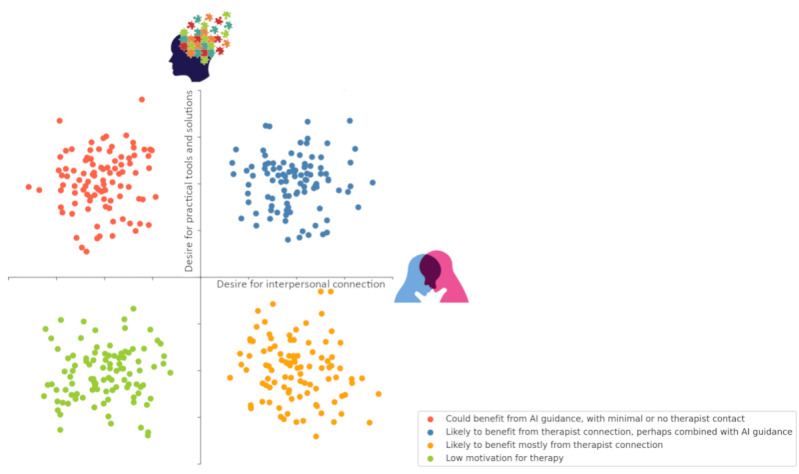
Recent breakthroughs in artificial intelligence (AI) language models have elevated the vision of using conversational AI support for mental health, with a growing body of literature indicating varying degrees of efficacy. In this paper, we ask when, in therapy, it will be easier to replace humans and, conversely, in what instances, human connection will still be more valued. We suggest that empathy lies at the heart of the answer to this question. First, we define different aspects of empathy and outline the potential empathic capabilities of humans versus AI. Next, we consider what determines when these aspects are needed most in therapy, both from the perspective of therapeutic methodology and from the perspective of patient objectives. Ultimately, our goal is to prompt further investigation and dialogue, urging both practitioners and scholars engaged in AI-mediated therapy to keep these questions and considerations in mind when investigating AI implementation in mental health.
最近人工智能 (AI) 语言模型的突破提高了使用会话式 AI 支持心理健康的愿景,越来越多的文献表明其具有不同程度的疗效。在本文中,我们探讨了在治疗中何时更容易取代人类,以及在哪些情况下,人类的联系仍然更有价值。我们认为同理心是回答这个问题的核心。首先,我们定义了同理心的不同方面,并概述了人类与 AI 之间潜在的同理心能力。接下来,我们考虑了是什么决定了在治疗中何时最需要这些方面,既从治疗方法的角度,也从患者目标的角度。最终,我们的目标是促使进一步的调查和对话,敦促从事 AI 介导治疗的从业者和学者在调查 AI 在心理健康中的实施时,牢记这些问题和考虑因素。