Section of Endocrinology, Diabetes and Metabolism, Department of Medicine, Chinese General Hospital and Medical Center, Philippines.
J ASEAN Fed Endocr Soc. 2024;39(1):18-25. doi: 10.15605/jafes.039.01.10. Epub 2024 Jan 23.
Gestational diabetes mellitus (GDM) is a common pregnancy complication with adverse fetal and maternal outcomes. Currently, there are only a few validated tools available that address knowledge in GDM. Recognition of the inconsistencies will provide an effective learning program to achieve optimal results. This study aimed at validating the "Gestational Diabetes Mellitus Knowledge Questionnaire" (GDMKQ).
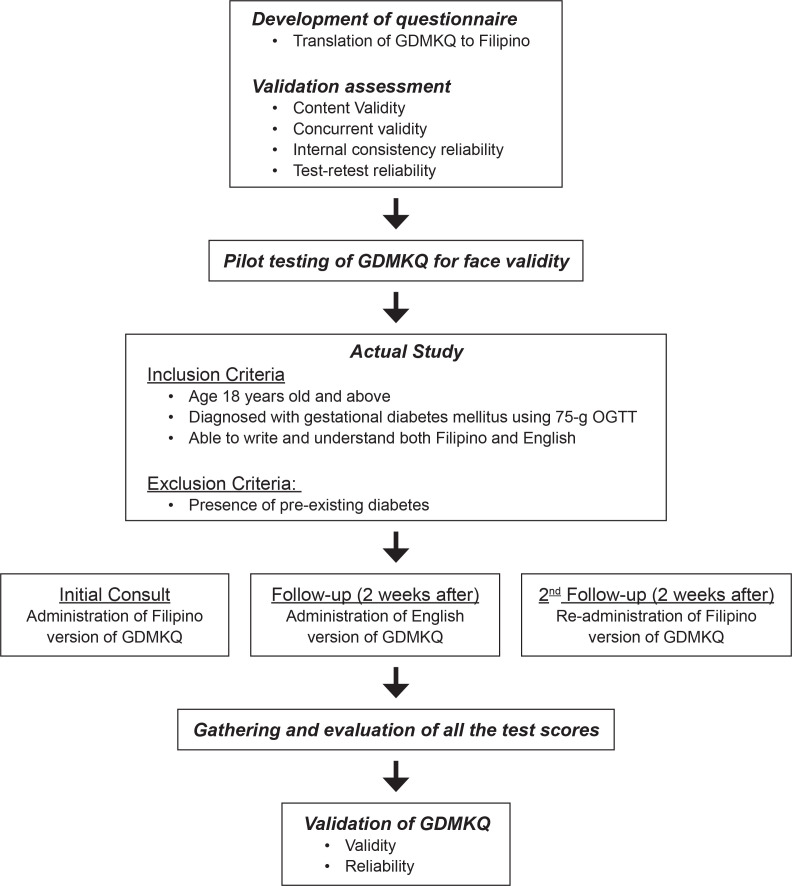
A cross-sectional validation study on GDMKQ among 51 GDM patients aged at least 18 years was conducted in the outpatient clinics of a tertiary hospital. Excluded were those with pre-existing diabetes. The questionnaire was submitted for peer review for translation to Filipino and back-translation. Concurrent validity, internal consistency and test-retest reliability of the questionnaire were undertaken as part of the validation process. Descriptive analysis was used for data elaboration by using SPSS v23.
The Filipino version of GDMKQ demonstrated sensible content and face validity. As measured, respondents obtained higher total and domain scores with better knowledge levels of GDM compared to its English version. Overall adequate knowledge was observed among those married and college subgroups as compared to single women and those with secondary levels of education. The reliability of the questionnaire was calculated at 0.632 using the Kuder-Richardson 20. The test-retest scores using the Filipino-translated questionnaire have a Pearson correlation coefficient of 0.853 with moderate to good level of agreement with each other, and Cohen's kappa of 0.564 with an intra-class correlation coefficient of 0.828.
The Filipino-translated version of GDMKQ is a valid screening tool that assesses a patient's knowledge on gestational diabetes. Identifying the level of their understanding will enable clinicians to develop an individualized, effective learning program to improve pregnancy outcomes.
妊娠糖尿病(GDM)是一种常见的妊娠并发症,可导致母婴不良结局。目前,仅有少数经过验证的工具可用于评估 GDM 相关知识。认识到这些不一致之处将提供一个有效的学习计划,以实现最佳结果。本研究旨在验证“妊娠糖尿病知识问卷”(GDMKQ)。
在一家三级医院的门诊对至少 18 岁的 51 名 GDM 患者进行了 GDMKQ 的横断面验证研究。排除有既往糖尿病的患者。该问卷经过同行评审,翻译成菲律宾语并进行回译。作为验证过程的一部分,进行了问卷的并行效度、内部一致性和重测信度。使用 SPSS v23 进行描述性分析以详细说明数据。
菲律宾语版的 GDMKQ 表现出合理的内容和表面有效性。与英文版相比,回答者在 GDM 方面的总得分和各领域得分更高,表明其知识水平更高。与单身女性和接受中等教育的人相比,已婚和大学组的人整体知识水平更高。使用 Kuder-Richardson 20 计算问卷的可靠性为 0.632。使用菲律宾语翻译的问卷的重测分数的皮尔逊相关系数为 0.853,具有中度至良好的一致性,而 Cohen's kappa 为 0.564,组内相关系数为 0.828。
菲律宾语翻译的 GDMKQ 是一种有效的筛查工具,可评估患者对妊娠糖尿病的知识水平。确定他们的理解程度将使临床医生能够制定个性化、有效的学习计划,以改善妊娠结局。