Department of Mechanical Engineering, Colorado State University, Fort Collins, Colorado 80523, United States.
Energy Institute, Colorado State University, Fort Collins, Colorado 80524, United States.
Environ Sci Technol. 2024 Jun 25;58(25):10941-10955. doi: 10.1021/acs.est.3c08511. Epub 2024 Jun 12.
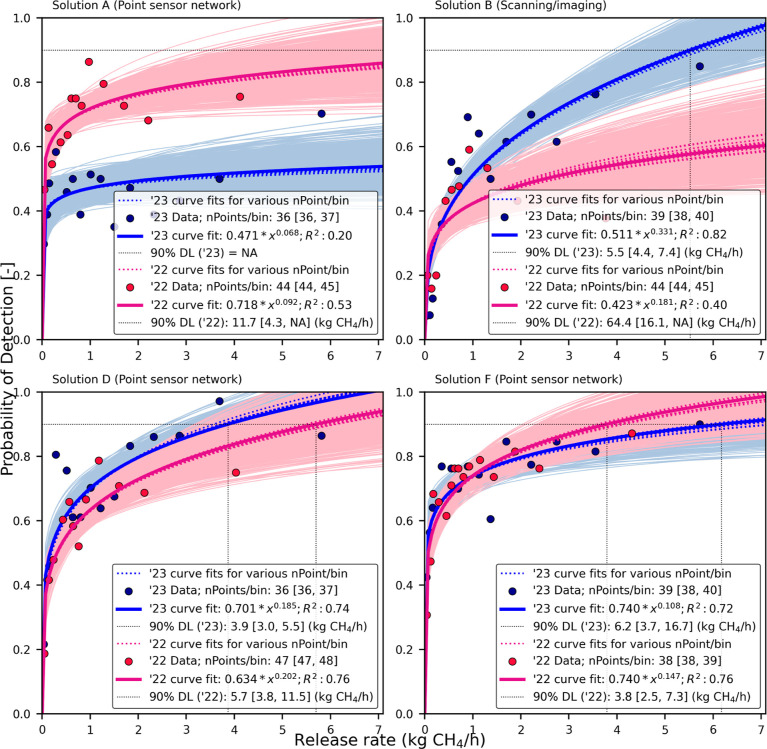
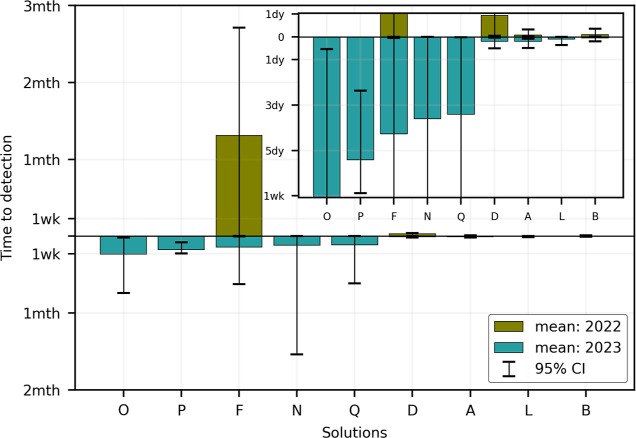
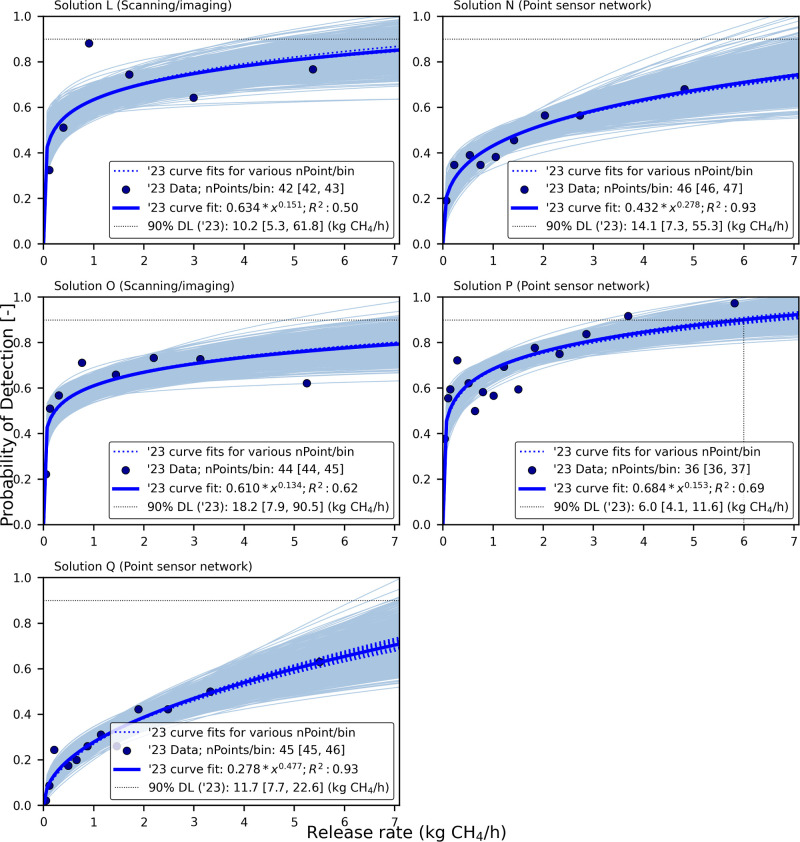
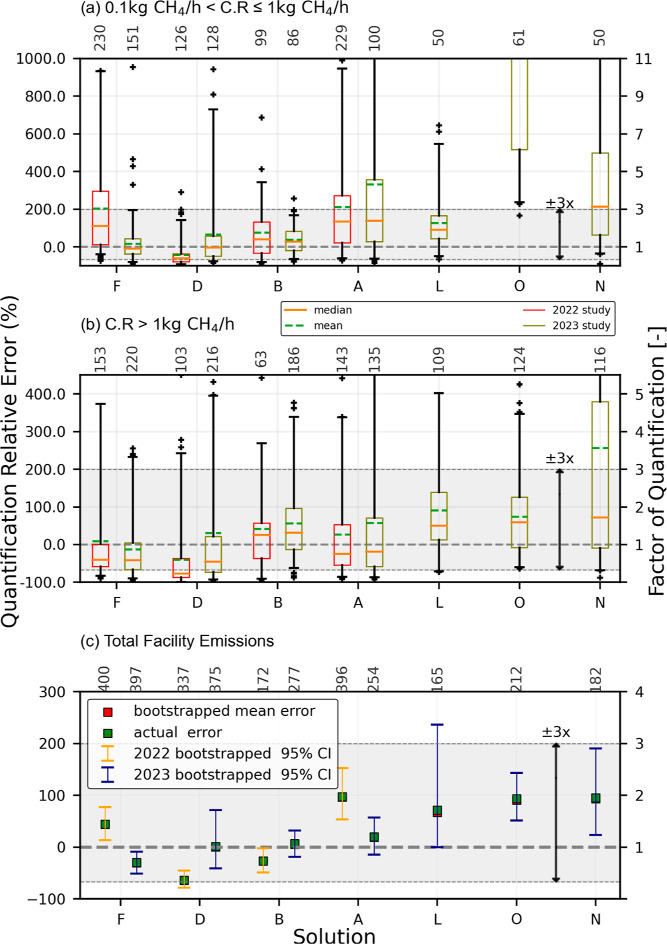
The recent regulatory spotlight on continuous monitoring (CM) solutions and the rapid development of CM solutions have demanded the characterization of solution performance through regular, rigorous testing using consensus test protocols. This study is the second known implementation of such a protocol involving single-blind controlled testing of 9 CM solutions. Controlled releases of rates (6-7100 g) CH/h over durations (0.4-10.2 h) under a wind speed range of (0.7-9.9 m/s) were conducted for 11 weeks. Results showed that 4 solutions achieved method detection limits (DL90s) within the tested emission rate range, with all 4 solutions having both the lowest DL90s (3.9 [3.0, 5.5] kg CH/h to 6.2 [3.7, 16.7] kg CH/h) and false positive rates (6.9-13.2%), indicating efforts at balancing low sensitivity with a low false positive rate. These results are likely best-case scenario estimates since the test center represents a near-ideal upstream field natural gas operation condition. Quantification results showed wide individual estimate uncertainties, with emissions underestimation and overestimation by factors up to >14 and 42, respectively. Three solutions had >80% of their estimates within a quantification factor of 3 for controlled releases in the ranges of [0.1-1] kg CH/h and > 1 kg CH/h. Relative to the study by Bell et al., current solutions performance, as a group, generally improved, primarily due to solutions from the study by Bell et al. that were retested. This result highlights the importance of regular quality testing to the advancement of CM solutions for effective emissions mitigation.
最近,连续监测(CM)解决方案受到了监管关注,并且 CM 解决方案也在迅速发展,这就需要使用共识测试协议通过定期、严格的测试来对解决方案的性能进行评估。本研究是第二次实施此类协议,涉及 9 种 CM 解决方案的单盲对照测试。在风速范围为(0.7-9.9 m/s)下,进行了为期 11 周的受控释放速率(6-7100 g/h)和持续时间(0.4-10.2 h)的测试。结果表明,有 4 种解决方案在测试的排放速率范围内达到了方法检测限(DL90s),这 4 种解决方案均具有最低的 DL90s(3.9[3.0,5.5]kg CH/h 至 6.2[3.7,16.7]kg CH/h)和最低的假阳性率(6.9-13.2%),表明它们在平衡低灵敏度和低假阳性率方面做出了努力。由于测试中心代表了近乎理想的上游天然气作业条件,因此这些结果可能是最佳情况的估计。定量结果显示,个体估计的不确定性很大,排放的低估和高估分别高达>14 和 42 倍。在 [0.1-1]kg CH/h 和>1kg CH/h 的受控释放范围内,有 3 种解决方案的估计值中有>80%处于量化因子 3 以内。与 Bell 等人的研究相比,当前解决方案的性能作为一个整体普遍有所提高,主要是因为 Bell 等人的研究中的解决方案进行了重新测试。这一结果强调了定期进行质量测试对 CM 解决方案的发展和有效减排的重要性。