Clinical Memory Research Unit, Department of Clinical Sciences Malmö, Lund University, Lund, Sweden.
German Center for Neurodegenerative Diseases, Magdeburg, Germany.
Alzheimers Dement. 2024 Jul;20(7):4775-4791. doi: 10.1002/alz.13919. Epub 2024 Jun 12.
Remote unsupervised cognitive assessments have the potential to complement and facilitate cognitive assessment in clinical and research settings.
Here, we evaluate the usability, validity, and reliability of unsupervised remote memory assessments via mobile devices in individuals without dementia from the Swedish BioFINDER-2 study and explore their prognostic utility regarding future cognitive decline.
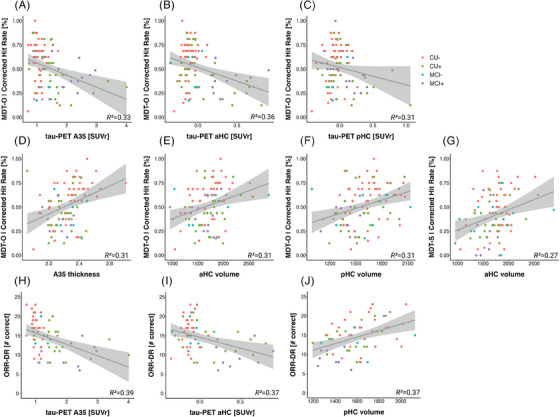
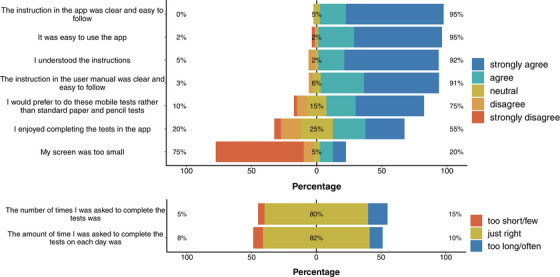
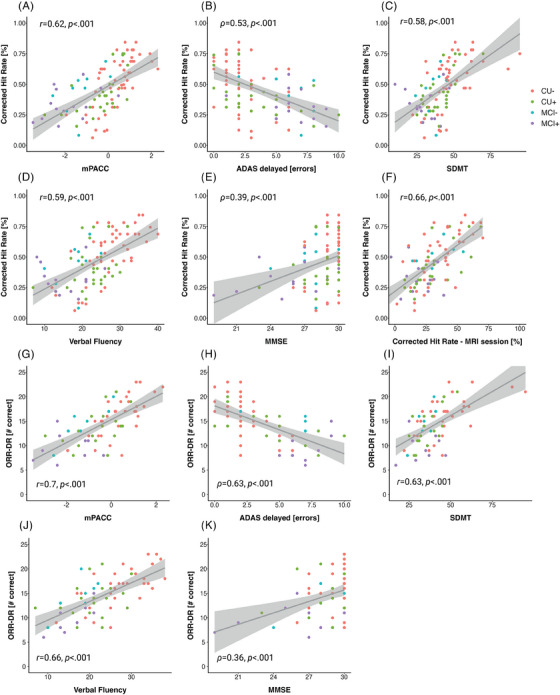
Usability was rated positively; remote memory assessments showed good construct validity with traditional neuropsychological assessments and were significantly associated with tau-positron emission tomography and downstream magnetic resonance imaging measures. Memory performance at baseline was associated with future cognitive decline and prediction of future cognitive decline was further improved by combining remote digital memory assessments with plasma p-tau217. Finally, retest reliability was moderate for a single assessment and good for an aggregate of two sessions.
Our results demonstrate that unsupervised digital memory assessments might be used for diagnosis and prognosis in Alzheimer's disease, potentially in combination with plasma biomarkers.
Remote and unsupervised digital memory assessments are feasible in older adults and individuals in early stages of Alzheimer's disease. Digital memory assessments are associated with neuropsychological in-clinic assessments, tau-positron emission tomography and magnetic resonance imaging measures. Combination of digital memory assessments with plasma p-tau217 holds promise for prognosis of future cognitive decline. Future validation in further independent, larger, and more diverse cohorts is needed to inform clinical implementation.
远程无监督认知评估有可能补充和促进临床和研究环境中的认知评估。
在这里,我们评估了无监督远程记忆评估在无痴呆症的瑞典 BioFINDER-2 研究个体中的可用性、有效性和可靠性,并探讨了它们在未来认知下降方面的预后效用。
可用性评价良好;远程记忆评估与传统神经心理学评估具有良好的结构效度,并且与 tau 正电子发射断层扫描和下游磁共振成像测量显著相关。基线时的记忆表现与未来的认知下降有关,并且通过将远程数字记忆评估与血浆 p-tau217 相结合,可以进一步提高对未来认知下降的预测。最后,单次评估的重测信度为中等,两次评估的总重测信度为良好。
我们的结果表明,无监督的数字记忆评估可能可用于阿尔茨海默病的诊断和预后,可能与血浆生物标志物相结合。
远程和无监督的数字记忆评估在老年人和阿尔茨海默病早期个体中是可行的。数字记忆评估与临床神经心理学评估、tau 正电子发射断层扫描和磁共振成像测量相关。数字记忆评估与血浆 p-tau217 的结合有望预测未来认知下降的预后。需要进一步在独立的、更大的、更多样化的队列中进行验证,以告知临床实施。