Pierce Stephanie A, Jacobelli Jordan, Given Katherine S, Macklin Wendy B, Gopinath Juliet T, Siemens Mark E, Restrepo Diego, Gibson Emily A
University of Colorado Anschutz Medical Campus, Department of Bioengineering, Aurora, Colorado, United States.
University of Colorado Anschutz Medical Campus, Department of Immunology and Microbiology, Aurora, Colorado, United States.
Neurophotonics. 2024 Jul;11(3):034311. doi: 10.1117/1.NPh.11.3.034311. Epub 2024 Jun 12.
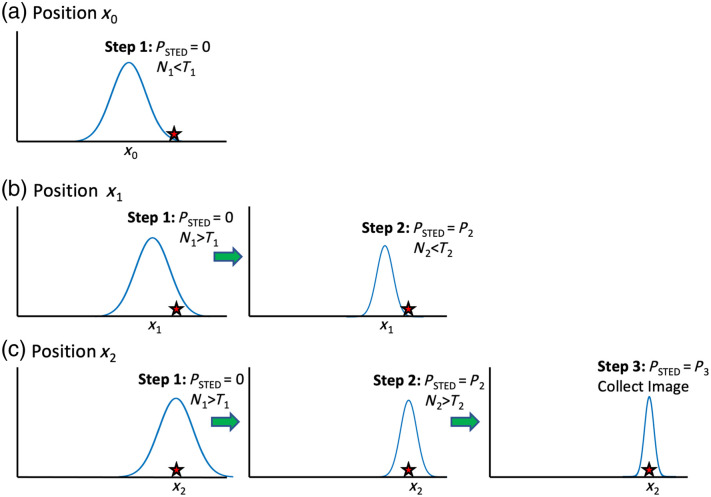
Stimulated emission depletion (STED) is a powerful super-resolution microscopy technique that can be used for imaging live cells. However, the high STED laser powers can cause significant photobleaching and sample damage in sensitive biological samples. The dynamic intensity minimum (DyMIN) technique turns on the STED laser only in regions of the sample where there is fluorescence signal, thus saving significant sample photobleaching. The reduction in photobleaching allows higher resolution images to be obtained and longer time-lapse imaging of live samples. A stand-alone module to perform DyMIN is not available commercially.
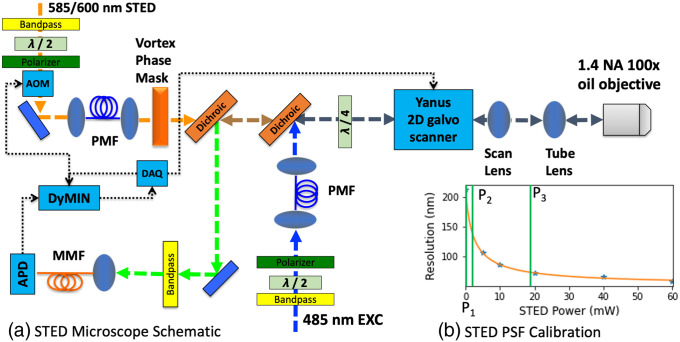
In this work, we developed an open-source design to implement three-step DyMIN on a STED microscope and demonstrated reduced photobleaching for timelapse imaging of beads, cells, and tissue.
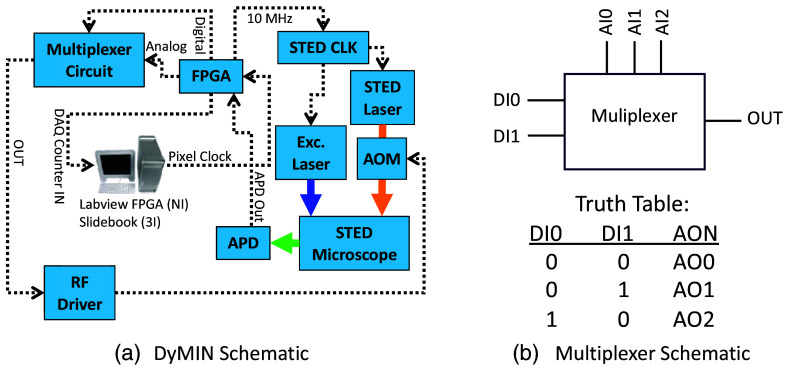
The DyMIN system uses a fast multiplexer circuit and inexpensive field-programmable gate array controlled by Labview software that operates as a stand-alone module for a STED microscope. All software and circuit diagrams are freely available.
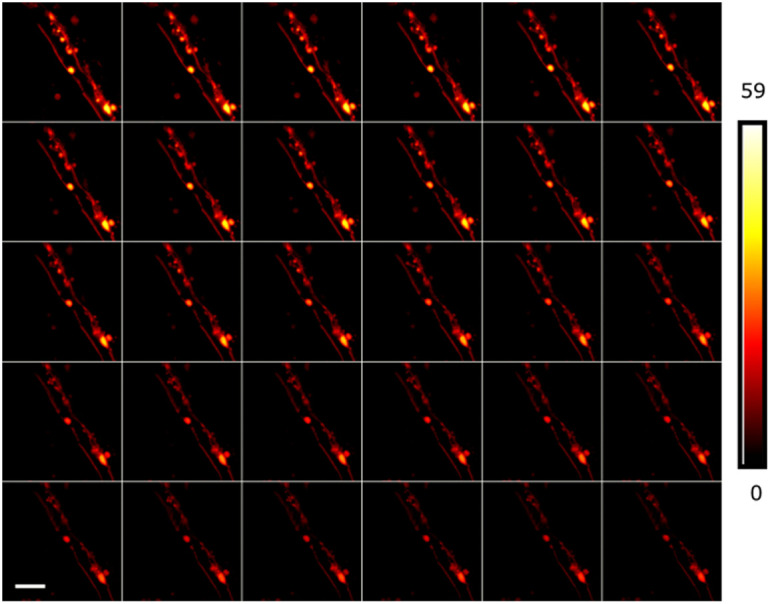
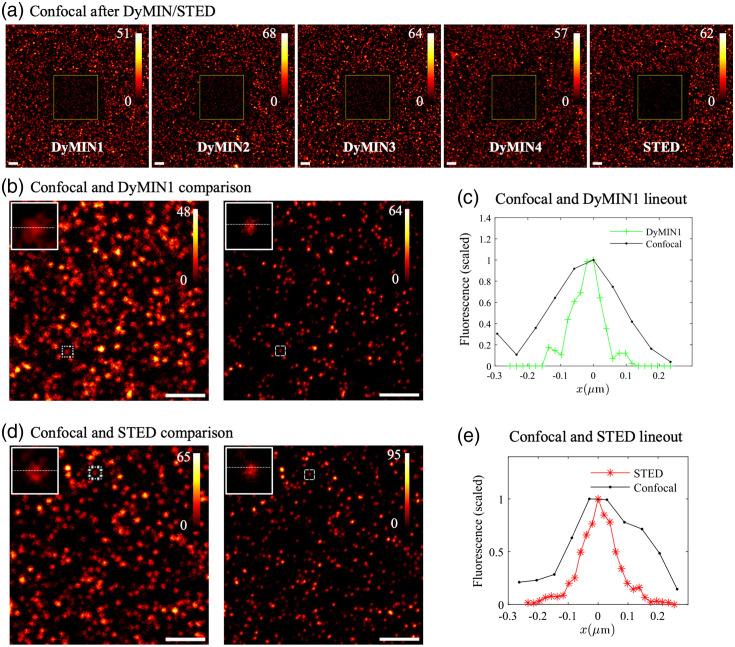
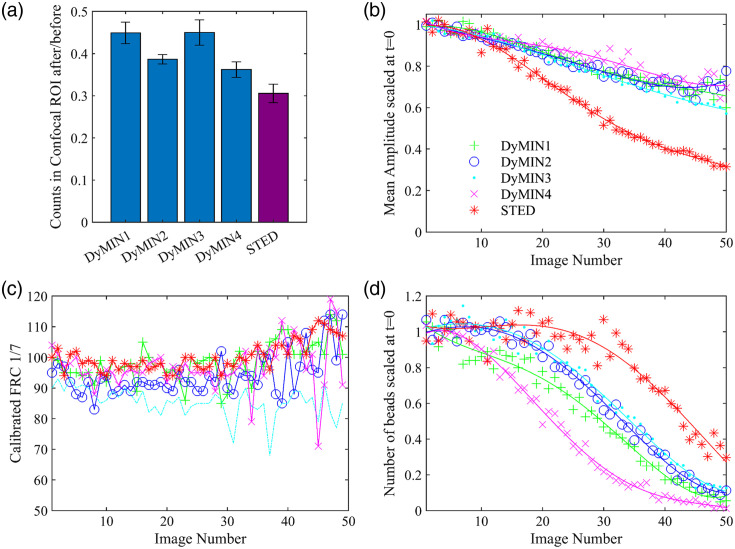
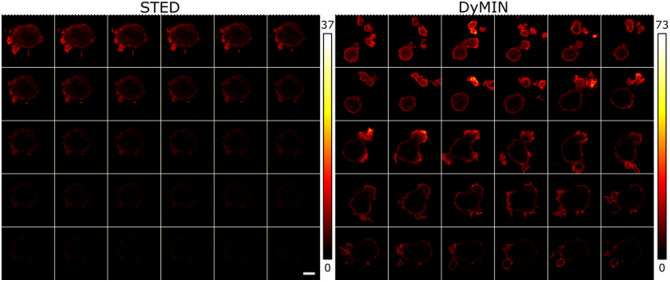
We compared time-lapse images of bead samples using our custom DyMIN system to conventional STED and recorded a higher signal when using DyMIN after a 50-image sequence. We further demonstrated the DyMIN system for time-lapse STED imaging of live cells and brain tissue slices.
Our open-source DyMIN system is an inexpensive add-on to a conventional STED microscope that can reduce photobleaching. The system can significantly improve signal to noise for dynamic time-lapse STED imaging of live samples.
受激辐射损耗(STED)是一种强大的超分辨率显微镜技术,可用于对活细胞进行成像。然而,高功率的STED激光会在敏感的生物样本中导致显著的光漂白和样本损伤。动态强度最小值(DyMIN)技术仅在样本中有荧光信号的区域开启STED激光,从而显著减少样本的光漂白。光漂白的减少使得能够获得更高分辨率的图像,并对活样本进行更长时间的延时成像。目前市面上没有独立执行DyMIN的模块。
在这项工作中,我们开发了一种开源设计,用于在STED显微镜上实现三步DyMIN,并证明了在对珠子、细胞和组织进行延时成像时光漂白减少。
DyMIN系统使用一个快速多路复用器电路和由Labview软件控制的廉价现场可编程门阵列,该阵列作为STED显微镜的独立模块运行。所有软件和电路图均可免费获取。
我们将使用我们定制的DyMIN系统获得的珠子样本延时图像与传统STED进行了比较,并记录到在50帧图像序列后使用DyMIN时信号更高。我们进一步展示了DyMIN系统用于活细胞和脑组织切片的延时STED成像。
我们的开源DyMIN系统是传统STED显微镜的一种廉价附加装置,可减少光漂白。该系统可显著提高活样本动态延时STED成像的信噪比。