Yarns Brandon C, Jackson Nicholas J, Alas Alexander, Melrose Rebecca J, Lumley Mark A, Sultzer David L
Department of Mental Health, VA Greater Los Angeles Healthcare System, California.
Department of Psychiatry and Biobehavioral Sciences, David Geffen School of Medicine at University of California, Los Angeles.
JAMA Netw Open. 2024 Jun 3;7(6):e2415842. doi: 10.1001/jamanetworkopen.2024.15842.
Chronic pain is common and disabling in older adults, and psychological interventions are indicated. However, the gold standard approach, cognitive-behavioral therapy (CBT), produces only modest benefits, and more powerful options are needed.
To evaluate whether emotional awareness and expression therapy (EAET) is superior to CBT for treatment of chronic pain among predominantly male older veterans and whether higher baseline depression, anxiety, or posttraumatic stress disorder (PTSD) symptoms-key targets of EAET-moderate treatment response.
DESIGN, SETTING, AND PARTICIPANTS: This 2-arm randomized clinical trial was conducted from May 16, 2019, to September 14, 2023, in the US Department of Veterans Affairs Greater Los Angeles Healthcare System. The trial included a racially and ethnically diverse group of veterans aged 60 to 95 years with at least 3 months of musculoskeletal pain.
Emotional awareness and expression therapy or CBT, conducted concurrently, each presented as one 90-minute individual session followed by eight 90-minute group sessions.
The primary outcome was Brief Pain Inventory pain severity (range, 0 to 10) from baseline to posttreatment (week 10, primary end point) and 6-month follow-up. Secondary outcomes included Patient Reported Outcomes Institute Measurement System Anxiety, Depression, Fatigue, General Life Satisfaction (NIH Toolbox), Pain Interference, and Sleep Disturbance Short Forms, Patient Global Impression of Change (PGIC), and Satisfaction with Therapy and Therapist Scale-Revised. A subset of participants completed the PTSD Checklist for Diagnostic and Statistical Manual of Mental Disorders (Fifth Edition). All analyses were for the intention-to-treat population and included all randomized participants.
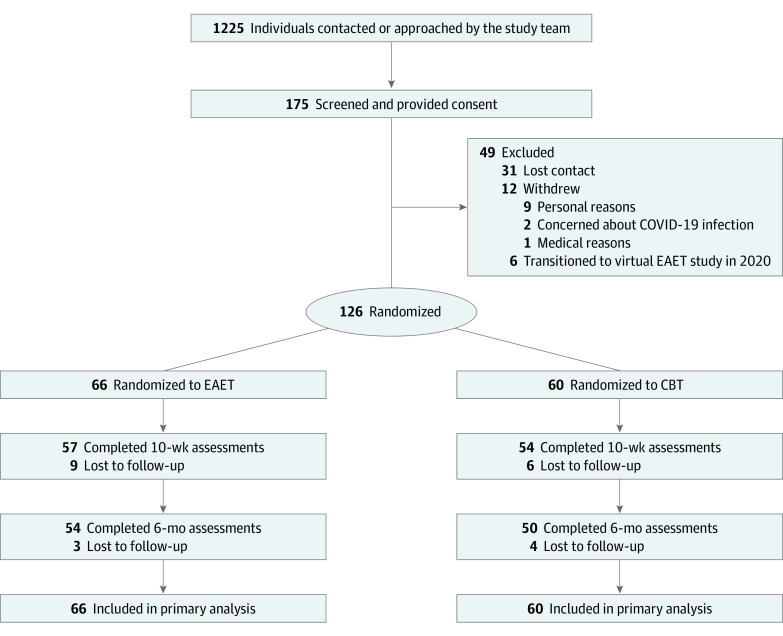
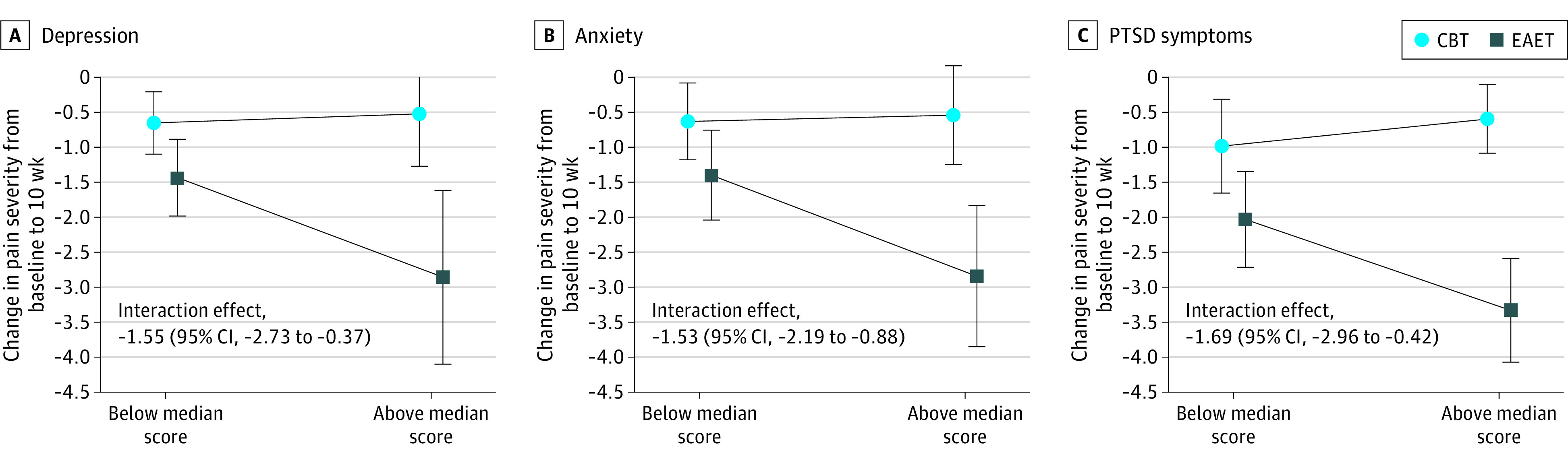
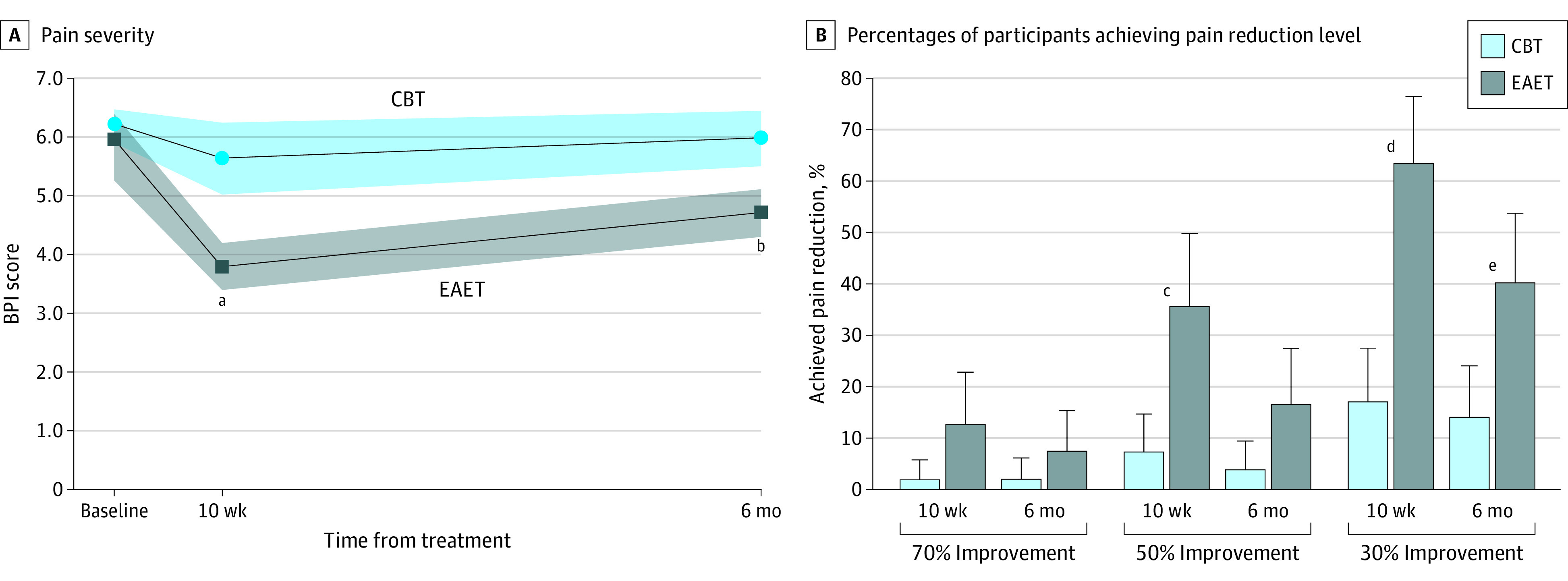
Among 126 randomized participants (66 in the EAET group and 60 in the CBT group; mean [SD] age, 71.9 [5.9] years; 116 [92%] male), 111 (88%) completed posttreatment, and 104 (82%) completed the 6-month follow-up. The EAET was superior to CBT for the primary outcome of reduction in pain severity at posttreatment (estimate, -1.59 [95% CI, -2.35 to -0.83]; P < .001) and follow-up (estimate, -1.01 [95% CI, -1.78 to -0.24]; P = .01). A greater percentage of participants in EAET vs CBT had clinically significant (at least 30%) pain reduction (63% vs 17%; odds ratio, 21.54 [95% CI, 4.66-99.56]; P < .001) at posttreatment. In addition, EAET was superior to CBT on 50% pain reduction (35% vs 7%; odds ratio, 11.77 [95% CI, 2.38-58.25]; P = .002), anxiety (estimate, -2.49 [95% CI, -4.30 to -0.68]; P = .006), depression (estimate, -3.06 [95% CI, -5.88 to -0.25]; P = .03), general life satisfaction (estimate, 1.23 [95% CI, 0.36-2.10]; P = .005), PTSD symptoms (estimate, -4.39 [95% CI, -8.44 to -0.34]; P = .03), PGIC score (estimate, 1.46 [95% CI, 0.77-2.15]; P < .001), and global treatment satisfaction (estimate, 0.28 [95% CI, 0.12-0.45]; P < .001) at posttreatment. Higher baseline depression (estimate, -1.55 [95% CI, -0.37 to 2.73]; P < .001), anxiety (estimate, -1.53 [95% CI, -2.19 to -0.88]; P < .001), and PTSD symptoms (estimate, -1.69 [95% CI, -2.96 to -0.42]; P = .009) moderated greater reduction in pain severity after EAET but not CBT.
The results of this randomized clinical trial suggest that EAET may be a preferred intervention for medically and psychiatrically complex patients with pain. The societal burden of chronic pain could be improved by further incorporating the principles of EAET into mainstream clinical pain medicine.
ClinicalTrials.gov Identifier: NCT03918642.
慢性疼痛在老年人中很常见且会导致残疾,心理干预是必要的。然而,金标准方法,即认知行为疗法(CBT),仅产生适度的益处,因此需要更有效的选择。
评估情绪觉察与表达疗法(EAET)在治疗以男性为主的老年退伍军人慢性疼痛方面是否优于CBT,以及较高的基线抑郁、焦虑或创伤后应激障碍(PTSD)症状——EAET的关键目标——是否会调节治疗反应。
设计、地点和参与者:这项双臂随机临床试验于2019年5月16日至2023年9月14日在美国退伍军人事务部大洛杉矶医疗保健系统进行。该试验纳入了年龄在60至95岁、患有至少3个月肌肉骨骼疼痛的种族和族裔多样化的退伍军人。
情绪觉察与表达疗法或CBT,同时进行,每种疗法均包括一次90分钟的个体治疗,随后是八次90分钟的小组治疗。
主要结局是从基线到治疗后(第10周,主要终点)和6个月随访时的简明疼痛量表疼痛严重程度(范围为0至10)。次要结局包括患者报告结局测量系统焦虑、抑郁、疲劳、总体生活满意度(NIH工具箱)、疼痛干扰和睡眠障碍简表、患者对变化的总体印象(PGIC)以及治疗和治疗师满意度量表修订版。一部分参与者完成了《精神障碍诊断与统计手册》(第五版)的PTSD检查表。所有分析均针对意向性治疗人群,包括所有随机分组的参与者。
在126名随机分组的参与者中(EAET组66名,CBT组60名;平均[标准差]年龄为71.9[5.9]岁;116名[92%]为男性),111名(88%)完成了治疗后评估,104名(82%)完成了6个月随访。对于治疗后疼痛严重程度降低这一主要结局,EAET优于CBT(估计值为 -1.59[95%置信区间,-2.35至 -0.83];P <.001)以及随访时(估计值为 -1.01[95%置信区间,-1.78至 -0.24];P = 0.01)。与CBT相比,EAET组中疼痛减轻具有临床意义(至少30%)的参与者比例更高(63%对17%;优势比为21.54[95%置信区间,4.66 - 99.56];P <.001)。此外,在治疗后50%疼痛减轻方面(35%对7%;优势比为11.77[95%置信区间,2.38 - 58.25];P = 0.002)、焦虑(估计值为 -2.49[95%置信区间,-4.30至 -0.68];P = 0.006)、抑郁(估计值为 -3.06[95%置信区间,-5.88至 -0.25];P = 0.03)、总体生活满意度(估计值为1.23[95%置信区间,0.36 - 2.10];P = 0.005)、PTSD症状(估计值为 -4.39[95%置信区间,-8.44至 -0.34];P = 0.03)、PGIC评分(估计值为1.46[95%置信区间,0.77 - 2.15];P <.001)以及总体治疗满意度(估计值为0.28[95%置信区间,0.12 - 0.45];P <.001)方面,EAET均优于CBT。较高的基线抑郁(估计值为 -1.55[95%置信区间,-0.37至 -2.73];P <.001)、焦虑(估计值为 -1.53[95%置信区间,-2.19至 -0.88];P <.001)和PTSD症状(估计值为 -1.69[95%置信区间,-2.96至 -0.42];P = 0.009)会调节EAET后疼痛严重程度的更大降低,但CBT后则不然。
这项随机临床试验的结果表明,EAET可能是患有疼痛的医学和精神复杂患者的首选干预措施。通过将EAET的原则进一步纳入主流临床疼痛医学,可以减轻慢性疼痛的社会负担。
ClinicalTrials.gov标识符:NCT03918642。