Gupta Ritu, Malik Ankur, Kumari Kusum, Singh Saurabh Kumar, Vivier Vincent, Mondal Prakash Chandra
Department of Chemistry, Indian Institute of Technology Kanpur Uttar Pradesh 208016 India
Department of Chemistry, Indian Institute of Technology Hyderabad Telangana 502285 India.
Chem Sci. 2024 Apr 25;15(23):8775-8785. doi: 10.1039/d4sc00611a. eCollection 2024 Jun 12.
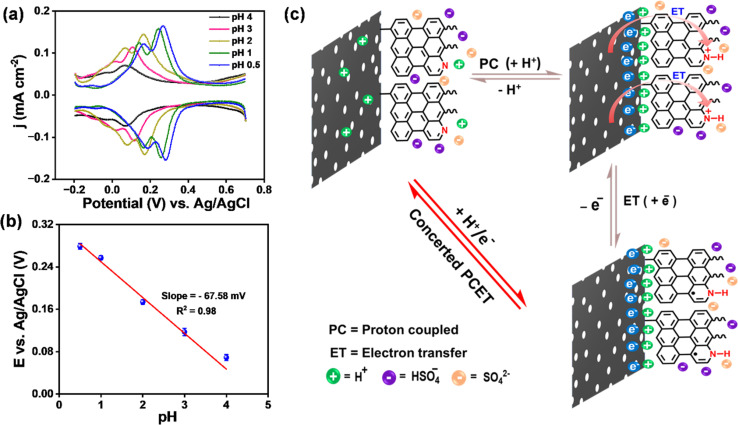
Controlling chemical functionalization and achieving stable electrode-molecule interfaces for high-performance electrochemical energy storage applications remain challenging tasks. Herein, we present a simple, controllable, scalable, and versatile electrochemical modification approach of graphite rods (GRs) extracted from low-cost Eveready cells that were covalently modified with anthracene oligomers. The anthracene oligomers with a total layer thickness of ∼24 nm on the GR electrode yield a remarkable specific capacitance of ∼670 F g with good galvanostatic charge-discharge cycling stability (10 000) recorded in 1 M HSO electrolyte. Such a boost in capacitance is attributed mainly to two contributions: (i) an electrical double-layer at the anthracene oligomer/GR/electrolyte interfaces, and (ii) the proton-coupled electron transfer (PCET) reaction, which ensures a substantial faradaic contribution to the total capacitance. Due to the higher conductivity of the anthracene films, it possesses more azo groups (-N[double bond, length as m-dash]N-) during the electrochemical growth of the oligomer films compared to pyrene and naphthalene oligomers, which is key to PCET reactions. AC-based electrical studies unravel the in-depth charge interfacial electrical behavior of anthracene-grafted electrodes. Asymmetrical solid-state supercapacitor devices were made using anthracene-modified biomass-derived porous carbon, which showed improved performance with a specific capacitance of ∼155 F g at 2 A g with an energy density of 5.8 W h kg at a high-power density of 2010 W kg and powered LED lighting for a longer period. The present work provides a promising metal-free approach in developing organic thin-film hybrid capacitors.
对于高性能电化学储能应用而言,控制化学功能化并实现稳定的电极-分子界面仍然是具有挑战性的任务。在此,我们提出了一种简单、可控、可扩展且通用的电化学修饰方法,用于修饰从低成本永备电池中提取的石墨棒(GRs),这些石墨棒用蒽低聚物进行了共价修饰。在GR电极上总层厚度约为24 nm的蒽低聚物,在1 M HSO电解质中记录到具有良好的恒电流充放电循环稳定性(10000次),产生了约670 F g的显著比电容。这种电容的提升主要归因于两个方面:(i)蒽低聚物/GR/电解质界面处的双电层,以及(ii)质子耦合电子转移(PCET)反应,该反应确保了对总电容有相当大的法拉第贡献。由于蒽膜具有较高的导电性,与芘和萘低聚物相比,在低聚物膜的电化学生长过程中它具有更多的偶氮基团(-N=N-),这是PCET反应的关键。基于交流的电学研究揭示了蒽接枝电极的深入电荷界面电学行为。使用蒽修饰的生物质衍生多孔碳制成了不对称固态超级电容器器件,在2 A g时表现出改进的性能,比电容约为155 F g,在2010 W kg的高功率密度下能量密度为5.8 W h kg,并为LED照明供电了更长时间。本工作为开发有机薄膜混合电容器提供了一种有前景的无金属方法。