The Injury Clinic, South Geelong, Victoria, Australia.
Discipline of Podiatry, School of Allied Health, Human Services and Sport, La Trobe University, Melbourne, Victoria, Australia.
J Foot Ankle Res. 2024 Jun;17(2):e12029. doi: 10.1002/jfa2.12029.
Running retraining is commonly used in the management of medial tibial stress syndrome (MTSS) but evidence for its effectiveness is lacking. The primary aim of this study is to determine if the addition of running retraining to best standard care is beneficial in the management of runners with MTSS.
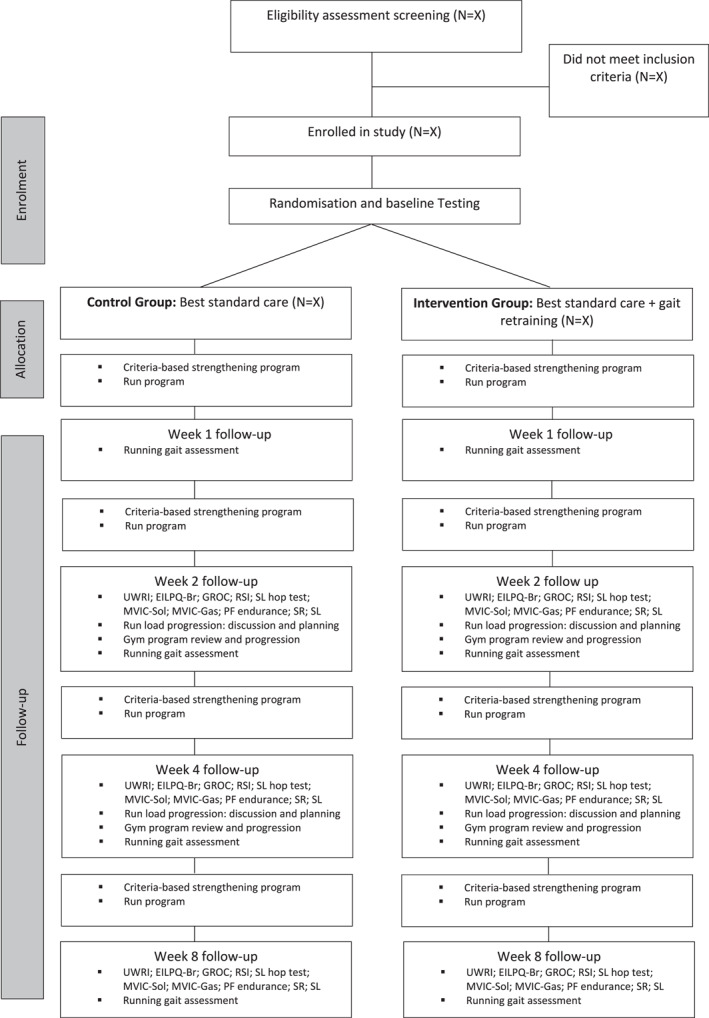
This study is an assessor-blinded and participant-blinded, parallel-group, randomised controlled trial. The trial will recruit 64 participants aged between 18 and 45 years, with a clinical diagnosis of MTSS that has affected their running participation for at least four weeks. Participants will be randomised to receive best standard care (control) or running retraining and best standard care (intervention group) over an 8-week period. Best standard care will consist of load management advice, symptom management advice, footwear advice and a strengthening program. Running retraining will consist of a cue to reduce running step length. Outcomes will be measured at weeks 1, 2, 4 and 8. The primary outcome measure will be the University of Wisconsin Running Injury and Recovery Index at week 4. Secondary outcome measures include: (i) Exercise Induced Leg Pain Questionnaire-British Version, (ii) global rating of change scale, (iii) worst pain experienced during a run, (iv) weekly run volume, (v) reactive strength index score, (vi) single leg hop test, (vii) soleus single leg maximum voluntary isometric contraction, (viii) gastrocnemius single leg maximum voluntary isometric contraction, (ix) single leg plantar flexor endurance test, (x) running step length, and (xi) running step rate. Data will be analysed using the intention-to-treat principle.
This randomised controlled trial will evaluate if reducing running step length provides additional benefit to best standard care in the management of runners with MTSS over an 8-week period.
Australian New Zealand Clinical Trials Registry: ACTRN12624000230550.
跑步再训练常用于治疗胫骨内侧应力综合征(MTSS),但其有效性的证据不足。本研究的主要目的是确定在 MTSS 患者的管理中,将跑步再训练与最佳标准护理相结合是否有益。
这是一项评估者和参与者设盲的、平行组、随机对照试验。该试验将招募 64 名年龄在 18 至 45 岁之间、有 MTSS 临床诊断且跑步活动至少已受影响四周的患者。参与者将被随机分为接受最佳标准护理(对照组)或跑步再训练和最佳标准护理(干预组)的患者,干预持续 8 周。最佳标准护理将包括负荷管理建议、症状管理建议、鞋类建议和强化计划。跑步再训练将包括减少跑步步长的提示。在第 1、2、4 和 8 周时将进行评估。主要结局测量指标是第 4 周时的威斯康星大学跑步损伤和康复指数。次要结局测量指标包括:(i)英国版运动诱发腿部疼痛问卷,(ii)总体变化量表评分,(iii)跑步时最痛程度,(iv)每周跑步量,(v)反应强度指数评分,(vi)单腿跳跃测试,(vii)比目鱼肌单腿最大随意等长收缩,(viii)腓肠肌单腿最大随意等长收缩,(ix)单腿足底屈肌耐力测试,(x)跑步步长,以及(xi)跑步步频。将使用意向治疗原则对数据进行分析。
这项随机对照试验将评估在 8 周内,减少跑步步长是否能为 MTSS 患者的最佳标准护理提供额外益处。
澳大利亚新西兰临床试验注册:ACTRN12624000230550。