National Key Laboratory of Immunity and Inflammation, and CAMS Key Laboratory of Synthetic Biology Regulatory Elements, Chinese Academy of Medical Sciences & Peking Union Medical College, Suzhou Institute of Systems Medicine, Suzhou 215123, Jiangsu, China.
Department of Orthopedics, The Second Affiliated Hospital of Soochow University, Suzhou 215004, Jiangsu, China.
J Bone Miner Res. 2024 Aug 21;39(8):1132-1146. doi: 10.1093/jbmr/zjae093.
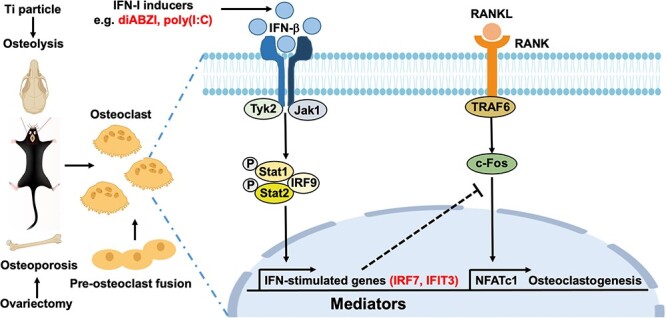
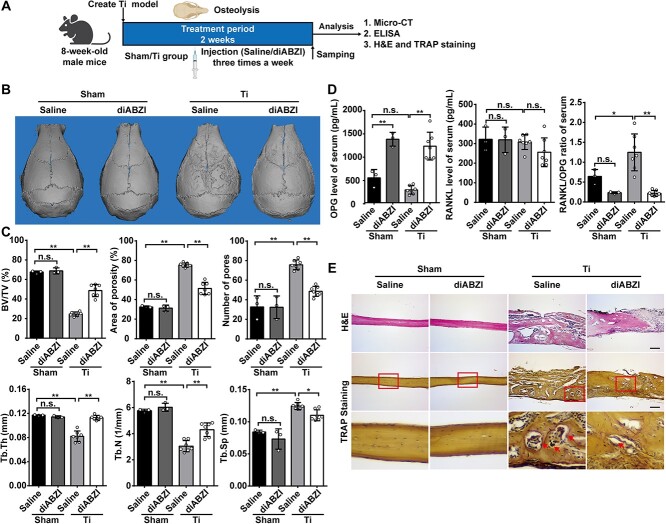
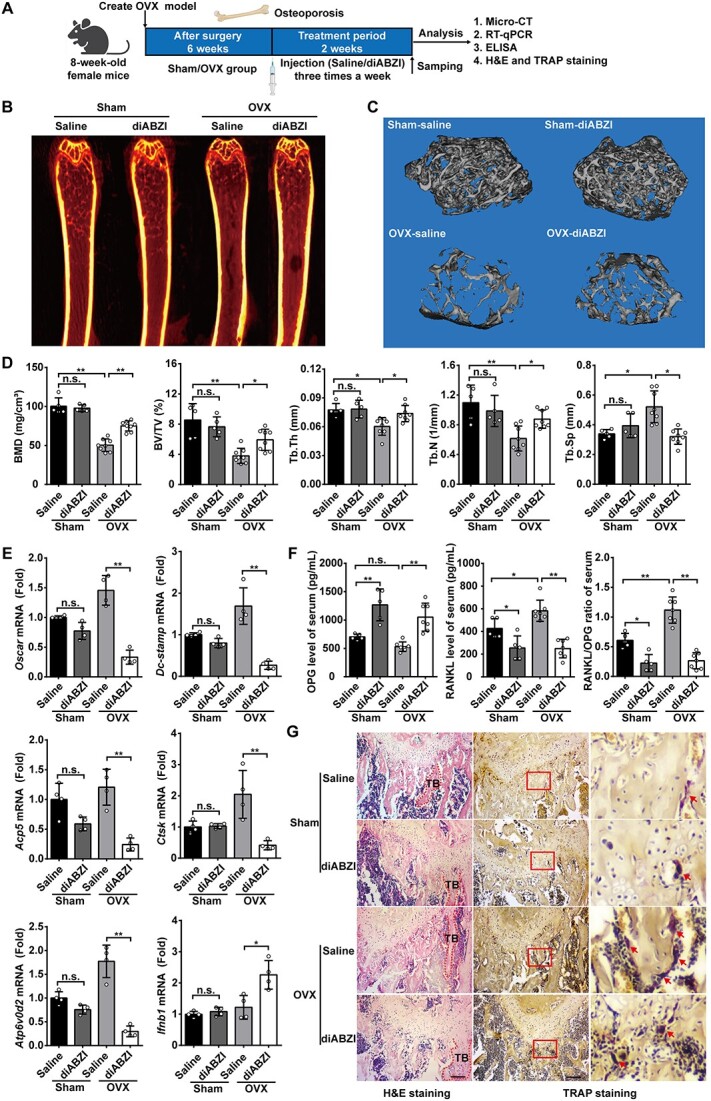
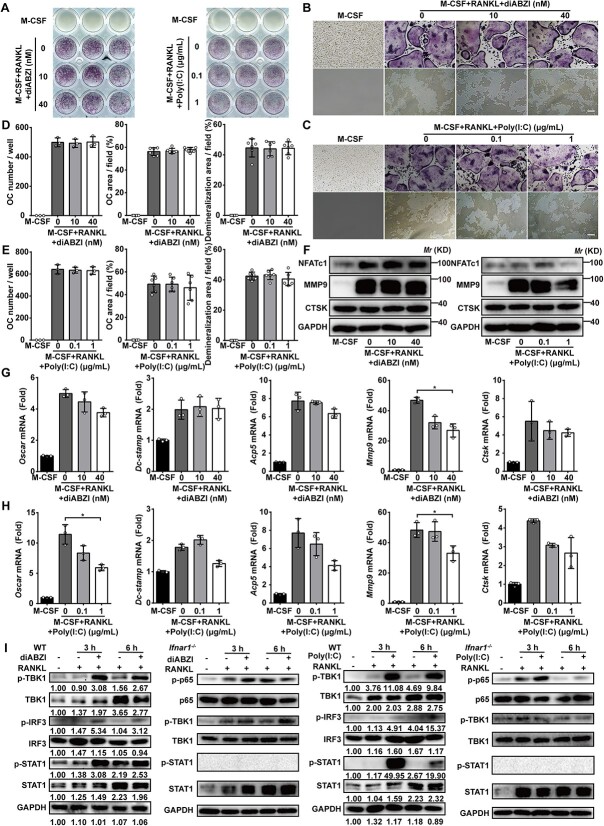
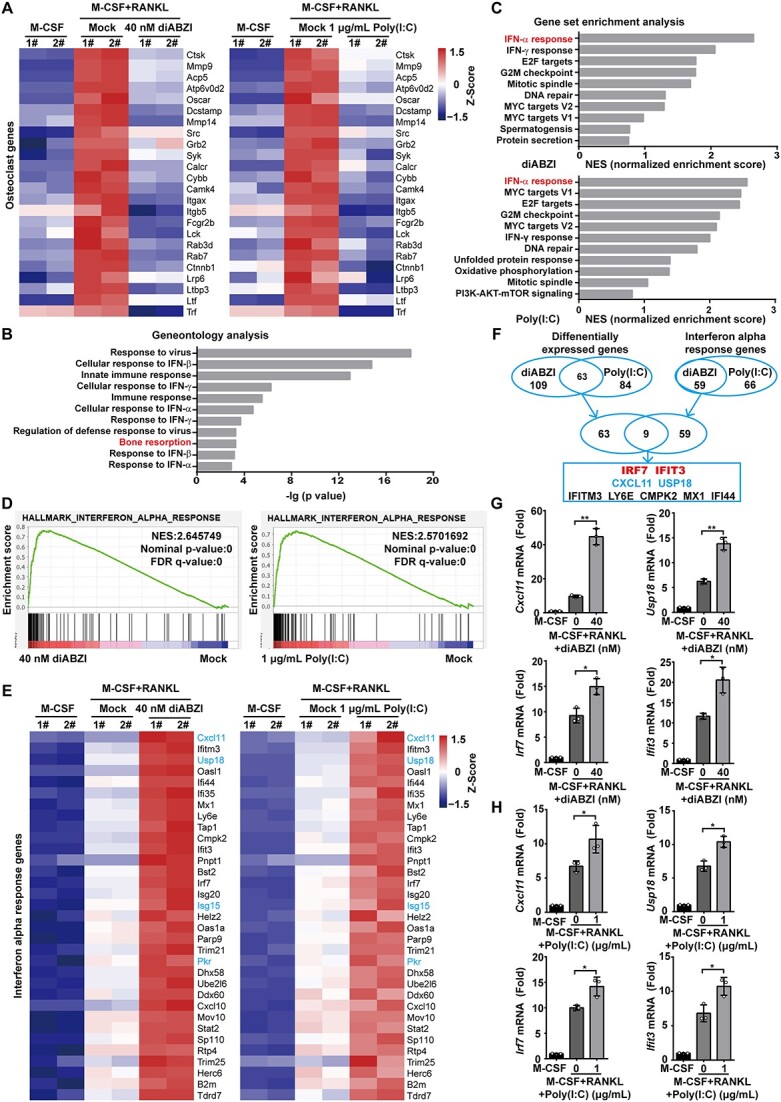
Type I interferons (IFN-I) are pleiotropic factors endowed with multiple activities that play important roles in innate and adaptive immunity. Although many studies indicate that IFN-I inducers exert favorable effects on broad-spectrum antivirus, immunomodulation, and anti-tumor activities by inducing endogenous IFN-I and IFN-stimulated genes, their function in bone homeostasis still needs further exploration. Here, our study demonstrates 2 distinct IFN-I inducers, diABZI and poly(I:C), as potential therapeutics to alleviate osteolysis and osteoporosis. First, IFN-I inducers suppress the genes that control osteoclast (OC) differentiation and activity in vitro. Moreover, diABZI alleviates bone loss in Ti particle-induced osteolysis and ovariectomized -induced osteoporosis in vivo by inhibiting OC differentiation and function. In addition, the inhibitory effects of IFN-I inducers on OC differentiation are not observed in macrophages derived from Ifnar1-/-mice, which indicate that the suppressive effect of IFN-I inducers on OC is IFNAR-dependent. Mechanistically, RNAi-mediated silencing of IRF7 and IFIT3 in OC precursors impairs the suppressive effect of the IFN-I inducers on OC differentiation. Taken together, these results demonstrate that IFN-I inducers play a protective role in bone turnover by limiting osteoclastogenesis and bone resorption through the induction of OC-specific mediators via the IFN-I signaling pathway.
I 型干扰素 (IFN-I) 是一种具有多种活性的多功能因子,在先天免疫和适应性免疫中发挥重要作用。虽然许多研究表明,IFN-I 诱导剂通过诱导内源性 IFN-I 和 IFN 刺激基因发挥广谱抗病毒、免疫调节和抗肿瘤活性的有利作用,但它们在骨稳态中的功能仍需要进一步探索。在这里,我们的研究表明 2 种不同的 IFN-I 诱导剂,diABZI 和 poly(I:C),可作为缓解骨质溶解和骨质疏松症的潜在治疗药物。首先,IFN-I 诱导剂在体外抑制控制破骨细胞 (OC) 分化和活性的基因。此外,diABZI 通过抑制 OC 分化和功能,减轻钛颗粒诱导的骨质溶解和去卵巢诱导的骨质疏松症中的骨丢失。此外,IFNAR1-/-小鼠来源的巨噬细胞中未观察到 IFN-I 诱导剂对 OC 分化的抑制作用,这表明 IFN-I 诱导剂对 OC 的抑制作用是 IFNAR 依赖性的。在机制上,OC 前体中的 IRF7 和 IFIT3 的 RNAi 介导沉默会损害 IFN-I 诱导剂对 OC 分化的抑制作用。总之,这些结果表明,IFN-I 诱导剂通过诱导 OC 特异性介质通过 IFN-I 信号通路发挥作用,限制破骨细胞生成和骨吸收,在骨代谢中发挥保护作用。