Merali Nabeel, Chouari Tarak, Sweeney Casie, Halle-Smith James, Jessel Maria-Danae, Wang Bing, O' Brien James, Suyama Satoshi, Jiménez José I, Roberts Keith J, Velliou Eirini, Sivakumar Shivan, Rockall Timothy A, Demirkan Ayse, Pedicord Virginia, Deng Dongmei, Giovannetti Elisa, Annels Nicola E, Frampton Adam E
Minimal Access Therapy Training Unit (MATTU), Royal Surrey Hospital NHS Foundation Trust.
Department of Hepato-Pancreato-Biliary (HPB) Surgery, Royal Surrey County Hospital NHS Foundation Trust.
Int J Surg. 2024 Oct 1;110(10):6771-6799. doi: 10.1097/JS9.0000000000001762.
Pancreatic cancer, specifically pancreatic ductal adenocarcinoma (PDAC), continues to pose a significant clinical and scientific challenge. The most significant finding of recent years is that PDAC tumours harbour their specific microbiome, which differs amongst tumour entities and is distinct from healthy tissue. This review aims to evaluate and summarise all PDAC studies that have used the next-generation technique, 16S rRNA gene amplicon sequencing within each bodily compartment. As well as establishing a causal relationship between PDAC and the microbiome.
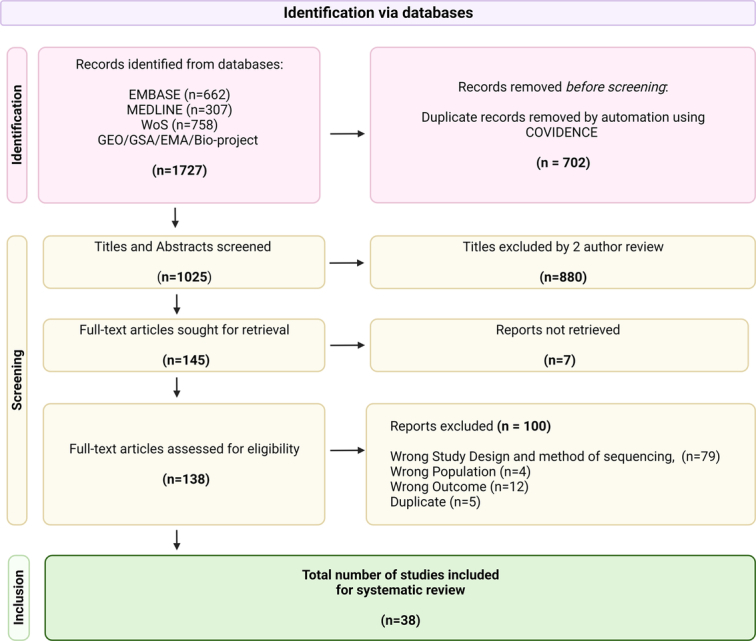
This systematic review was carried out according to the Preferred Reporting Items for Systematic Reviews and Meta-analysis (PRISMA) guidelines. A comprehensive search strategy was designed, and 1727 studies were analysed.
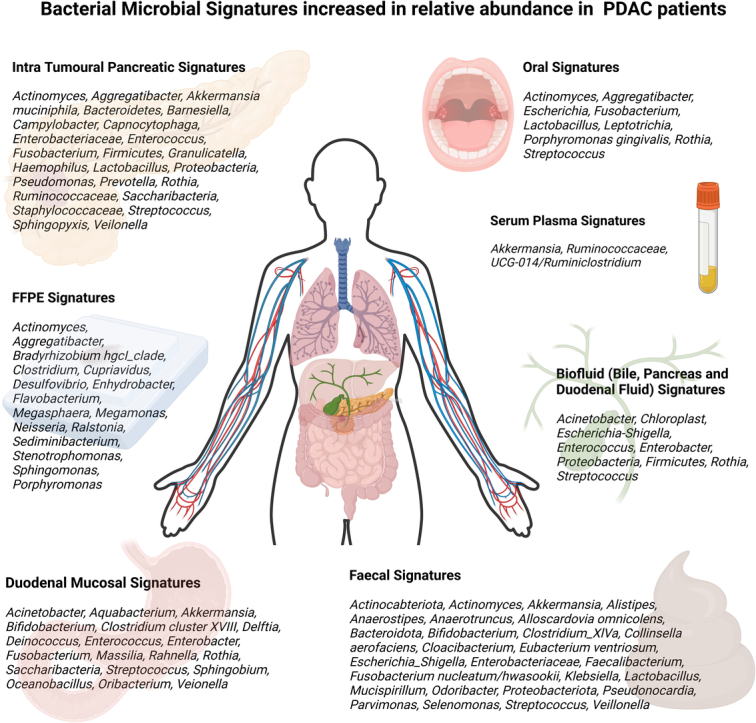
In total, 38 studies were selected for qualitative analysis and summarised significant PDAC bacterial signatures. Despite the growing amount of data provided, we are not able to state a universal 16S rRNA gene microbial signature that can be used for PDAC screening. This is most certainly due to the heterogeneity of the presentation of results, lack of available datasets, and the intrinsic selection bias between studies.
Several key studies have begun to shed light on causality and the influence the microbiome constituents and their produced metabolites could play in tumorigenesis and influencing outcomes. The challenge in this field is to shape the available microbial data into targetable signatures. Making sequenced data readily available is critical, coupled with the coordinated standardisation of data and the need for consensus guidelines in studies investigating the microbiome in PDAC.
胰腺癌,特别是胰腺导管腺癌(PDAC),仍然是一个重大的临床和科学挑战。近年来最重要的发现是,PDAC肿瘤有其特定的微生物群,不同肿瘤实体之间存在差异,且与健康组织不同。本综述旨在评估和总结所有使用下一代技术(即对每个身体部位进行16S rRNA基因扩增子测序)的PDAC研究。以及建立PDAC与微生物群之间的因果关系。
本系统综述按照系统评价和Meta分析的首选报告项目(PRISMA)指南进行。设计了全面的检索策略,并分析了1727项研究。
总共选择了38项研究进行定性分析,并总结了重要的PDAC细菌特征。尽管提供的数据越来越多,但我们无法确定一个可用于PDAC筛查的通用16S rRNA基因微生物特征。这很可能是由于结果呈现的异质性、可用数据集的缺乏以及研究之间固有的选择偏差。
几项关键研究已开始阐明因果关系,以及微生物群成分及其产生的代谢产物在肿瘤发生和影响预后方面可能发挥的作用。该领域的挑战是将现有的微生物数据转化为可靶向的特征。使测序数据易于获取至关重要,同时需要对数据进行协调标准化,并且在研究PDAC中的微生物群时需要达成共识指南。