UMR9019 - CNRS, Intégrité du Génome et Cancers, Université Paris-Saclay, Gustave Roussy, Villejuif, France, 114 rue Edouard Vaillant, 94805, Villejuif, France.
Commun Biol. 2024 Jun 14;7(1):729. doi: 10.1038/s42003-024-06412-1.
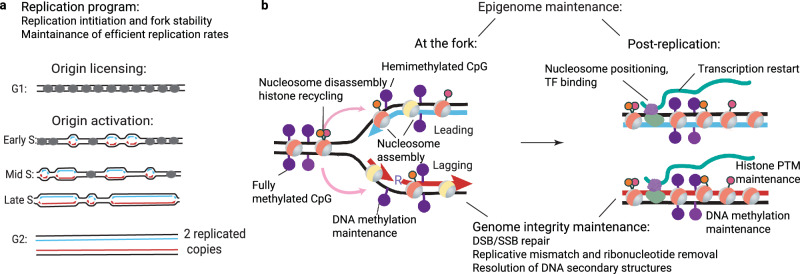
Before each cell division, eukaryotic cells must replicate their chromosomes to ensure the accurate transmission of genetic information. Chromosome replication involves more than just DNA duplication; it also includes chromatin assembly, inheritance of epigenetic marks, and faithful resumption of all genomic functions after replication. Recent progress in quantitative technologies has revolutionized our understanding of the complexity and dynamics of DNA replication forks at both molecular and genomic scales. Here, we highlight the pivotal role of these novel methods in uncovering the principles and mechanisms of chromosome replication. These technologies have illuminated the regulation of genome replication programs, quantified the impact of DNA replication on genomic mutations and evolutionary processes, and elucidated the mechanisms of replication-coupled chromatin assembly and epigenome maintenance.
在每个细胞分裂之前,真核细胞必须复制它们的染色体,以确保遗传信息的准确传递。染色体复制不仅仅涉及 DNA 复制;它还包括染色质组装、表观遗传标记的遗传,以及在复制后所有基因组功能的忠实恢复。定量技术的最新进展彻底改变了我们对分子和基因组尺度上 DNA 复制叉的复杂性和动态性的理解。在这里,我们强调了这些新方法在揭示染色体复制原理和机制方面的关键作用。这些技术阐明了基因组复制程序的调控,量化了 DNA 复制对基因组突变和进化过程的影响,并揭示了复制偶联的染色质组装和表观基因组维持的机制。