Department of Health Research, SINTEF Digital, Trondheim, Norway.
Department of Mental Health, Norwegian University of Science and Technology (NTNU), Regional Centre for Child and Youth Mental Health and Child Welfare (RKBU Central Norway), Trondheim, Norway.
BMC Health Serv Res. 2024 Jun 14;24(1):729. doi: 10.1186/s12913-024-11157-y.
Videoconferencing is considered an alternative to face-to-face consultations and a possibility to help overcome access-to-care barriers in mental health care services. Barriers to child and adolescent mental health services are particularly apparent in the case of children and adolescents receiving child welfare services. This scoping review aims to provide an overview of research on videoconferencing in the mental health treatment of children and adolescents receiving support from child welfare services.
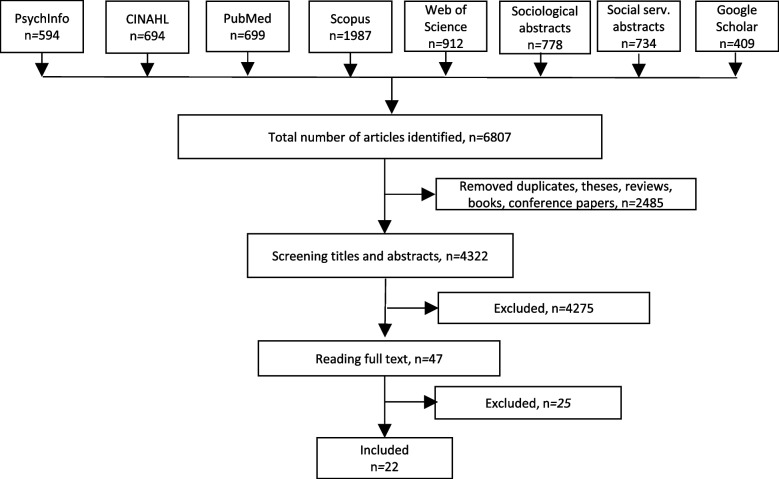
This scoping review follows the review framework outlined by the Joanna Briggs Institute. The following databases were searched from January 2012 to April 2024: Scopus, Web of Science, PubMed, PsycINFO (Ovid), CINAHL Plus, Social Services Abstracts (ProQuest), Sociological Abstracts (ProQuest), and Google Scholar.
The search yielded 4322 unique records and resulted in the inclusion of 22 articles that met the inclusion criteria. The studies originated from Denmark, England, Australia, Norway, Canada, Chile, and the USA, and were grouped into four areas: (1) videoconferencing to increase access to mental health treatment for vulnerable groups (2) young people's perspectives (3) videoconferencing in interdisciplinary collaborative meetings, and (4) use, awareness, and acceptance of videoconferencing among health and social care providers.
This scoping review shows that if videoconferencing in mental health care is to become an established and trusted method aimed at children and adolescents receiving child welfare services, several unresolved and potentially negative issues need attention and more research. This particularly applies to whether videoconferencing decreases or exacerbates inequalities in access to mental health services. A further question is whether new barriers are raised by screen-based treatment to threaten good therapeutic relationships, and by extension treatment quality and clinical outcomes.
视频会议被认为是面对面咨询的一种替代方法,也是克服精神卫生保健服务获取障碍的一种可能性。儿童和青少年精神卫生服务的障碍在接受儿童福利服务的儿童和青少年中尤为明显。本范围综述旨在概述关于视频会议在接受儿童福利服务支持的儿童和青少年的精神健康治疗中的研究。
本范围综述遵循 Joanna Briggs 研究所概述的综述框架。从 2012 年 1 月至 2024 年 4 月,在以下数据库中进行了搜索:Scopus、Web of Science、PubMed、PsycINFO(Ovid)、CINAHL Plus、社会服务摘要(ProQuest)、社会学摘要(ProQuest)和 Google Scholar。
搜索产生了 4322 条独特的记录,并纳入了符合纳入标准的 22 篇文章。这些研究来自丹麦、英国、澳大利亚、挪威、加拿大、智利和美国,分为四个领域:(1)视频会议增加弱势群体获得精神卫生治疗的机会;(2)年轻人的观点;(3)跨学科合作会议中的视频会议;(4)卫生和社会保健提供者对视频会议的使用、意识和接受。
本范围综述表明,如果视频会议在精神卫生保健中要成为针对接受儿童福利服务的儿童和青少年的既定和可信赖的方法,则需要关注和进一步研究几个未解决的潜在负面问题。这尤其适用于视频会议是否会减少或加剧获得精神卫生服务的不平等。另一个问题是,基于屏幕的治疗是否会产生新的障碍,威胁到良好的治疗关系,进而威胁到治疗质量和临床结果。