Zhou Fang, Lü Linyuan, Liu Jianguo, Mariani Manuel Sebastian
Institute of Fundamental and Frontier Sciences, University of Electronic Science and Technology of China, Chengdu 610054, China.
Yangtze Delta Region Institute (Huzhou), University of Electronic Science and Technology of China, Huzhou 313001, China.
Natl Sci Rev. 2024 Mar 1;11(7):nwae073. doi: 10.1093/nsr/nwae073. eCollection 2024 Jul.
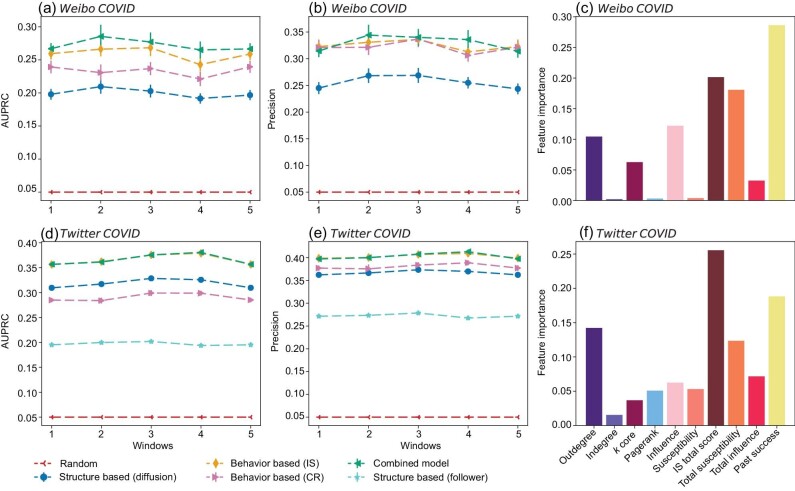
Understanding the heterogeneous role of individuals in large-scale information spreading is essential to manage online behavior as well as its potential offline consequences. To this end, most existing studies from diverse research domains focus on the disproportionate role played by highly connected 'hub' individuals. However, we demonstrate here that information superspreaders in online social media are best understood and predicted by simultaneously considering two individual-level behavioral traits: influence and susceptibility. Specifically, we derive a nonlinear network-based algorithm to quantify individuals' influence and susceptibility from multiple spreading event data. By applying the algorithm to large-scale data from Twitter and Weibo, we demonstrate that individuals' estimated influence and susceptibility scores enable predictions of future superspreaders above and beyond network centrality, and reveal new insights into the network positions of the superspreaders.
了解个体在大规模信息传播中的异质作用对于管理在线行为及其潜在的线下后果至关重要。为此,来自不同研究领域的大多数现有研究都聚焦于高度连接的“枢纽”个体所起的不成比例的作用。然而,我们在此证明,通过同时考虑两个个体层面的行为特征:影响力和易感性,可以最好地理解和预测在线社交媒体中的信息超级传播者。具体而言,我们推导了一种基于网络的非线性算法,用于从多个传播事件数据中量化个体的影响力和易感性。通过将该算法应用于来自推特和微博的大规模数据,我们证明,个体的估计影响力和易感性得分能够在网络中心性之外预测未来的超级传播者,并揭示超级传播者网络位置的新见解。