Yang Xuanwen, Su Ying, Huang Siyang, Hou Qiandong, Wei Pengcheng, Hao Yani, Huang Jiaqi, Xiao Hua, Ma Zhiyao, Xu Xiaodong, Wang Xu, Cao Shuo, Cao Xuejing, Zhang Mengyan, Wen Xiaopeng, Ma Yuhua, Peng Yanling, Zhou Yongfeng, Cao Ke, Qiao Guang
Key Laboratory of Plant Resource Conservation and Germplasm Innovation in Mountainous Region (Ministry of Education), Institute of Agro-bioengineering/College of Life Sciences, Guizhou University, Guiyang 550025, China.
National Key Laboratory for Germplasm Innovation & Utilization of Horticultural Crops, Zhengzhou Fruit Research Institute, Chinese Academy of Agricultural Science, Zhengzhou 450009, China.
Hortic Res. 2024 Apr 16;11(6):uhae109. doi: 10.1093/hr/uhae109. eCollection 2024 Jun.
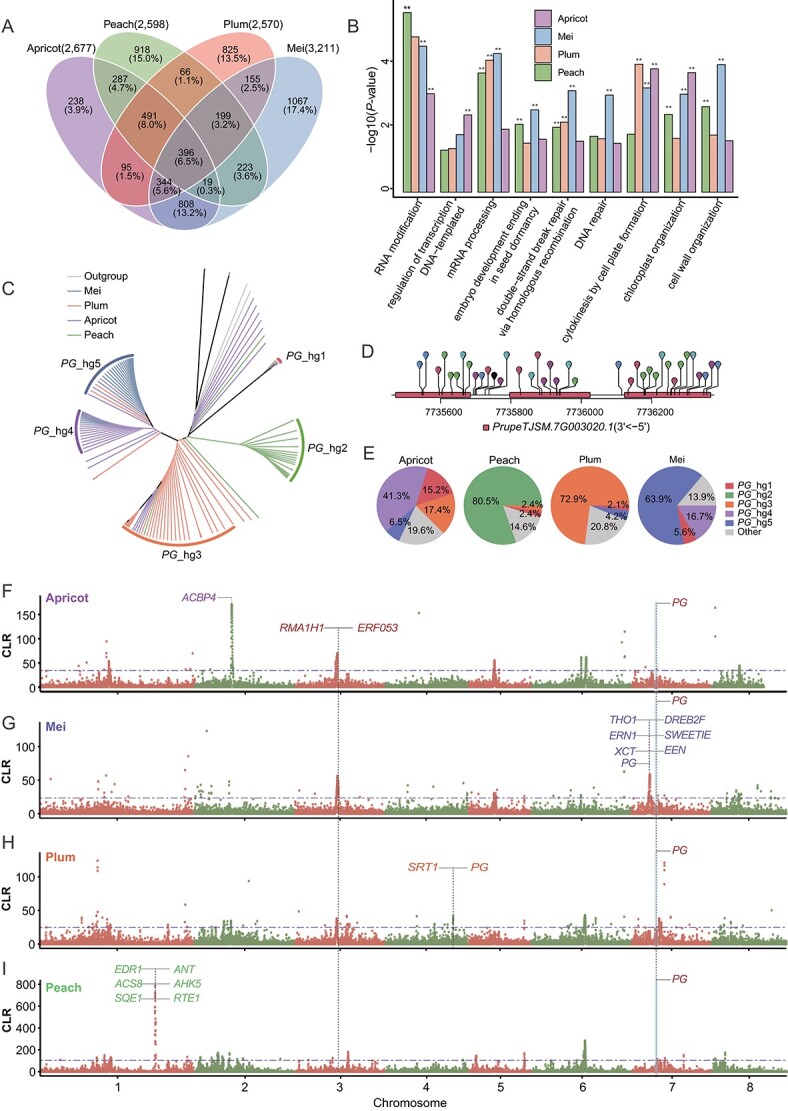
The economically significant genus includes fruit and nut crops that have been domesticated for shared and specific agronomic traits; however, the genomic signals of convergent and divergent selection have not been elucidated. In this study, we aimed to detect genomic signatures of convergent and divergent selection by conducting comparative population genomic analyses of the apricot-peach-plum-mei (APPM) complex, utilizing a haplotype-resolved telomere-to-telomere (T2T) genome assembly and population resequencing data. The haplotype-resolved T2T reference genome for the plum cultivar was assembled through HiFi and Hi-C reads, resulting in two haplotypes 251.25 and 251.29 Mb in size, respectively. Comparative genomics reveals a chromosomal translocation of ~1.17 Mb in the apricot genomes compared with peach, plum, and mei. Notably, the translocation involves the locus, significantly impacting titratable acidity (TA), pH, and sugar content. Population genetic analysis detected substantial gene flow between plum and apricot, with introgression regions enriched in post-embryonic development and pollen germination processes. Comparative population genetic analyses revealed convergent selection for stress tolerance, flower development, and fruit ripening, along with divergent selection shaping specific crop, such as somatic embryogenesis in plum, pollen germination in mei, and hormone regulation in peach. Notably, selective sweeps on chromosome 7 coincide with a chromosomal collinearity from the comparative genomics, impacting key fruit-softening genes such as , regulated by and . Overall, this study provides insights into the genetic diversity, evolutionary history, and domestication of the APPM complex, offering valuable implications for genetic studies and breeding programs of crops.
这个具有经济重要性的属包括因共同和特定农艺性状而被驯化的水果和坚果作物;然而,趋同和趋异选择的基因组信号尚未得到阐明。在本研究中,我们旨在通过对杏 - 桃 - 李 - 梅(APPM)复合体进行比较群体基因组分析,利用单倍型解析的端粒到端粒(T2T)基因组组装和群体重测序数据,来检测趋同和趋异选择的基因组特征。李品种的单倍型解析T2T参考基因组通过HiFi和Hi-C reads组装而成,分别产生了两个大小为251.25和251.29 Mb的单倍型。比较基因组学揭示,与桃、李和梅相比,杏基因组中存在一个约1.17 Mb的染色体易位。值得注意的是,该易位涉及 位点,对可滴定酸度(TA)、pH值和糖含量有显著影响。群体遗传分析检测到李和杏之间存在大量基因流动,渐渗区域在胚胎后发育和花粉萌发过程中富集。比较群体遗传分析揭示了对胁迫耐受性、花发育和果实成熟的趋同选择,以及塑造特定作物的趋异选择,如李中的体细胞胚胎发生、梅中的花粉萌发和桃中的激素调节。值得注意的是,7号染色体上的选择性清除与比较基因组学中的染色体共线性一致,影响了关键的果实软化基因,如 ,该基因受 和 调控。总体而言,本研究为APPM复合体的遗传多样性、进化历史和驯化提供了见解,为 作物的遗传研究和育种计划提供了有价值的启示。