
利用多模态神经影像学构建非痴呆老年人肌少症认知障碍预测模型。
Development of a prediction model for cognitive impairment of sarcopenia using multimodal neuroimaging in non-demented older adults.
机构信息
Department of Psychiatry, Yeouido St. Mary's Hospital, College of Medicine, The Catholic University of Korea, Seoul, Republic of Korea.
Department of Psychiatry, Seoul St. Mary's Hospital, College of Medicine, The Catholic University of Korea, Seoul, Republic of Korea.
出版信息
Alzheimers Dement. 2024 Jul;20(7):4868-4878. doi: 10.1002/alz.14054. Epub 2024 Jun 18.
INTRODUCTION
Despite prior research on the association between sarcopenia and cognitive impairment in the elderly, a comprehensive model that integrates various brain pathologies is still lacking.
METHODS
We used data from 528 non-demented older adults with or without sarcopenia in the Catholic Aging Brain Imaging (CABI) database, containing magnetic resonance imaging scans, positron emission tomography scans, and clinical data. We also measured three key components of sarcopenia: skeletal muscle index (SMI), hand grip strength (HGS), and the five times sit-to-stand test (5STS).
RESULTS
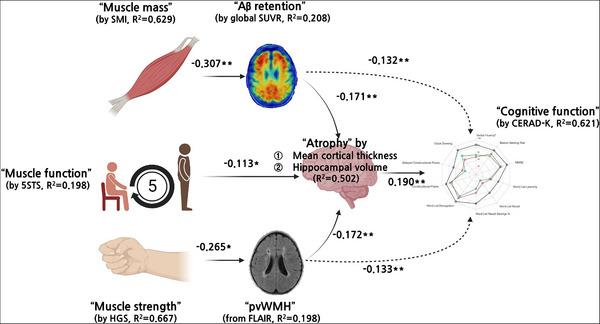
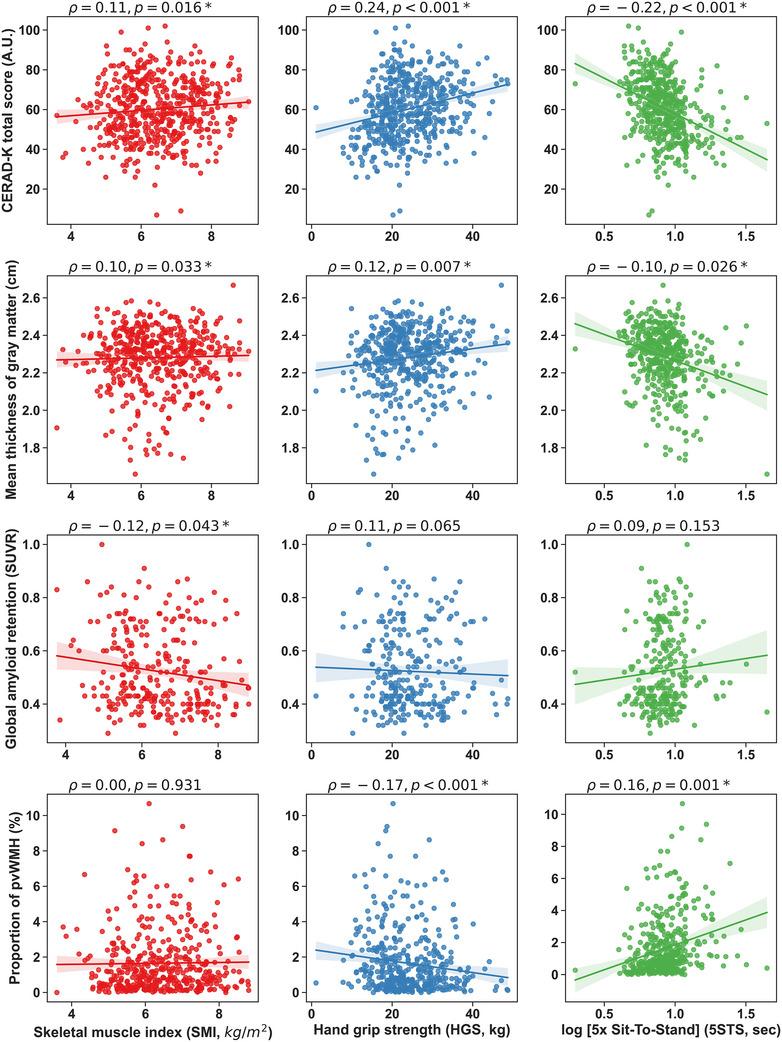
All components of sarcopenia were significantly correlated with global cognitive function, but cortical thickness and amyloid-beta (Aβ) retention had distinctive relationships with each measure. In the path model, brain atrophy resulting in cognitive impairment was mediated by Aβ retention for SMI and periventricular white matter hyperintensity for HGS, but directly affected by the 5STS.
DISCUSSION
Treatments targeting each sub-domain of sarcopenia should be considered to prevent cognitive decline.
HIGHLIGHTS
We identified distinct impacts of three sarcopenia measures on brain structure and Aβ. Muscle mass is mainly associated with Aβ and has an influence on the brain atrophy. Muscle strength linked with periventricular WMH and brain atrophy. Muscle function associated with cortical thinning in specific brain regions. Interventions on sarcopenia may be important to ease cognitive decline in the elderly.
简介
尽管先前有研究探讨了老年人肌少症与认知障碍之间的关系,但仍缺乏一个综合各种脑病理的全面模型。
方法
我们使用了天主教老龄化脑成像(CABI)数据库中 528 名非痴呆老年人的数据,这些老年人中有的有肌少症,有的没有。该数据库包含磁共振成像扫描、正电子发射断层扫描和临床数据。我们还测量了肌少症的三个关键组成部分:骨骼肌指数(SMI)、手握力(HGS)和五次坐立试验(5STS)。
结果
肌少症的所有组成部分与整体认知功能都有显著相关性,但皮质厚度和淀粉样蛋白-β(Aβ)保留与每个测量值的关系是不同的。在路径模型中,脑萎缩导致认知障碍是由 SMI 的 Aβ保留和 HGS 的脑室周围白质高信号介导的,但直接受到 5STS 的影响。
讨论
应该考虑针对肌少症的每个亚领域的治疗方法,以预防认知能力下降。
要点
我们确定了三种肌少症测量方法对大脑结构和 Aβ 的不同影响。肌肉质量主要与 Aβ 相关,并对脑萎缩有影响。肌肉力量与脑室周围的 WMH 和脑萎缩有关。肌肉功能与特定脑区的皮质变薄有关。对肌少症的干预可能对缓解老年人的认知能力下降很重要。

 Zotero 插件