Daghlas Iyas, Nassan Malik, Gill Dipender
Department of Neurology, University of California San Francisco, San Francisco, California, USA.
Mesulam Center for Cognitive Neurology and Alzheimer's Disease, Northwestern University, Chicago, Illinois, USA.
BMJ Med. 2023 Jun 29;2(1):e000354. doi: 10.1136/bmjmed-2022-000354. eCollection 2023.
To examine whether genetically proxied lean mass is associated with risk of Alzheimer's disease.
Mendelian randomisation study.
The UK Biobank study and genome wide association study meta-analyses of Alzheimer's disease and cognitive performance.
Summary level genetic data from: 450 243 UK Biobank participants with impedance measures of lean mass and fat mass; an independent sample of 21 982 patients with Alzheimer's disease and 41 944 controls without Alzheimer's disease; a replication sample of 7329 patients with Alzheimer's disease and 252 879 controls; and 269 867 individuals taking part in a genome wide association study of cognitive performance.
Effect of genetically proxied lean mass on the risk of Alzheimer's disease, and the related phenotype of cognitive performance.
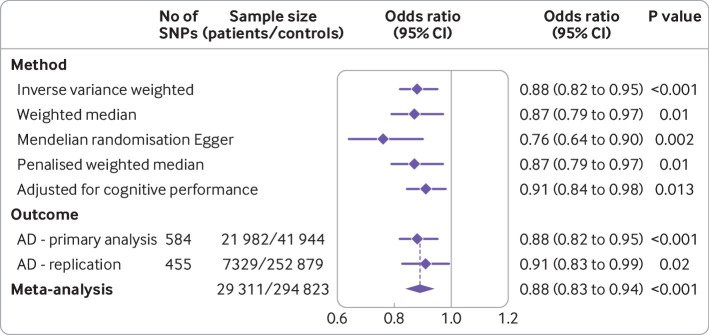
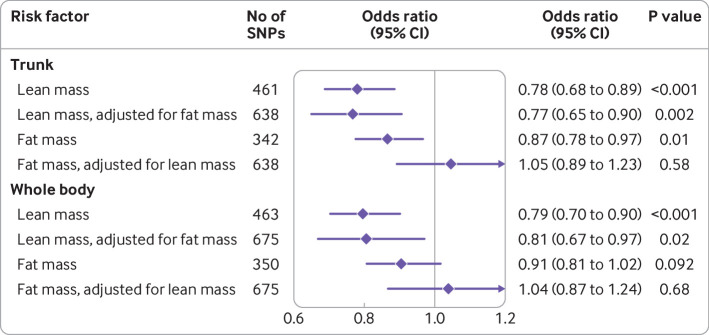
An increase in genetically proxied appendicular lean mass of one standard deviation was associated with a 12% reduced risk of Alzheimer's disease (odds ratio 0.88, 95% confidence interval 0.82 to 0.95, P=0.001). This finding was replicated in an independent cohort of patients with Alzheimer's disease (0.91, 0.83 to 0.99, P=0.02) and was consistent in sensitivity analyses that are more robust to the inclusion of pleiotropic variants. Higher genetically proxied appendicular lean mass was also associated with increased cognitive performance (standard deviation increase in cognitive performance for each standard deviation increase in appendicular lean mass 0.09, 95% confidence interval 0.06 to 0.11, P=0.001), and adjusting for potential mediation through genetically proxied cognitive performance did not reduce the association between appendicular lean mass and risk of Alzheimer's disease. Similar results were found for the outcomes of Alzheimer's disease and cognitive performance when the risk factors of genetically proxied trunk lean mass and whole body lean mass were used, respectively, adjusted for genetically proxied fat mass.
These findings suggest that lean mass might be a possible modifiable protective factor for Alzheimer's disease. The mechanisms underlying this finding, as well as the clinical and public health implications, warrant further investigation.
研究基因预测的瘦体重是否与阿尔茨海默病风险相关。
孟德尔随机化研究。
英国生物银行研究以及阿尔茨海默病和认知功能的全基因组关联研究荟萃分析。
汇总水平的基因数据来自:450243名英国生物银行参与者,他们有瘦体重和脂肪量的阻抗测量数据;21982例阿尔茨海默病患者和41944名无阿尔茨海默病对照的独立样本;7329例阿尔茨海默病患者和252879名对照的重复样本;以及269867名参与认知功能全基因组关联研究的个体。
基因预测的瘦体重对阿尔茨海默病风险的影响以及相关的认知功能表型。
基因预测的四肢瘦体重增加一个标准差与阿尔茨海默病风险降低12%相关(比值比0.88,95%置信区间0.82至0.95,P = 0.001)。这一发现 在一个独立的阿尔茨海默病患者队列中得到重复验证(0.91,0.83至0.99,P = 0.02),并且在对多效性变异纳入更具稳健性的敏感性分析中也一致。基因预测的四肢瘦体重较高也与认知功能增强相关(四肢瘦体重每增加一个标准差,认知功能标准差增加0.09,95%置信区间0.06至0.11,P = 0.001),并且通过基因预测的认知功能进行潜在中介调整并没有降低四肢瘦体重与阿尔茨海默病风险之间的关联。当分别使用基因预测的躯干瘦体重和全身瘦体重的风险因素并对基因预测的脂肪量进行调整时,在阿尔茨海默病和认知功能结局方面也发现了类似结果。
这些发现表明瘦体重可能是阿尔茨海默病一个可能的可改变的保护因素。这一发现背后的机制以及临床和公共卫生意义值得进一步研究。