Pham An Thanh, van Dijk Boukje A C, van der Valk Eline S, van der Vegt Bert, van Rossum Elisabeth F C, de Bock Geertruida H
Department of Epidemiology, University Medical Center Groningen, University of Groningen, 9700 RB Groningen, The Netherlands.
Faculty of Pharmacy, Ton Duc Thang University, Ho Chi Minh City 700000, Vietnam.
Cancers (Basel). 2024 May 28;16(11):2044. doi: 10.3390/cancers16112044.
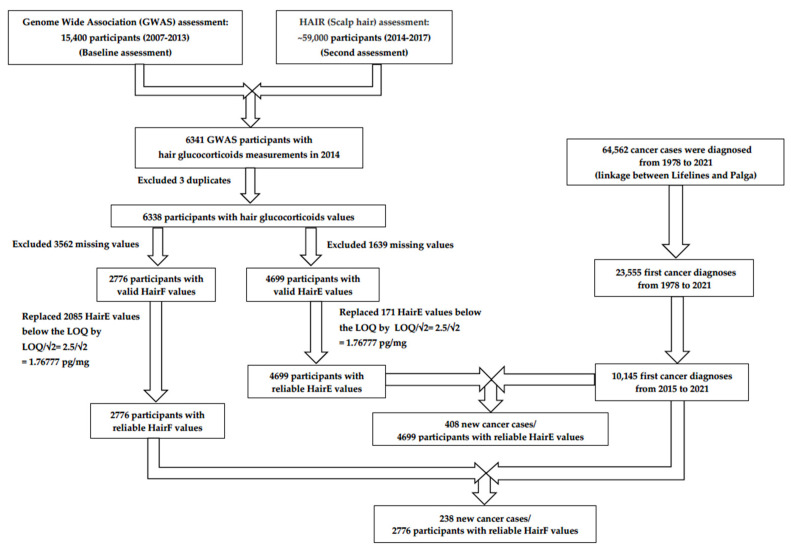
Epidemiological results on the link between chronic stress and cancer initiation have been inconsistent. This study examined the relation between chronic biological stress, indicated as hair cortisol (HairF) and hair cortisone (HairE), and cancer incidence, adjusting for metabolic syndrome (MetS) components. We analyzed HairF and HairE samples from 6341 participants from the population-based cohort Lifelines in 2014. A linkage with the Dutch Nationwide Pathology Databank (Palga) provided the cancer incidence from 2015 to 2021. The association between dichotomized HairF and log-transformed HairE (LogHairE) and cancer incidence was estimated using Cox regression. MetS components were evaluated as confounders or moderators. Of the 2776 participants with known HairF levels and no cancer history, 238 developed cancer. The HairF level did not predict cancer incidence (HR: 0.993, 95%CI: 0.740-1.333). No confounders or moderators were identified. Among the 4699 participants with known HairE levels and no cancer history, 408 developed cancer. There was no association between LogHairE and cancer incidence (HR: 1.113, 95%CI: 0.738-1.678). When including age as a confounder and gender as a moderator, LogHairE was statistically significantly associated with cancer incidence (HR: 6.403, 95%CI: 1.110-36.92). In a population-based cohort, chronic biological stress, measured by HairE, was associated with cancer incidence, after controlling for age and gender.
关于慢性应激与癌症发生之间联系的流行病学研究结果并不一致。本研究调查了以头发皮质醇(HairF)和头发可的松(HairE)表示的慢性生物应激与癌症发病率之间的关系,并对代谢综合征(MetS)各组分进行了校正。我们分析了2014年来自基于人群的队列研究“生命线”(Lifelines)中6341名参与者的HairF和HairE样本。与荷兰全国病理数据库(Palga)的链接提供了2015年至2021年的癌症发病率。使用Cox回归估计二分法的HairF和对数转换后的HairE(LogHairE)与癌症发病率之间的关联。将MetS各组分评估为混杂因素或调节因素。在2776名已知HairF水平且无癌症病史的参与者中,有238人患癌。HairF水平不能预测癌症发病率(风险比:0.993,95%置信区间:0.740 - 1.333)。未发现混杂因素或调节因素。在4699名已知HairE水平且无癌症病史的参与者中,有408人患癌。LogHairE与癌症发病率之间无关联(风险比:1.113,95%置信区间:0.738 - 1.678)。当将年龄作为混杂因素、性别作为调节因素纳入时,LogHairE与癌症发病率在统计学上有显著关联(风险比:6.403,95%置信区间:1.110 - 36.92)。在一项基于人群的队列研究中,在控制年龄和性别后,以HairE衡量的慢性生物应激与癌症发病率相关。