Park Yujin, Kim Su Hwan, Yoon Hyung-Jin
Healthcare Data Center, Kangbuk Samsung Hospital, Sungkyunkwan University School of Medicine, Seoul, South Korea.
Department of Information Statistics, Gyeongsang National University, Jinju, Gyeongsangnam-do, South Korea.
Digit Health. 2024 Jun 17;10:20552076241263691. doi: 10.1177/20552076241263691. eCollection 2024 Jan-Dec.
Individuals increasingly turn to the Internet for health information, with YouTube being a prominent source. However, the quality and reliability of the health information vary widely, potentially affecting health literacy and behavioural intentions.
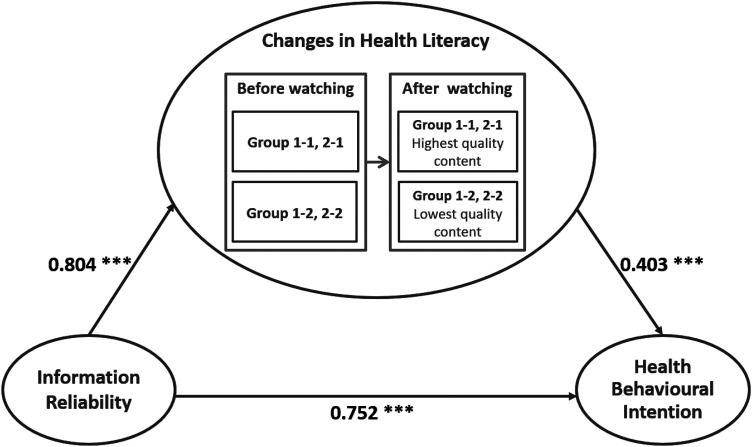
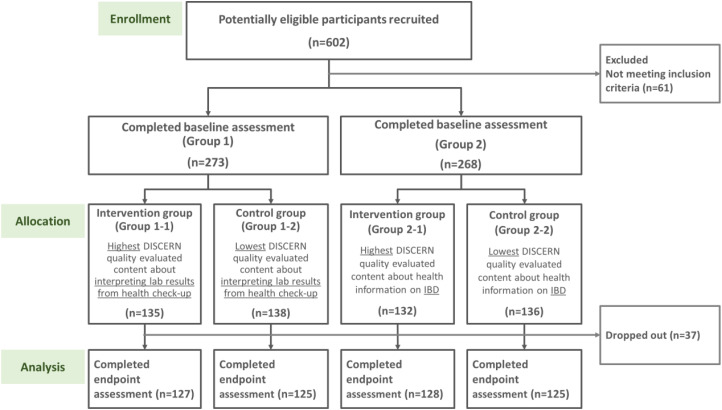
To analyse the impact of health information quality on health literacy and behavioural intention, we conducted a randomized controlled trial using a quality-controlled YouTube intervention. Health information quality on YouTube was evaluated using the Global Quality Score and DISCERN. We randomly allocated (1 : 1) to the intervention group to watch the highest quality-evaluated content and to the control group to watch the lowest quality-evaluated content. Health literacy and health behavioural intention were assessed before and after watching YouTube. The trial was set for two different topics: interpreting laboratory test results from health check-up and information about inflammatory bowel disease (IBD).
From 8 April 2022 to 15 April 2022, 505 participants were randomly assigned to watch either high-quality content (intervention group, n = 255) or low-quality content (control group, n = 250). Health literacy significantly improved in the intervention group (28.1 before and 31.8 after; < 0.01 for health check-up; 28.3 before and 31.3 after; < 0.01 for IBD). Health behavioural intention significantly improved in the intervention group (3.5 before and 4.1 after; < 0.01 for health check-up; 3.6 before and 4.0 after; < 0.01 for IBD). Control groups had no such effect.
High-quality health information can enhance health literacy and behavioural intention in both healthy individuals and those with specific conditions like IBD. It stresses the significance of ensuring reliable health information online and calls for future efforts to curate and provide access to high-quality health content.
人们越来越多地通过互联网获取健康信息,YouTube是一个重要的信息来源。然而,健康信息的质量和可靠性差异很大,可能会影响健康素养和行为意图。
为了分析健康信息质量对健康素养和行为意图的影响,我们进行了一项随机对照试验,采用了经过质量控制的YouTube干预措施。使用全球质量评分和DISCERN对YouTube上的健康信息质量进行评估。我们将参与者随机分配(1∶1)到干预组观看质量评估最高的内容,以及对照组观看质量评估最低的内容。在观看YouTube前后评估健康素养和健康行为意图。该试验针对两个不同主题进行:解读健康检查的实验室检测结果以及炎症性肠病(IBD)的信息。
从2022年4月8日至2022年4月15日,505名参与者被随机分配观看高质量内容(干预组,n = 255)或低质量内容(对照组,n = 250)。干预组的健康素养显著提高(健康检查主题:干预前28.1,干预后31.8;P<0.01;IBD主题:干预前28.3,干预后31.3;P<0.01)。干预组的健康行为意图显著提高(健康检查主题:干预前3.5,干预后4.1;P<0.01;IBD主题:干预前3.6,干预后4.0;P<0.01)。对照组则没有这种效果。
高质量的健康信息可以提高健康个体以及患有IBD等特定疾病的人群的健康素养和行为意图。这强调了确保在线健康信息可靠性的重要性,并呼吁未来努力策划和提供高质量的健康内容。