MRC/CSO Social and Public Health Sciences Unit, Institute of Health and Wellbeing, University of Glasgow, Glasgow, UK.
Physiotherapy and Cardiac Rehabilitation Unit, Department of Cardiac Surgery, Ibrahim Cardiac Hospital and Research Institute, Dhaka, Bangladesh.
Transl Behav Med. 2024 Sep 3;14(9):514-526. doi: 10.1093/tbm/ibae031.
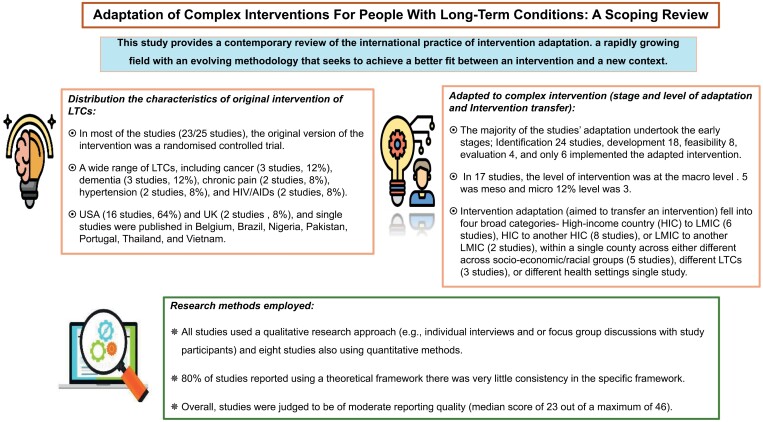
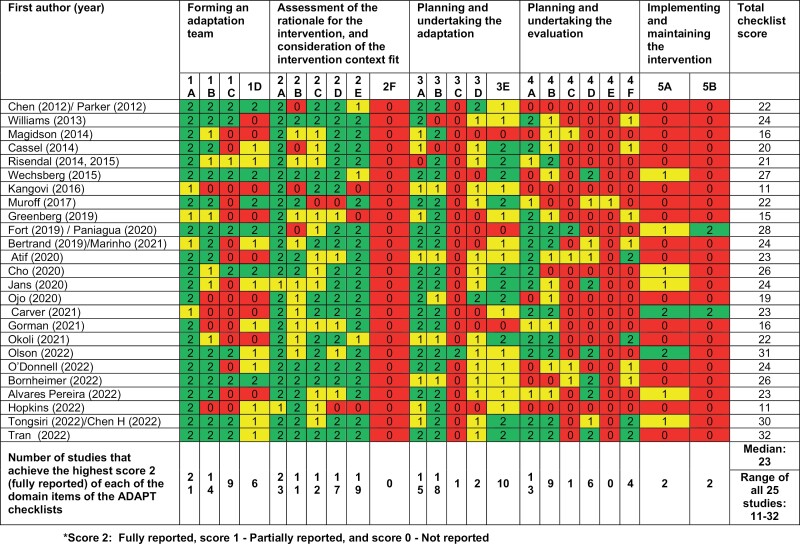
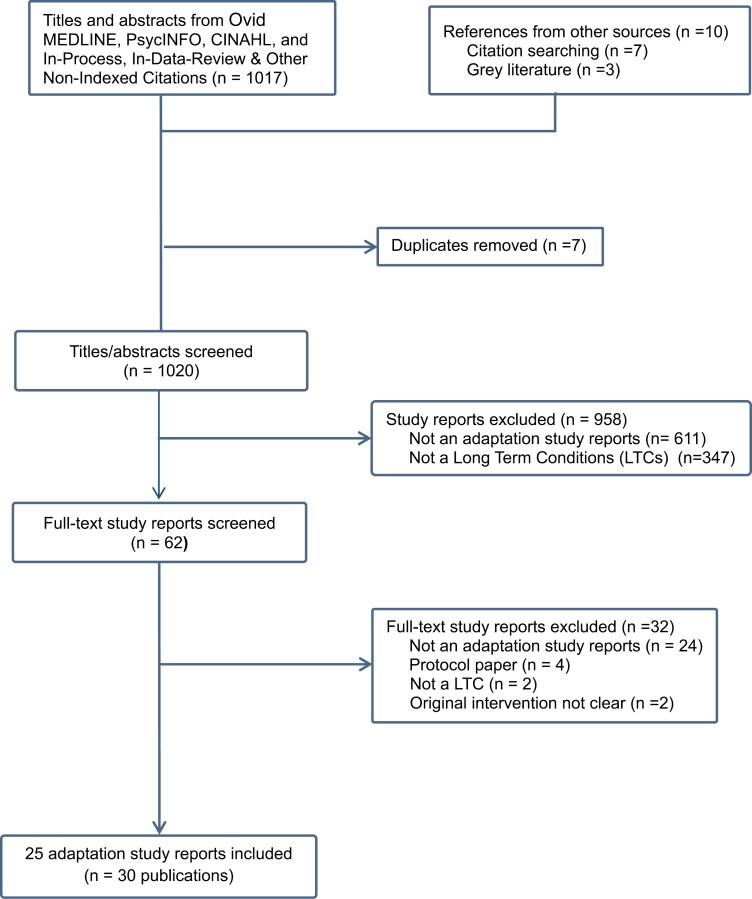
Adaptation seeks to transfer and implement healthcare interventions developed and evaluated in one context to another. The aim of this scoping review was to understand current approaches to the adaptation of complex interventions for people with long-term conditions (LTCs) and to identify issues for studies performed in low- and middle-income countries (LMICs). Bibliographic databases were searched from 2000 to October 2022. This review involved five stages: (i) definition of the research question(s); (ii) identifying relevant studies; (iii) study selection; (iv) data charting; and (v) data synthesis. Extraction included an assessment of the: rationale for adaptation; stages and levels of adaptation; use of theoretical frameworks, and quality of reporting using a checklist based on the 2021 ADAPT guidance. Twenty-five studies were included from across 21 LTCs and a range of complex interventions. The majority (16 studies) focused on macro (national or international) level interventions. The rationale for adaptation included intervention transfer across geographical settings [high-income country (HIC) to LMIC: six studies, one HIC to another: eight studies, one LMIC to another: two studies], or transfer across socio-economic/racial groups (five studies), or transfer between different health settings within a single country (one study). Overall, studies were judged to be of moderate reporting quality (median score 23, maximum 46), and typically focused on early stages of adaptation (identification and development) with limited outcome evaluation or implementation assessment of the adapted version of the intervention. Improved reporting of the adaptation for complex interventions targeted at LTCs is needed. Development of future adaptation methods guidance needs to consider the needs and priorities of the LMIC context.
适应性策略旨在将在一个背景下开发和评估的医疗干预措施转移和实施到另一个背景中。本范围综述的目的是了解目前针对慢性病患者的复杂干预措施适应性的方法,并确定在中低收入国家(LMIC)进行的研究中的问题。从 2000 年到 2022 年 10 月,对文献数据库进行了搜索。本综述涉及五个阶段:(i)定义研究问题;(ii)确定相关研究;(iii)研究选择;(iv)数据图表;和(v)数据综合。提取内容包括评估:适应性的基本原理;适应性的阶段和层次;理论框架的使用,以及使用基于 2021 年适应性指南的检查表报告的质量。从 21 个慢性病中选择了 25 项研究和一系列复杂干预措施。大多数(16 项研究)侧重于宏观(国家或国际)层面的干预措施。适应性的基本原理包括干预措施在地理环境中的转移[高收入国家(HIC)到 LMIC:六项研究,HIC 之间的转移:八项研究,LMIC 之间的转移:两项研究],或在社会经济/种族群体之间转移(五项研究),或在单一国家内不同卫生环境之间转移(一项研究)。总体而言,研究被认为具有中等报告质量(中位数评分为 23,最大值为 46),并且通常侧重于适应性的早期阶段(识别和开发),对干预措施适应性版本的结果评估或实施评估有限。需要改进针对慢性病的复杂干预措施的适应性报告。未来适应性方法指南的制定需要考虑 LMIC 背景的需求和优先事项。