Department of Psychiatry, Taichung Veterans General Hospital, Taichung, Taiwan.
Department of Otorhinolaryngology, Taichung Veterans General Hospital, Taichung, Taiwan.
BMC Psychiatry. 2024 Jun 19;24(1):459. doi: 10.1186/s12888-024-05912-y.
Tinnitus affects approximately 740 million adults globally, involving hearing, emotion, and sleep systems. However, studies using polysomnography and pure-tone audiometry (PTA) are limited. We aimed to assess the correlation between tinnitus and hearing, sleep quality, characteristics, and depression using polysomnography and PTA.
In this cross-sectional study, we divided participants into tinnitus and non-tinnitus groups. We included 100 outpatients (65 with tinnitus, 35 without) from a medical center in Taiwan, who underwent polysomnography and completed rating scales including the Patient Health Questionnaire-9 (PHQ-9), Chinese version of the Pittsburgh Sleep Quality Index (PSQI), and Chinese-Mandarin version of the Tinnitus Handicap Inventory (THI-CM). We analyzed correlations, conducted group comparisons, assessed factors related to THI-CM scores, constructed ROC curves to predict depression in the tinnitus group, and performed multinomial and logistic regression to explore associations.
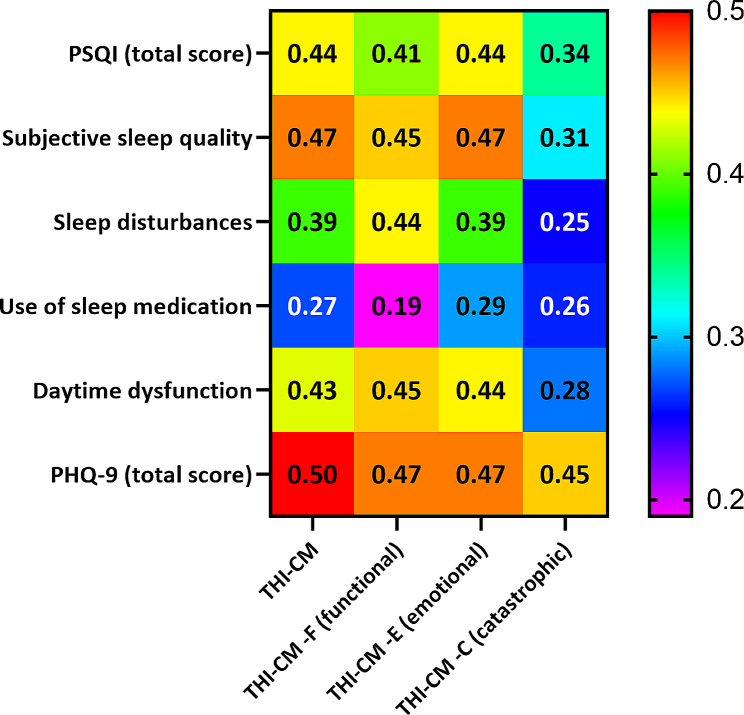
Descriptive statistics identified a cohort with mean age 53.9 ± 12.80 years, 63% exhibited PHQ-9 scores ≥ 10, and 66% had Apnea-Hypopnea Index (AHI) > 5. The ratio of rapid eye movement and deep sleep to stage 1 + 2 sleep was relatively low and non-significant. Likewise, leg movements was higher in the tinnitus group but not statistically significant. In the tinnitus group, 63.08% had depression, and 81.54% had AHI > 5. Univariate logistic regression linked tinnitus to AHI > 5 (Odds ratio (OR) 2.67, p = 0.026) and male sex (OR 2.49, p = 0.034). A moderate positive correlation was found between the THI-CM score and PHQ-9 score (rs = 0.50, p < 0.001). Further adjustment for obstructive sleep apnea showed associations between PHQ-9 (total score) or depression and THI-CM Grade 3-5 (OR = 1.28; OR = 8.68). Single- and multifactor regression analyses highlighted significant associations of PSQI scores > 13 (OR 7.06, p = 0.018) and THI-CM scores > 47 (OR 7.43, p = 0.002) with depression.
Our study recruited tinnitus participants with slight or mild hearing loss and mild tinnitus handicap. Depression was identified as a predominant factor in tinnitus-related handicap. The mild tinnitus handicap in tinnitus participants may explain the lack of significant differences in depression, sleep quality, and polysomnographic sleep characteristics between tinnitus and non-tinnitus groups. Further extensive and prospective studies are needed to elucidate the complex links among depression, sleep, and tinnitus.
耳鸣影响着全球约 7.4 亿成年人,涉及听力、情绪和睡眠系统。然而,使用多导睡眠图和纯音听力测试(PTA)的研究有限。我们旨在使用多导睡眠图和 PTA 评估耳鸣与听力、睡眠质量、特征和抑郁之间的相关性。
在这项横断面研究中,我们将参与者分为耳鸣组和非耳鸣组。我们纳入了来自台湾一家医疗中心的 100 名门诊患者(65 名耳鸣患者,35 名非耳鸣患者),他们接受了多导睡眠图检查,并完成了包括患者健康问卷-9(PHQ-9)、匹兹堡睡眠质量指数(PSQI)中文版本和耳鸣残疾量表(THI-CM)中文版本在内的评分量表。我们分析了相关性,进行了组间比较,评估了与 THI-CM 评分相关的因素,构建了预测耳鸣组抑郁的 ROC 曲线,并进行了多项和逻辑回归以探讨关联。
描述性统计数据确定了一个平均年龄为 53.9±12.80 岁的队列,其中 63%的人 PHQ-9 评分≥10,66%的人呼吸暂停低通气指数(AHI)>5。快速动眼期和深睡眠与 1+2 期睡眠的比例相对较低且无统计学意义。同样,耳鸣组的腿部运动较多,但无统计学意义。在耳鸣组中,63.08%的人患有抑郁,81.54%的人 AHI>5。单变量逻辑回归将耳鸣与 AHI>5(比值比(OR)2.67,p=0.026)和男性(OR 2.49,p=0.034)联系起来。THI-CM 评分与 PHQ-9 评分之间存在中度正相关(rs=0.50,p<0.001)。进一步调整阻塞性睡眠呼吸暂停后,PHQ-9(总分)或抑郁与 THI-CM 3-5 级(OR=1.28;OR=8.68)之间存在关联。单因素和多因素回归分析突出了 PSQI 评分>13(OR 7.06,p=0.018)和 THI-CM 评分>47(OR 7.43,p=0.002)与抑郁显著相关。
我们的研究招募了耳鸣参与者,他们有轻微或轻度听力损失和轻度耳鸣障碍。抑郁被确定为耳鸣相关障碍的主要因素。耳鸣参与者的轻度耳鸣障碍可能解释了耳鸣组和非耳鸣组之间在抑郁、睡眠质量和多导睡眠图睡眠特征方面没有显著差异。需要进一步广泛和前瞻性的研究来阐明抑郁、睡眠和耳鸣之间的复杂联系。