Zaidan Nadim, Wang Chan, Chen Ze, Lieske John C, Milliner Dawn, Seide Barbara, Ho Melody, Li Huilin, Ruggles Kelly V, Modersitzki Frank, Goldfarb David S, Blaser Martin, Nazzal Lama
Department of Medicine, Division of Nephrology, NYU Langone Medical Center, New York, New York, USA.
Department of Population Health, New York University School of Medicine, NYU Langone Health, New York, New York, USA.
Kidney Int Rep. 2024 Mar 11;9(6):1836-1848. doi: 10.1016/j.ekir.2024.03.004. eCollection 2024 Jun.
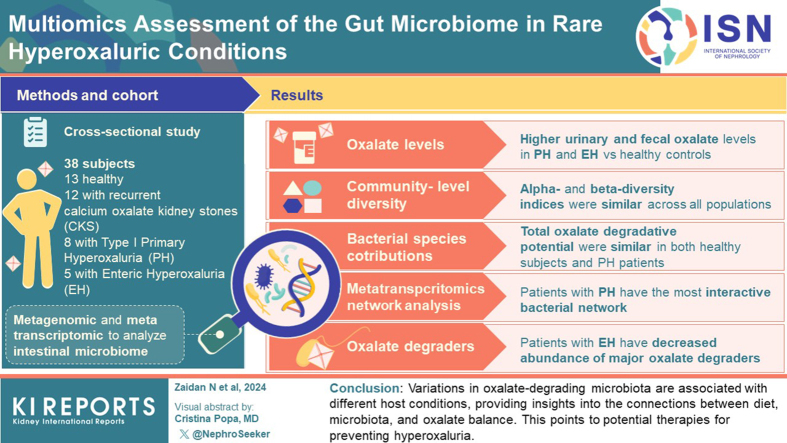
Hyperoxaluria is a risk factor for kidney stone formation and chronic kidney disease progression. The microbiome is an important protective factor against oxalate accumulation through the activity of its oxalate-degrading enzymes (ODEs). In this cross-sectional study, we leverage multiomics to characterize the microbial community of participants with primary and enteric hyperoxaluria, as well as idiopathic calcium oxalate kidney stone (CKS) formers, focusing on the relationship between oxalate degrading functions of the microbiome.
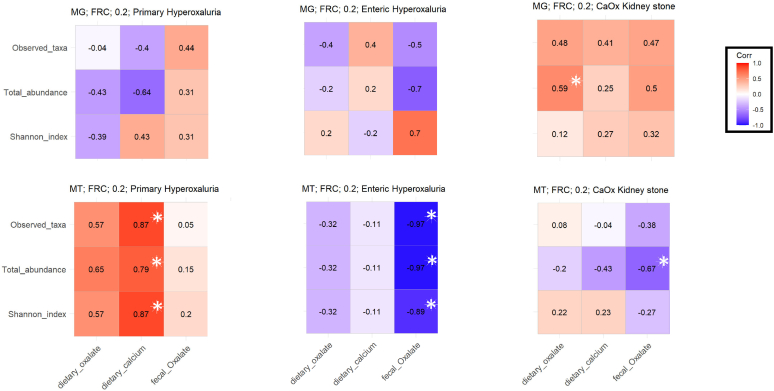
Patients diagnosed with type 1 primary hyperoxaluria (PH), enteric hyperoxaluria (EH), and CKS were screened for inclusion in the study. Participants completed a food frequency questionnaire recording their dietary oxalate content while fecal oxalate levels were ascertained. DNA and RNA were extracted from stool samples and sequenced. Metagenomic (MTG) and metatranscriptomic (MTT) data were processed through our bioinformatics pipelines, and microbiome diversity, differential abundance, and networks were subject to statistical analysis in relationship with oxalate levels.
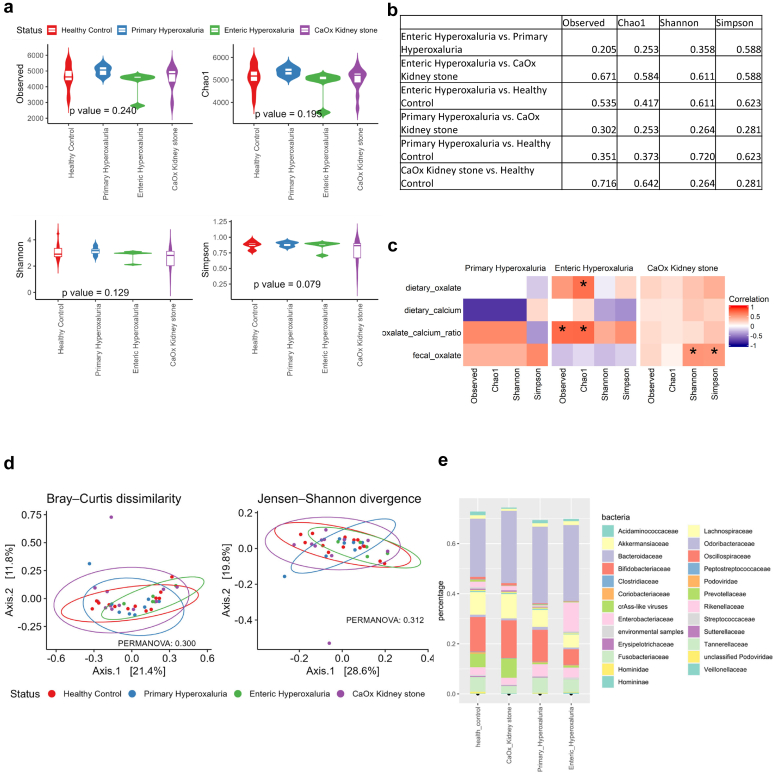
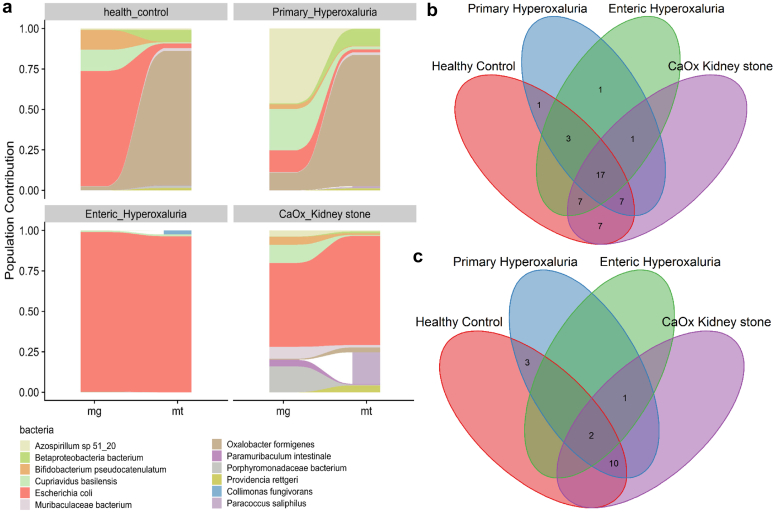
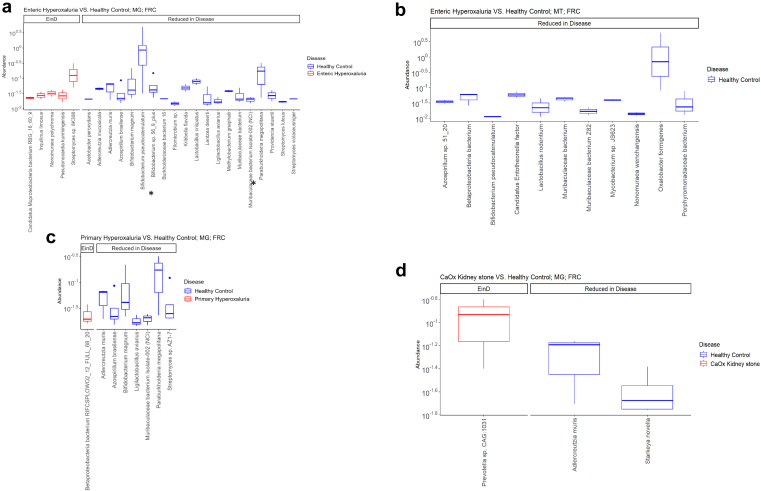
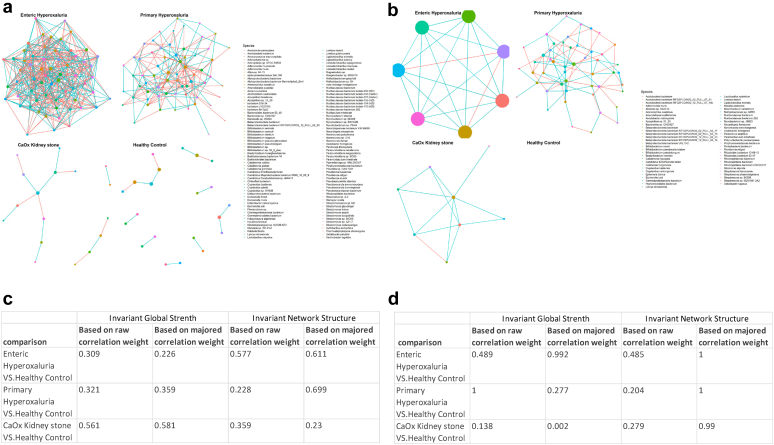
A total of 38 subjects were recruited, including 13 healthy participants, 12 patients with recurrent CKS, 8 with PH, and 5 with EH. Urinary and fecal oxalate were significantly higher in the PH and the EH population compared to healthy controls. At the community level, alpha-diversity and beta-diversity indices were similar across all populations. The respective contributions of single bacterial species to the total oxalate degradative potential were similar in healthy and PH subjects. MTT-based network analysis identified the most interactive bacterial network in patients with PH. Patients with EH had a decreased abundance of multiple major oxalate degraders.
The composition and inferred activity of oxalate-degrading microbiota were differentially associated with host clinical conditions. Identifying these changes improves our understanding of the relationships between dietary constituents, microbiota, and oxalate homeostasis, and suggests new therapeutic approaches protecting against hyperoxaluria.
高草酸尿症是肾结石形成和慢性肾病进展的危险因素。微生物群通过其草酸降解酶(ODEs)的活性,是防止草酸盐积累的重要保护因素。在这项横断面研究中,我们利用多组学技术来表征原发性和肠道高草酸尿症患者以及特发性草酸钙肾结石(CKS)患者的微生物群落,重点关注微生物群的草酸降解功能之间的关系。
对诊断为1型原发性高草酸尿症(PH)、肠道高草酸尿症(EH)和CKS的患者进行筛选,以纳入研究。参与者完成了一份食物频率问卷,记录他们饮食中的草酸盐含量,同时确定粪便草酸盐水平。从粪便样本中提取DNA和RNA并进行测序。宏基因组(MTG)和宏转录组(MTT)数据通过我们的生物信息学管道进行处理,微生物群多样性、差异丰度和网络与草酸盐水平进行统计分析。
共招募了38名受试者,包括13名健康参与者、12名复发性CKS患者、8名PH患者和5名EH患者。与健康对照组相比,PH和EH人群的尿草酸和粪便草酸显著更高。在群落水平上,所有人群的α多样性和β多样性指数相似。健康受试者和PH受试者中,单个细菌物种对总草酸降解潜力的各自贡献相似。基于MTT的网络分析确定了PH患者中最具交互性的细菌网络。EH患者中多种主要草酸降解菌的丰度降低。
草酸降解微生物群的组成和推断活性与宿主临床状况存在差异关联。识别这些变化有助于我们更好地理解饮食成分、微生物群和草酸稳态之间的关系,并提出预防高草酸尿症的新治疗方法。