Shah Akshat P, Dave Jigna D, Makwana Mohit N, Rupani Mihir P, Shah Immad A
Department of Community Medicine, Government Medical College Bhavnagar (Maharaja Krishnakumarsinhji Bhavnagar University), Near ST Bus Stand, Jail Road, Bhavnagar, Gujarat, 364001, India.
Department of Respiratory Medicine, Government Medical College Bhavnagar (Maharaja Krishnakumarsinhji Bhavnagar University), Jail Road, Bhavnagar, Gujarat, 364001, India.
Arch Public Health. 2024 Jun 20;82(1):92. doi: 10.1186/s13690-024-01326-0.
Tuberculosis (TB) remains a significant public health burden in India, with elimination targets set for 2025. Active case finding (ACF) is crucial for improving TB case detection rates, although conclusive evidence of its association with treatment outcomes is lacking. Our study aims to investigate the impact of ACF on successful TB treatment outcomes among pulmonary TB patients in Gujarat, India, and explore why ACF positively impacts these outcomes.
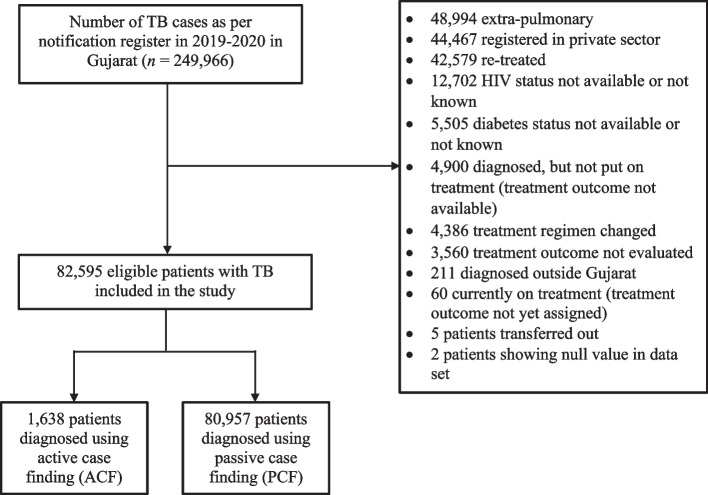
We conducted a retrospective cohort analysis in Gujarat, India, including 1,638 pulmonary TB cases identified through ACF and 80,957 cases through passive case finding (PCF) from January 2019 to December 2020. Generalized logistic mixed-model compared treatment outcomes between the ACF and PCF groups. Additionally, in-depth interviews were conducted with 11 TB program functionaries to explore their perceptions of ACF and its impact on TB treatment outcomes.
Our analysis revealed that patients diagnosed through ACF exhibited 1.4 times higher odds of successful treatment outcomes compared to those identified through PCF. Program functionaries emphasized that ACF enhances case detection rates and enables early detection and prompt treatment initiation. This early intervention facilitates faster sputum conversion and helps reduce the infectious period, thereby improving treatment outcomes. Functionaries highlighted that ACF identifies TB cases that might otherwise be missed, ensuring timely and appropriate treatment.
ACF significantly improves TB treatment outcomes in Gujarat, India. The mixed-methods analysis demonstrates a positive association between ACF and successful TB treatment, with early detection and prompt treatment initiation being key factors. Insights from TB program functionaries underscore the importance of ACF in ensuring timely diagnosis and treatment, which are critical for better treatment outcomes. Expanding ACF initiatives, especially among hard-to-reach populations, can further enhance TB control efforts. Future research should focus on optimizing ACF strategies and integrating additional interventions to sustain and improve TB treatment outcomes.
结核病在印度仍然是一项重大的公共卫生负担,设定了到2025年的消除目标。主动病例发现对于提高结核病病例检出率至关重要,尽管缺乏其与治疗结果关联的确凿证据。我们的研究旨在调查主动病例发现在印度古吉拉特邦肺结核患者成功治疗结果方面的影响,并探讨主动病例发现对这些结果产生积极影响的原因。
我们在印度古吉拉特邦进行了一项回顾性队列分析,纳入了2019年1月至2020年12月期间通过主动病例发现确定的1638例肺结核病例和通过被动病例发现确定的80957例病例。采用广义逻辑混合模型比较主动病例发现组和被动病例发现组的治疗结果。此外,对11名结核病项目工作人员进行了深入访谈,以探讨他们对主动病例发现及其对结核病治疗结果影响的看法。
我们的分析显示,与通过被动病例发现确定的患者相比,通过主动病例发现诊断的患者成功治疗结果的几率高出1.4倍。项目工作人员强调,主动病例发现提高了病例检出率,并能够早期发现并迅速开始治疗。这种早期干预有助于更快地实现痰菌转阴,并有助于缩短传染期,从而改善治疗结果。工作人员强调,主动病例发现能够识别那些可能会被漏诊的结核病病例,确保及时和适当的治疗。
在印度古吉拉特邦,主动病例发现显著改善了结核病治疗结果。混合方法分析表明主动病例发现与结核病成功治疗之间存在正相关,早期发现和迅速开始治疗是关键因素。结核病项目工作人员的见解强调了主动病例发现在确保及时诊断和治疗方面的重要性,这对于取得更好的治疗结果至关重要。扩大主动病例发现举措,特别是在难以触及的人群中,可以进一步加强结核病控制工作。未来的研究应侧重于优化主动病例发现策略,并整合其他干预措施,以维持和改善结核病治疗结果。