Hayashi Kiyohito, Koyama Daisuke, Hamazaki Yoichi, Kamiyama Takamichi, Yamada Shingo, Furukawa Miki, Tanino Yoshinori, Shibata Yoko, Ikezoe Takayuki
Department of Hematology, Fukushima Medical University, Fukushima, Fukushima, 960-1295, Japan.
Department of Hematology, Iwaki City Medical Center, Iwaki, Fukushima, Japan.
Thromb J. 2024 Jun 21;22(1):52. doi: 10.1186/s12959-024-00619-2.
The coronavirus disease 2019 (COVID-19) pandemic, caused by severe acute respiratory syndrome coronavirus 2 (SARS-CoV-2), has had a profound global impact, with millions of confirmed cases and deaths worldwide. While most cases are mild, a subset progresses to severe respiratory complications and death, with factors such as thromboembolism, age, and underlying health conditions increasing the risk. Vascular endothelial damage has been implicated in severe outcomes, but specific biomarkers remain elusive. This study investigated syndecan-1 (SDC-1), a marker of endothelial damage, as a potential prognostic factor for COVID-19, focusing on the Japanese population, which is known for its aging demographics and high prevalence of comorbidities.
A multicenter retrospective study of COVID-19 patients in Fukushima Prefecture in Japan who were admitted between February 2020 and August 2021 was conducted. SDC-1 levels were measured along with other clinical and laboratory parameters. Outcomes including thrombosis, 28-day survival, and disease severity were assessed, and disease severity was categorized according to established guidelines.
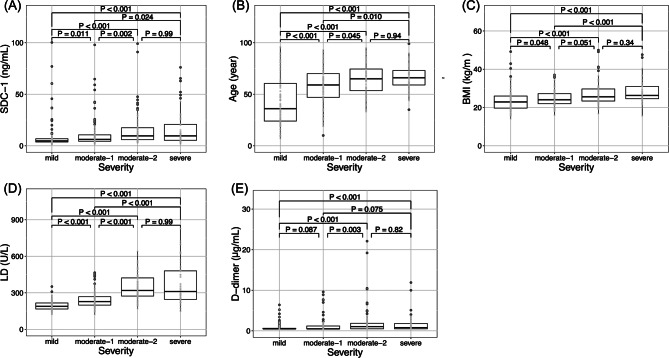
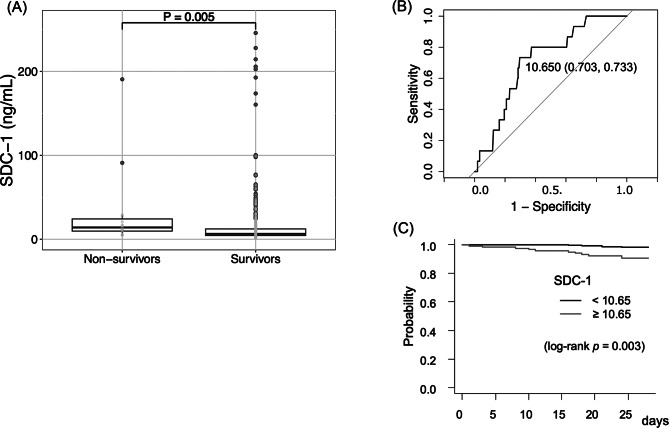
SDC-1 levels were correlated with disease severity. Patients who died from COVID-19 had greater SDC-1 levels than survivors, and the area under the receiver operating characteristic curve (AUC) analysis suggested the potential of the SDC-1 level as a predictor of mortality (AUC 0.714). K‒M analysis also revealed a significant difference in survival based on an SDC-1 cutoff of 10.65 ng/mL.
This study suggested that SDC-1 may serve as a valuable biomarker for assessing COVID-19 severity and predicting mortality within 28 days of hospitalization, particularly in the Japanese population. However, further investigations are required to assess longitudinal changes in SDC-1 levels, validate its predictive value for long-term survival, and consider its applicability to new viral variants.
SDC-1 is emerging as a potential biomarker for assessing the severity and life expectancy of COVID-19 in the Japanese population, offering promise for improved risk stratification and patient management in the ongoing fight against the virus.
由严重急性呼吸综合征冠状病毒2(SARS-CoV-2)引起的2019冠状病毒病(COVID-19)大流行对全球产生了深远影响,全球有数百万确诊病例和死亡病例。虽然大多数病例症状较轻,但一部分病例会进展为严重的呼吸道并发症甚至死亡,血栓栓塞、年龄和基础健康状况等因素会增加这种风险。血管内皮损伤与严重后果有关,但具体的生物标志物仍不明确。本研究以日本人群为对象,调查了内皮损伤标志物Syndecan-1(SDC-1)作为COVID-19潜在预后因素的情况,日本人群以人口老龄化和合并症高患病率而闻名。
对2020年2月至2021年8月期间在日本福岛县住院的COVID-19患者进行了一项多中心回顾性研究。测量了SDC-1水平以及其他临床和实验室参数。评估了包括血栓形成、28天生存率和疾病严重程度等结局,并根据既定指南对疾病严重程度进行了分类。
SDC-1水平与疾病严重程度相关。死于COVID-19的患者的SDC-1水平高于幸存者,受试者工作特征曲线(AUC)分析表明SDC-1水平有作为死亡率预测指标的潜力(AUC为0.714)。K-M分析还显示,基于SDC-1临界值10.65 ng/mL,生存率存在显著差异。
本研究表明,SDC-1可能是评估COVID-19严重程度和预测住院28天内死亡率的有价值生物标志物,尤其是在日本人群中。然而,需要进一步研究来评估SDC-1水平的纵向变化,验证其对长期生存的预测价值,并考虑其对新病毒变种的适用性。
SDC-1正在成为评估日本人群中COVID-19严重程度和预期寿命的潜在生物标志物,为在持续抗击该病毒过程中改善风险分层和患者管理带来了希望。