Division of Gene Regulation, Netherlands Cancer Institute, Amsterdam, The Netherlands.
Division of Molecular Genetics, Netherlands Cancer Institute, Amsterdam, The Netherlands.
Nat Commun. 2024 Jun 22;15(1):5334. doi: 10.1038/s41467-024-49232-x.
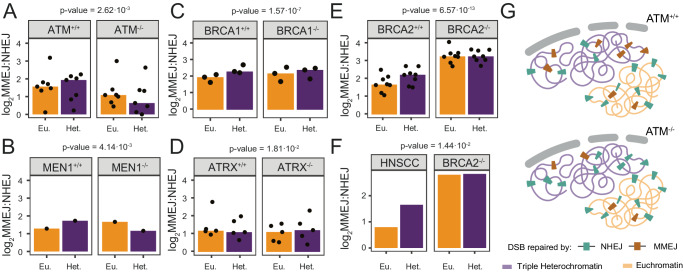
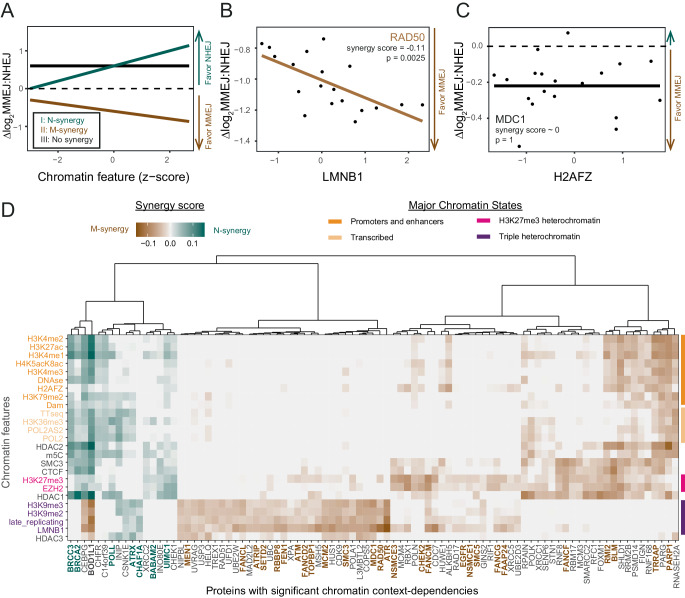
DNA double-strand breaks are repaired by multiple pathways, including non-homologous end-joining (NHEJ) and microhomology-mediated end-joining (MMEJ). The balance of these pathways is dependent on the local chromatin context, but the underlying mechanisms are poorly understood. By combining knockout screening with a dual MMEJ:NHEJ reporter inserted in 19 different chromatin environments, we identified dozens of DNA repair proteins that modulate pathway balance dependent on the local chromatin state. Proteins that favor NHEJ mostly synergize with euchromatin, while proteins that favor MMEJ generally synergize with distinct types of heterochromatin. Examples of the former are BRCA2 and POLL, and of the latter the FANC complex and ATM. Moreover, in a diversity of human cancer types, loss of several of these proteins alters the distribution of pathway-specific mutations between heterochromatin and euchromatin. Together, these results uncover a complex network of proteins that regulate MMEJ:NHEJ balance in a chromatin context-dependent manner.
DNA 双链断裂通过多种途径修复,包括非同源末端连接(NHEJ)和微同源介导的末端连接(MMEJ)。这些途径的平衡依赖于局部染色质环境,但潜在的机制尚不清楚。通过将敲除筛选与双 MMEJ:NHEJ 报告基因插入 19 种不同的染色质环境相结合,我们鉴定了数十种 DNA 修复蛋白,这些蛋白根据局部染色质状态调节途径平衡。有利于 NHEJ 的蛋白大多与常染色质协同作用,而有利于 MMEJ 的蛋白通常与不同类型的异染色质协同作用。前者的例子是 BRCA2 和 POLL,后者的例子是 FANC 复合物和 ATM。此外,在多种人类癌症类型中,这些蛋白中的几种缺失会改变特定途径突变在异染色质和常染色质之间的分布。总之,这些结果揭示了一个复杂的蛋白质网络,该网络以染色质环境依赖的方式调节 MMEJ:NHEJ 平衡。