Oncode Institute, Division of Cell Biology, the Netherlands Cancer Institute, Plesmanlaan 121, 1066 CX Amsterdam, The Netherlands.
Oncode Institute, Division of Oncogenomics, the Netherlands Cancer Institute, Plesmanlaan 121, 1066 CX Amsterdam, The Netherlands.
Nucleic Acids Res. 2022 Sep 23;50(17):9930-9947. doi: 10.1093/nar/gkac758.
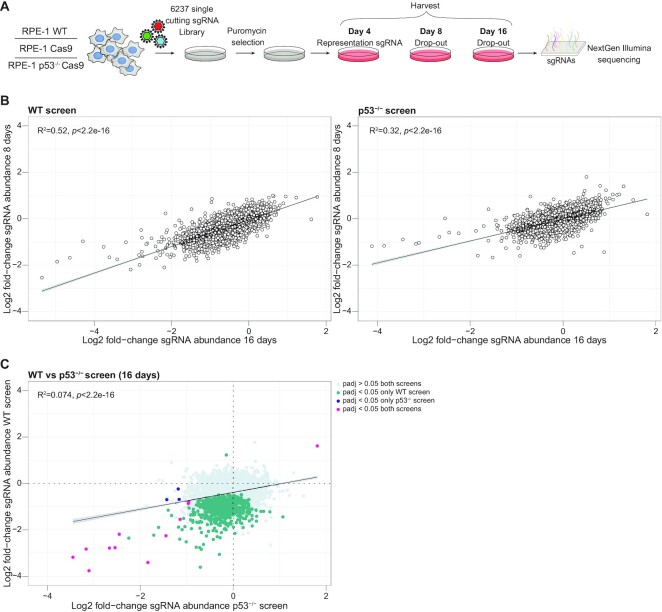
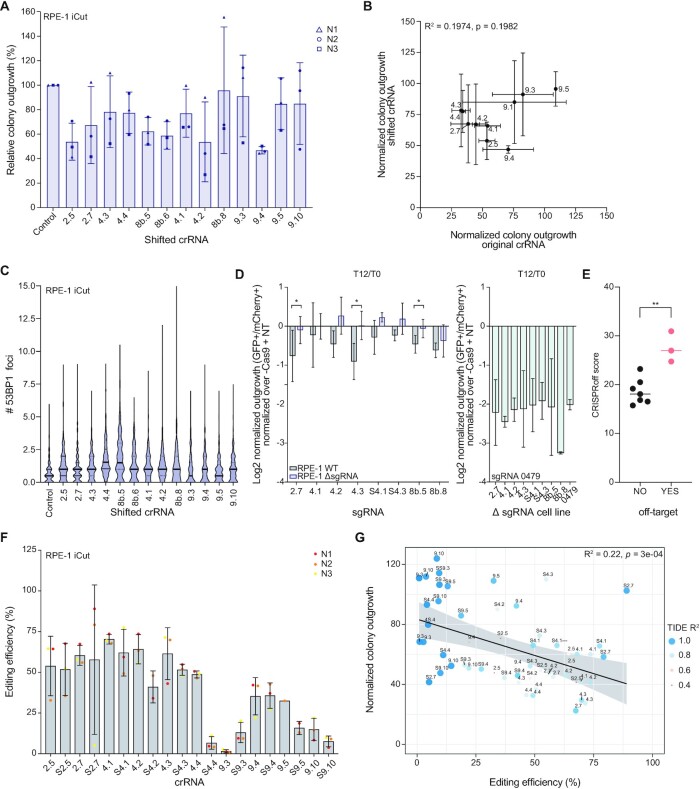
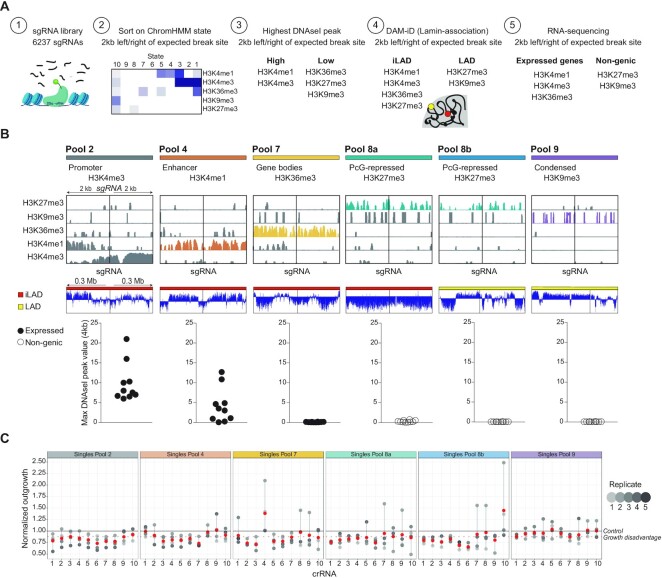
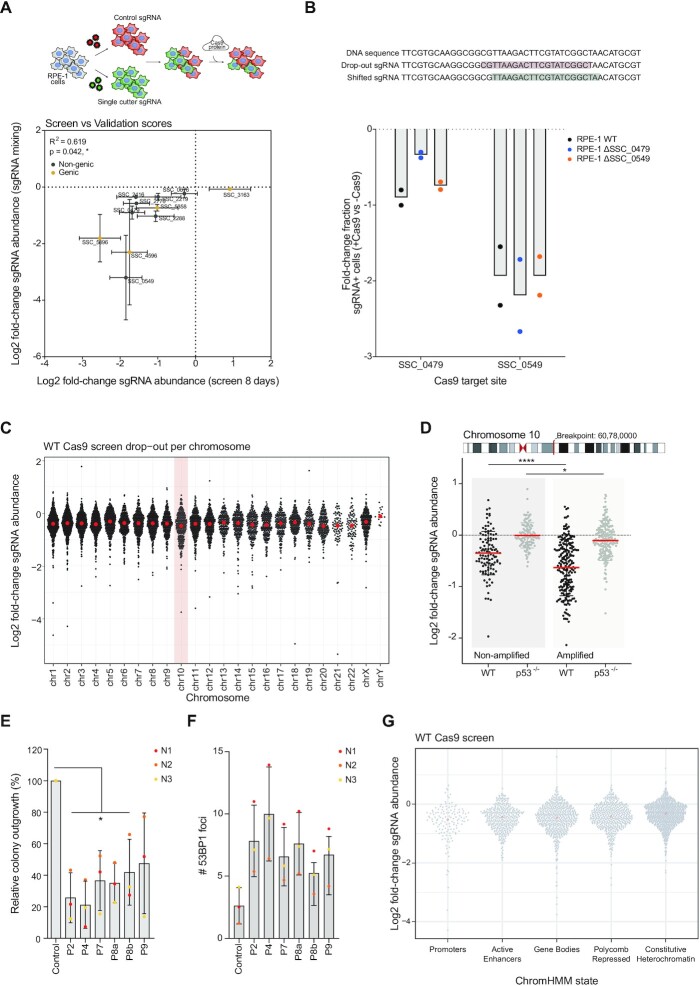
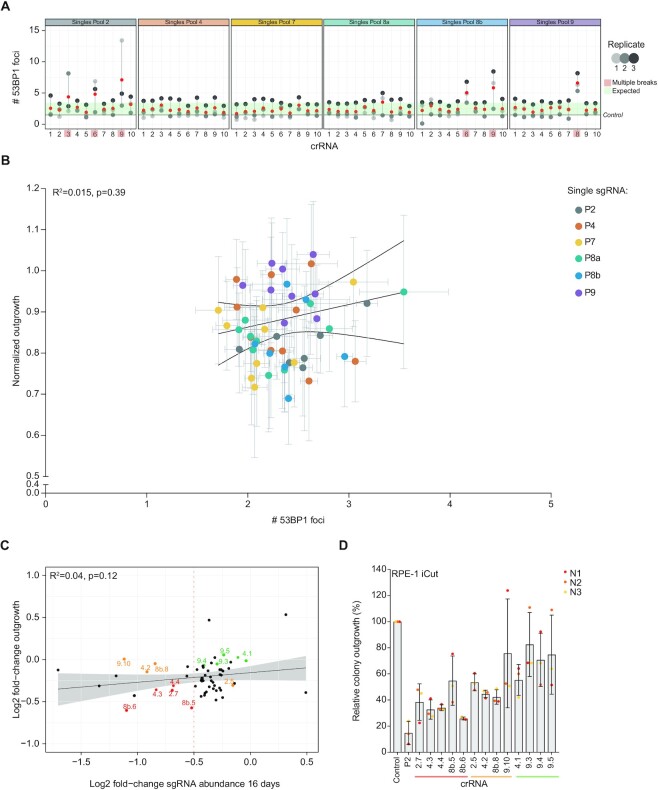
Cells respond to double-strand breaks (DSBs) by activating DNA damage response pathways, including cell cycle arrest. We have previously shown that a single double-strand break generated via CRISPR/Cas9 is sufficient to delay cell cycle progression and compromise cell viability. However, we also found that the cellular response to DSBs can vary, independent of the number of lesions. This implies that not all DSBs are equally toxic, and raises the question if the location of a single double-strand break could influence its toxicity. To systematically investigate if DSB-location is a determinant of toxicity we performed a CRISPR/Cas9 screen targeting 6237 single sites in the human genome. Next, we developed a data-driven framework to design CRISPR/Cas9 sgRNA (crRNA) pools targeting specific chromatin features. The chromatin context was defined using ChromHMM states, Lamin-B1 DAM-iD, DNAseI hypersensitivity, and RNA-sequencing data. We computationally designed 6 distinct crRNA pools, each containing 10 crRNAs targeting the same chromatin state. We show that the toxicity of a DSB is highly similar across the different ChromHMM states. Rather, we find that the major determinants of toxicity of a sgRNA are cutting efficiency and off-target effects. Thus, chromatin features have little to no effect on the toxicity of a single CRISPR/Cas9-induced DSB.
细胞通过激活 DNA 损伤反应途径(包括细胞周期停滞)来应对双链断裂(DSBs)。我们之前曾表明,通过 CRISPR/Cas9 产生的单个双链断裂足以延迟细胞周期进程并损害细胞活力。然而,我们还发现,细胞对 DSB 的反应可能会有所不同,而与损伤的数量无关。这意味着并非所有 DSB 都是同等毒性的,并提出了一个问题,即单个双链断裂的位置是否会影响其毒性。为了系统地研究 DSB 位置是否是毒性的决定因素,我们针对人类基因组中的 6237 个单一位点进行了 CRISPR/Cas9 筛选。接下来,我们开发了一种数据驱动的框架,用于设计针对特定染色质特征的 CRISPR/Cas9 sgRNA(crRNA)池。染色质背景使用 ChromHMM 状态、Lamin-B1 DAM-iD、DNAseI 超敏性和 RNA-seq 数据定义。我们通过计算设计了 6 个不同的 crRNA 池,每个池包含 10 个靶向相同染色质状态的 crRNA。我们表明,DSB 的毒性在不同的 ChromHMM 状态之间非常相似。相反,我们发现 sgRNA 毒性的主要决定因素是切割效率和脱靶效应。因此,染色质特征对单个 CRISPR/Cas9 诱导的 DSB 的毒性几乎没有影响。