The Third School of Clinical Medicine, Guangzhou University of Chinese Medicine, Guangzhou, Guangdong, 510405, China.
Department of Rehabilitation and Physiotherapy, Foresea Life Insurance, Guangzhou General Hospital, Guangzhou, Guangdong, 510000, China.
BMC Musculoskelet Disord. 2024 Jun 22;25(1):487. doi: 10.1186/s12891-024-07605-9.
Increased intake of specific vitamins has been linked to a decreased prevalence of osteoporosis. However, the association between dietary folate intake and the risk of osteoporosis in the general population remains incompletely understood. Therefore, we aimed to determine the association between dietary folate intake and the risk of osteoporosis in the general population of the USA.
In this cross-sectional study, data from the National Health and Nutrition Examination Survey (2017-2020) were collected. Osteoporosis was considered to be indicated by a bone mineral density greater than 2.5 standard deviations below the mean of the young adult reference group. Dietary folate intake was measured by a 24-hour dietary recall. Multivariate logistic regression models and restricted cubic spline models were used.
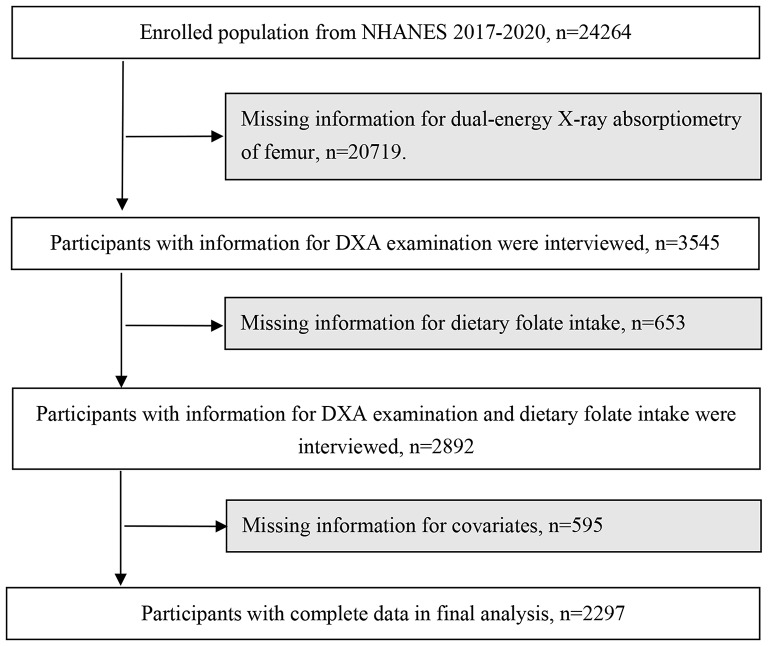
The study included 2297 participants (mean age: 63.69 ± 0.35 years), 49.92% of whom were female. In the general population, increased dietary folate intake was directly associated with a decreased risk of osteoporosis (P for trend = 0.005). In the age > 60 years and female subgroups, folate intake was inversely associated with the risk of osteoporosis (P for trend < 0.001). The dose‒response curve suggested that this association was nonlinear (P for nonlinearity = 0.015).
Our cross-sectional study provides initial insights into the inverse association between dietary folate intake and the risk of osteoporosis in the general U.S.
Further research is needed to confirm these associations.
摄入特定维生素与骨质疏松症的患病率降低有关。然而,一般人群饮食叶酸摄入量与骨质疏松症风险之间的关联仍不完全清楚。因此,我们旨在确定一般人群饮食叶酸摄入量与骨质疏松症风险之间的关联。
在这项横断面研究中,收集了 2017-2020 年全国健康与营养调查的数据。骨质疏松症被认为是骨矿物质密度大于年轻成人参考组平均值的 2.5 个标准差以上。饮食叶酸摄入量通过 24 小时膳食回顾来测量。使用多变量逻辑回归模型和限制三次样条模型。
该研究纳入了 2297 名参与者(平均年龄:63.69±0.35 岁),其中 49.92%为女性。在一般人群中,饮食叶酸摄入量增加与骨质疏松症风险降低直接相关(趋势 P=0.005)。在年龄>60 岁和女性亚组中,叶酸摄入量与骨质疏松症风险呈负相关(趋势 P<0.001)。剂量-反应曲线表明这种关联是非线性的(非线性 P=0.015)。
我们的横断面研究初步揭示了一般美国人群饮食叶酸摄入量与骨质疏松症风险之间的反比关系。
需要进一步的研究来证实这些关联。