College of Chemistry and Molecular Sciences, Wuhan University, Wuhan, China.
College of Chemistry, Nankai University, Tianjin, China.
Virulence. 2024 Dec;15(1):2367671. doi: 10.1080/21505594.2024.2367671. Epub 2024 Jun 23.
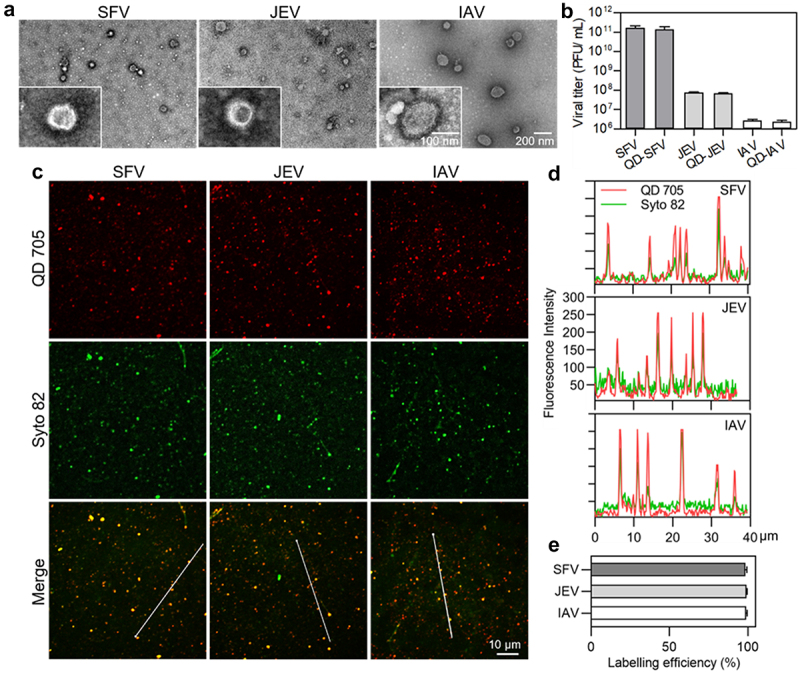
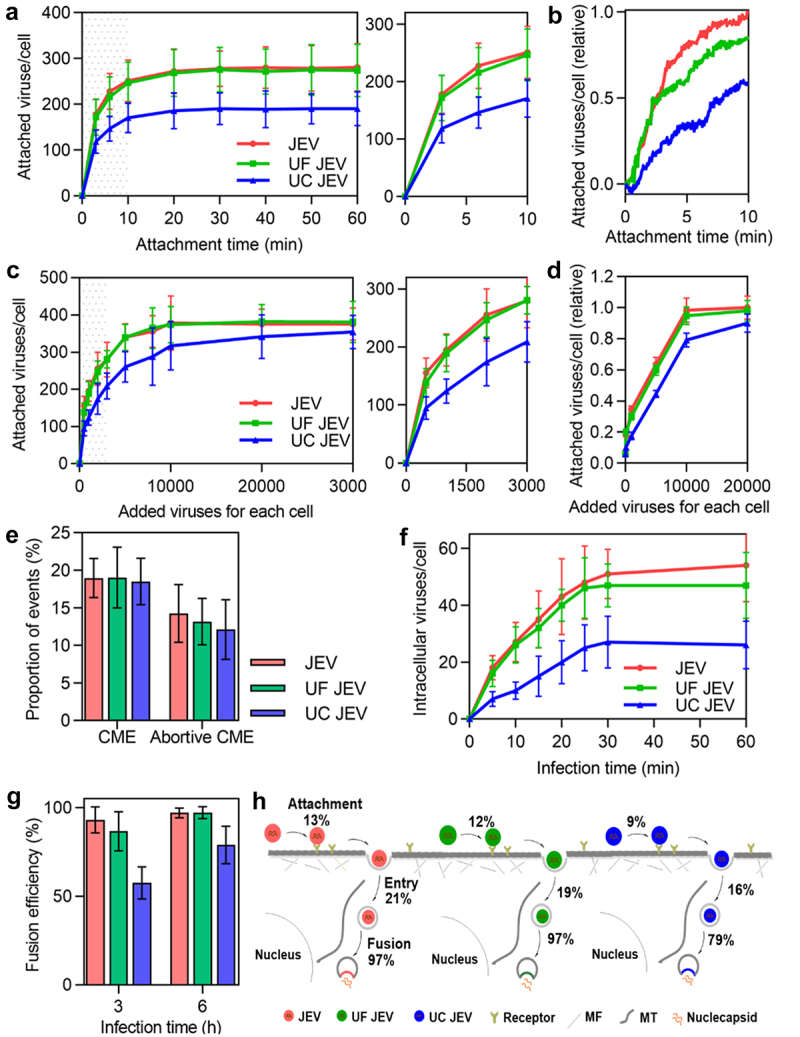
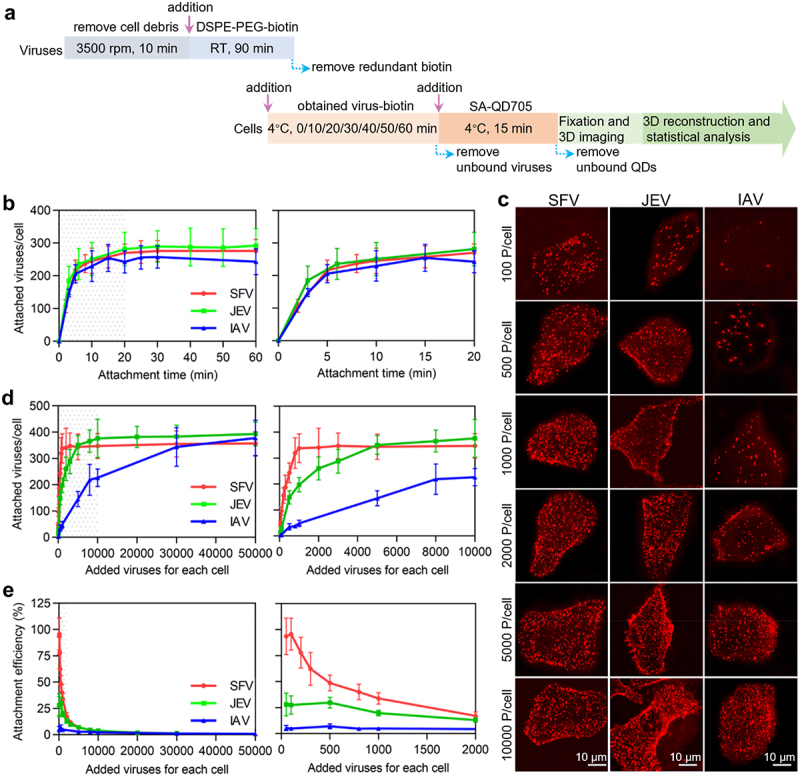
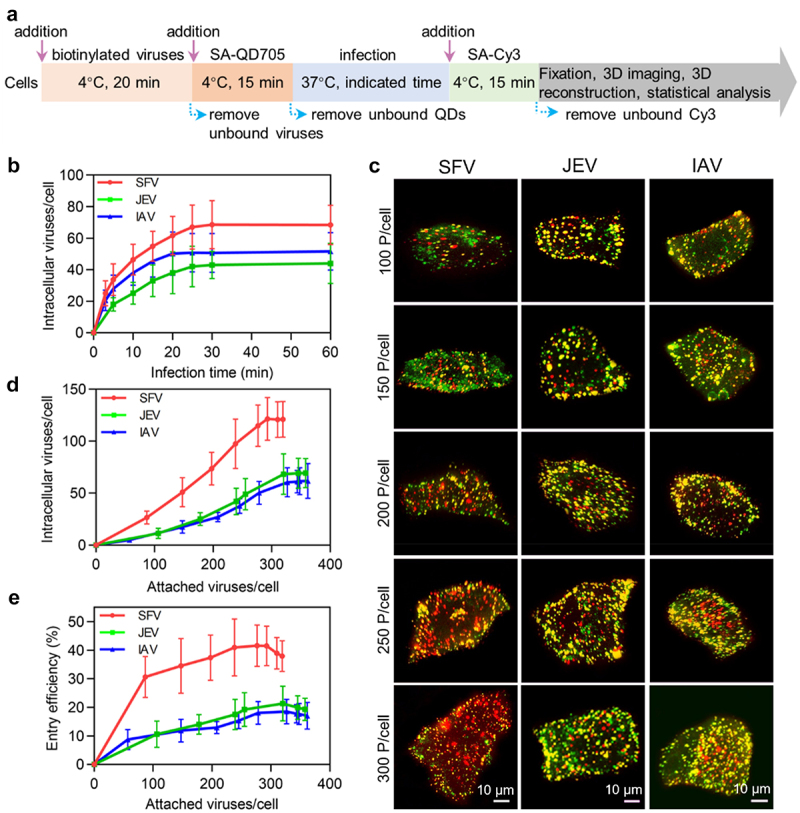
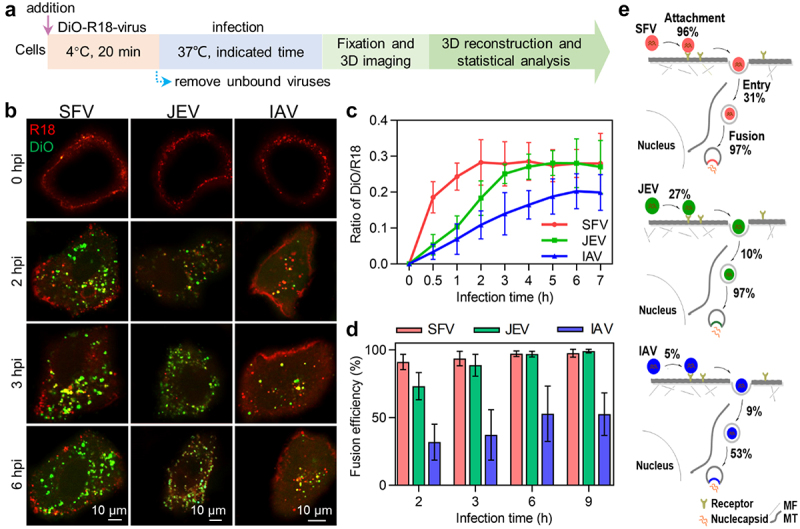
Viral diseases are among the main threats to public health. Understanding the factors affecting viral invasion is important for antiviral research. Until now, it was known that most viruses have very low plaque-forming unit (PFU)-to-particle ratios. However, further investigation is required to determine the underlying factors. Here, using quantitative single-particle analysis methods, the invasion of Semliki Forest virus (SFV), Japanese encephalitis virus (JEV), and influenza A virus (IAV) containing attachment to the cell surface, entry into the cell, transport towards the cell interior, and fusion with endosomes to release nucleocapsids were quantitatively analysed in parallel. It was found that for SFV with an PFU-to-particle ratio of approximately 1:2, an entry efficiency of approximately 31% limited infection. For JEV, whose PFU-to-particle ratio was approximately 1:310, an attachment efficiency of approximately 27% and an entry efficiency of 10% were the main factors limiting its infection. Meanwhile, for IAV with PFU-to-particle ratios of 1:8100, 5% attachment efficiency, 9% entry efficiency, and 53% fusion efficiency significantly limited its infection. These results suggest that viruses with different infectivities have different limited steps in the invasion process. Moreover, there are significant differences in attachment efficiencies among viruses, emphasizing the pivotal role of attachment in viral invasion. The influence of the virus purification method on virus invasion was also investigated. This study, for the first time, reports the efficiencies of different stages of virus invasion, leading to a better understanding of virus invasion and providing a protocol to quantitatively analyse the virus invasion efficiency.
病毒病是对公众健康的主要威胁之一。了解影响病毒入侵的因素对于抗病毒研究很重要。到目前为止,人们已经知道大多数病毒的空斑形成单位(PFU)与颗粒的比值非常低。然而,还需要进一步研究以确定潜在因素。在这里,使用定量单颗粒分析方法,同时对含有细胞表面附着、进入细胞、向细胞内部运输以及与内体融合以释放核衣壳的 Semliki Forest 病毒(SFV)、日本脑炎病毒(JEV)和甲型流感病毒(IAV)的入侵进行了定量分析。结果发现,对于 PFU 与颗粒的比值约为 1:2 的 SFV,约 31%的进入效率限制了感染。对于 PFU 与颗粒的比值约为 1:310 的 JEV,约 27%的附着效率和 10%的进入效率是限制其感染的主要因素。同时,对于 PFU 与颗粒的比值为 1:8100 的 IAV,5%的附着效率、9%的进入效率和 53%的融合效率显著限制了其感染。这些结果表明,具有不同感染力的病毒在入侵过程中有不同的限制步骤。此外,病毒之间的附着效率存在显著差异,强调了附着在病毒入侵中的关键作用。还研究了病毒纯化方法对病毒入侵的影响。本研究首次报道了不同阶段的病毒入侵效率,有助于更好地理解病毒入侵,并提供了一种定量分析病毒入侵效率的方案。