State Key Laboratory of Virology, Wuhan Institute of Virology, Chinese Academy of Sciences, 430071 Wuhan, People's Republic of China.
University of Chinese Academy of Sciences, 100049 Beijing, People's Republic of China.
Proc Natl Acad Sci U S A. 2019 Feb 12;116(7):2577-2582. doi: 10.1073/pnas.1812632116. Epub 2019 Jan 9.
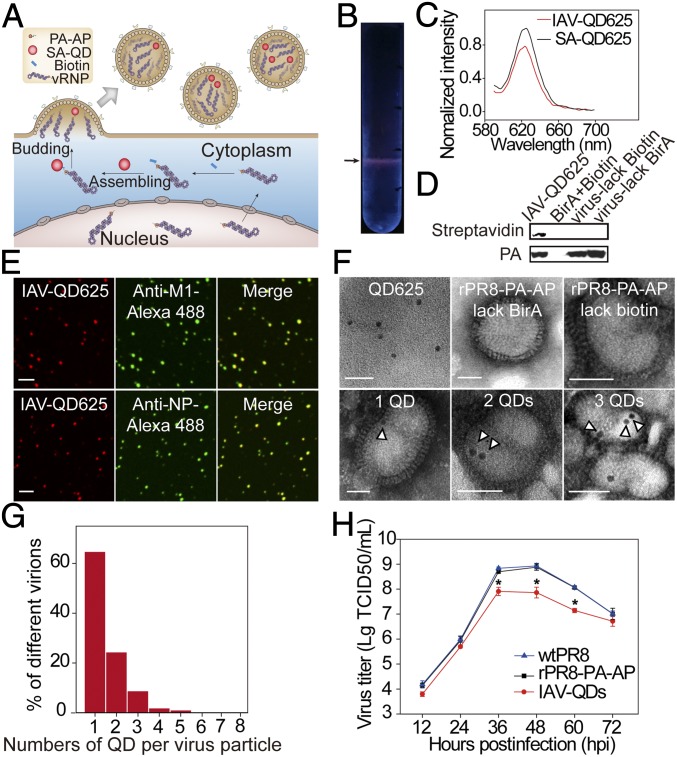
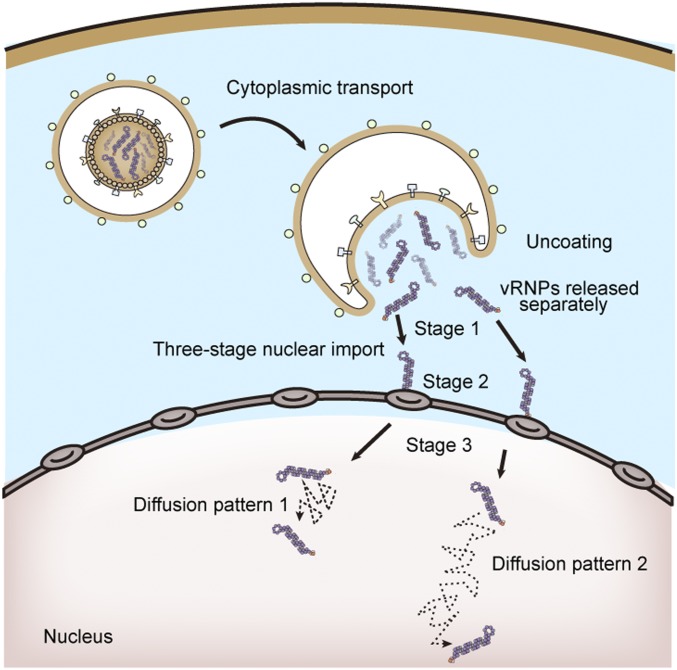
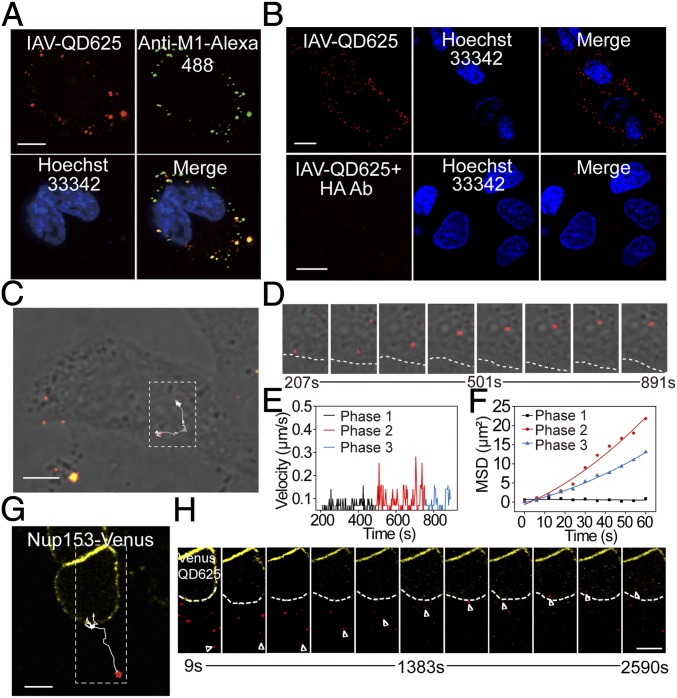
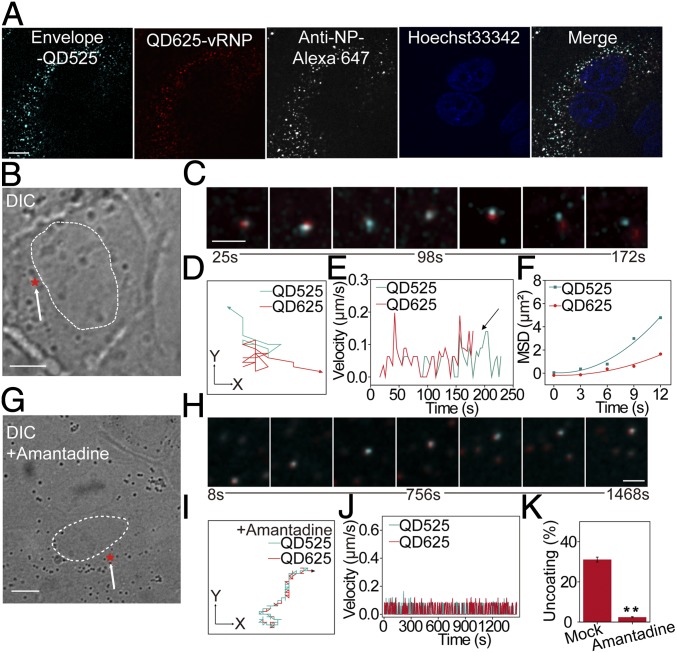
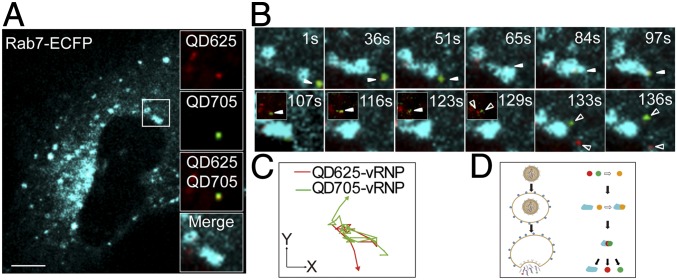
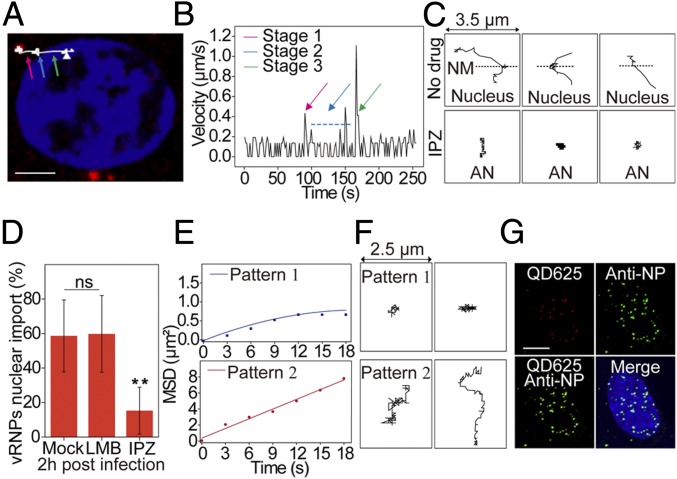
Uncoating is an obligatory step in the virus life cycle that serves as an antiviral target. Unfortunately, it is challenging to study viral uncoating due to methodology limitations for detecting this transient and dynamic event. The uncoating of influenza A virus (IAV), which contains an unusual genome of eight segmented RNAs, is particularly poorly understood. Here, by encapsulating quantum dot (QD)-conjugated viral ribonucleoprotein complexes (vRNPs) within infectious IAV virions and applying single-particle imaging, we tracked the uncoating process of individual IAV virions. Approximately 30% of IAV particles were found to undergo uncoating through fusion with late endosomes in the "around-nucleus" region at 30 to 90 minutes postinfection. Inhibition of viral M2 proton channels and cellular endosome acidification prevented IAV uncoating. IAV vRNPs are released separately into the cytosol after virus uncoating. Then, individual vRNPs undergo a three-stage movement to the cell nucleus and display two diffusion patterns when inside the nucleus. These findings reveal IAV uncoating and vRNP trafficking mechanisms, filling a critical gap in knowledge about influenza viral infection.
脱壳是病毒生命周期中的一个必需步骤,可作为抗病毒的靶点。不幸的是,由于缺乏检测这种短暂和动态事件的方法学限制,研究病毒脱壳具有挑战性。流感 A 病毒(IAV)的脱壳尤其了解甚少,它包含一个不寻常的 8 个分段 RNA 基因组。在这里,我们通过将量子点 (QD)-缀合的病毒核糖核蛋白复合物 (vRNP) 包裹在传染性 IAV 病毒粒子中,并应用单颗粒成像,追踪了单个 IAV 病毒粒子的脱壳过程。大约 30%的 IAV 颗粒被发现通过与感染后 30 至 90 分钟时“核周”区域的晚期内体融合而脱壳。病毒 M2 质子通道的抑制和细胞内体酸化可防止 IAV 脱壳。IAV vRNP 在病毒脱壳后分别释放到细胞质中。然后,单个 vRNP 经历三个阶段的运动到细胞核,并在核内显示两种扩散模式。这些发现揭示了 IAV 脱壳和 vRNP 运输机制,填补了流感病毒感染知识的关键空白。