Evangelou Georgios, Trontzas Ioannis P, Gkiozos Ioannis, Vamvakaris Ioannis, Paraskeva Christina, Grammoustianou Maria, Gomatou Georgia, Tsamis Ioannis, Vathiotis Ioannis, Anagnostakis Maximillian, Koliaraki Vasiliki, Syrigos Kostas
3rd Department of Medicine, National and Kapodistrian University of Athens, Sotiria Chest Diseases Hospital, Mesogeion 152, 11527 Athens, Greece.
Department of Pathology, Sotiria Chest Diseases Hospital, Mesogeion 152, 11527 Athens, Greece.
Biomedicines. 2024 May 23;12(6):1161. doi: 10.3390/biomedicines12061161.
Large cell neuroendocrine carcinoma (LCNEC) presents significant treatment challenges due to its rarity and limited therapeutic options. The LANCE study was designed to explore the survival benefits of incorporating atezolizumab in chemotherapy for metastatic LCNEC.
In this non-randomized study, patients with metastatic LCNEC were prospectively enrolled and assigned to receive either standard chemotherapy plus atezolizumab followed by maintenance with atezolizumab or standard chemotherapy alone. The primary outcomes measured were 12- and 24-month survival rates, progression-free survival (PFS), and overall survival (OS) between the two groups.
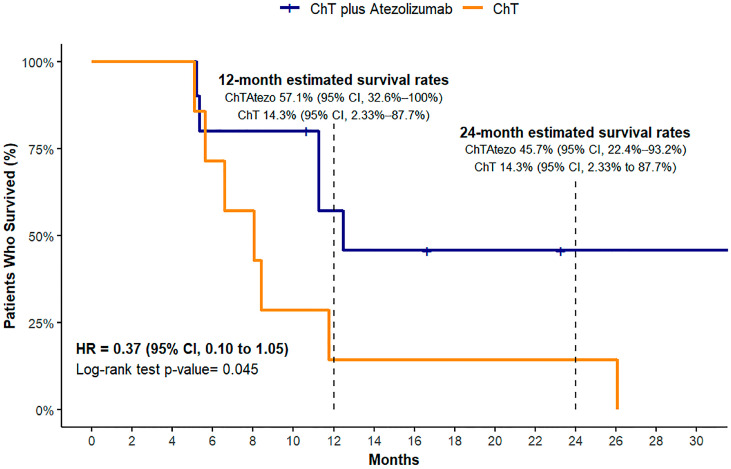
Of the 22 patients screened, 17 met the inclusion criteria and received either atezolizumab plus platinum-based chemotherapy ( = 10) or chemotherapy alone ( = 7). After a median follow-up of 23.3 months, the 12-month survival rate was 57.1% (95% CI: 32.6-100%) and 14.3% (95% CI: 2.33-87.7%) for the atezolizumab and the chemotherapy-only groups, respectively. The survival benefit for the atezolizumab group was sustained at 24 months (45.7% vs. 14.3%). Overall survival was significantly higher for the atezolizumab group, and PFS was non-significantly associated with the addition of atezolizumab (log-rank = 0.04 and 0.05, respectively).
This pilot study suggests that the addition of atezolizumab to standard platinum-based chemotherapy may provide a substantial survival benefit compared with chemotherapy alone in the first-line treatment of metastatic LCNEC.
大细胞神经内分泌癌(LCNEC)因其罕见性和有限的治疗选择而带来了重大的治疗挑战。LANCE研究旨在探索在转移性LCNEC化疗中加入阿替利珠单抗的生存获益。
在这项非随机研究中,前瞻性纳入转移性LCNEC患者,并将其分配接受标准化疗加阿替利珠单抗,随后用阿替利珠单抗维持治疗或仅接受标准化疗。测量的主要结局是两组之间的12个月和24个月生存率、无进展生存期(PFS)和总生存期(OS)。
在筛选的22例患者中,17例符合纳入标准,接受了阿替利珠单抗加铂类化疗(n = 10)或单纯化疗(n = 7)。中位随访23.3个月后,阿替利珠单抗组和单纯化疗组的12个月生存率分别为57.1%(95%CI:32.6 - 100%)和14.3%(95%CI:2.33 - 87.7%)。阿替利珠单抗组的生存获益在24个月时仍持续存在(45.7%对14.3%)。阿替利珠单抗组的总生存期显著更高,PFS与加入阿替利珠单抗无显著相关性(对数秩检验分别为0.04和0.05)。
这项初步研究表明,在转移性LCNEC的一线治疗中,与单纯化疗相比,在标准铂类化疗中加入阿替利珠单抗可能带来显著的生存获益。