School of Public Health, Chongqing Medical University, Chongqing, People's Republic of China.
Department of Thoracic Surgery, Sichuan Clinical Research Center for Cancer, Sichuan Cancer Hospital & Institute, Sichuan Cancer Center, Affiliated Cancer Hospital of the University of Electronic Science and Technology of China, Chengdu, China.
J Cardiothorac Surg. 2024 Jun 27;19(1):398. doi: 10.1186/s13019-024-02845-1.
Symptom assessment based on patient-reported outcome (PRO) can correlate with disease severity, making it a potential tool for threshold alerts of postoperative complications. This study aimed to determine whether shortness of breath (SOB) scores on the day of discharge could predict the development of post-discharge complications in patients who underwent lung cancer surgery.
Patients were from a study of a dynamic perioperative rehabilitation cohort of lung cancer patients focusing on patient-reported outcomes. Patients were assessed using the Perioperative Symptom Assessment Scale for Lung surgery (PSA-Lung). Logistic regression model was used to examine the potential association between SOB on the day of discharge and complications within 3 months after discharge. The post-discharge complications were taken as the anchor variable to determine the optimal cutpoint for SOB on the day of discharge.
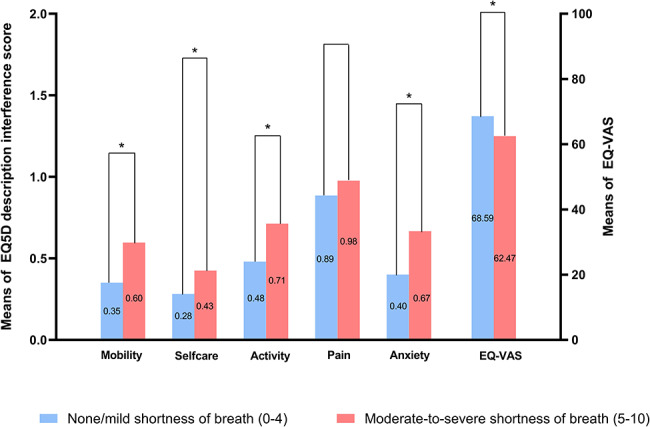
Complications within 3 months post-discharge occurred in 71 (10.84%) of 655 patients. Logistic regression analysis revealed that being female (OR 1.764, 95% CI 1.006-3.092, P < 0.05) and having two chest tubes (OR 2.026, 95% CI 1.107-3.710, P < 0.05) were significantly associated with post-discharge complications. Additionally, the SOB score on the day of discharge (OR 1.125, 95% CI 1.012-1.250, P < 0.05) was a significant predictor. The optimal SOB cutpoint was 5 (on a scale of 0-10). Patients with an SOB score ≥ 5 at discharge experienced a lower quality of life 1 month later compared to those with SOB score<5 at discharge (73 [50-86] vs. 81 [65-91], P < 0.05).
SOB on the day of discharge may serve as an early warning sign for the timely detection of 3 month post-discharge complications.
基于患者报告的结局(PRO)进行症状评估可以与疾病严重程度相关,因此可能成为术后并发症预警的潜在工具。本研究旨在确定肺癌手术后患者出院当天的呼吸困难(SOB)评分是否可以预测出院后并发症的发生。
患者来自一项以患者报告的结局为重点的肺癌患者围手术期动态康复队列研究。使用围手术期肺部症状评估量表(PSA-Lung)对患者进行评估。使用逻辑回归模型来检查出院当天的 SOB 与出院后 3 个月内并发症之间的潜在关联。将出院后的并发症作为锚变量,以确定出院当天 SOB 的最佳切点。
在 655 例患者中,出院后 3 个月内发生并发症的患者有 71 例(10.84%)。逻辑回归分析显示,女性(OR 1.764,95%CI 1.006-3.092,P<0.05)和有两根胸腔引流管(OR 2.026,95%CI 1.107-3.710,P<0.05)与出院后并发症显著相关。此外,出院当天的 SOB 评分(OR 1.125,95%CI 1.012-1.250,P<0.05)也是一个显著的预测因子。SOB 的最佳切点为 5(满分 10 分)。与出院时 SOB 评分<5 的患者相比,出院时 SOB 评分≥5 的患者在 1 个月后生活质量较低(73 [50-86] vs. 81 [65-91],P<0.05)。
出院当天的 SOB 可能是及时发现出院后 3 个月并发症的早期预警信号。