Spychala Kellyn M, Friedman Naomi P, Gizer Ian R
Department of Psychological Sciences, University of Missouri, Columbia, MO 65211.
Institute for Behavioral Genetics, University of Colorado Boulder, Boulder, Colorado.
medRxiv. 2024 Jun 11:2024.06.10.24308620. doi: 10.1101/2024.06.10.24308620.
Executive functioning (EF) has been proposed as a transdiagnostic risk factor for externalizing disorders and behavior more broadly, including attention-deficit/hyperactivity disorder (ADHD), aggression, and alcohol use. Previous research has demonstrated both phenotypic and genetic overlap among these behaviors, but has yet to examine EF as a common causal mechanism. The current study examined reciprocal causal associations between EF and several externalizing behaviors using a Mendelian randomization (MR) approach.
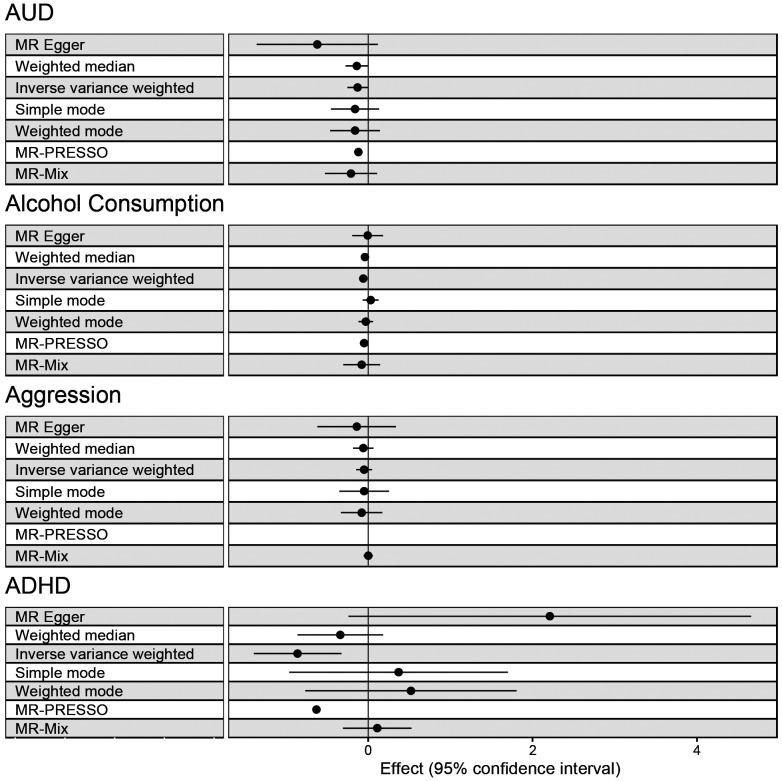
Two-sample MR was conducted to test causal associations between EF and externalizing behaviors. Summary statistics from several genome-wide association studies (GWASs) were used in these analyses, including GWASs of EF, ADHD diagnostic status, drinks per week, aggressive behavior, and alcohol use disorder (AUD) diagnostic status. Multiple estimation methods were employed to account for horizontal pleiotropy (e.g., inverse variance weighted, MR-PRESSO, MR-MIX).
EF demonstrated significant causal relationships with ADHD (P < 0.01), AUD (P < 0.03), and alcohol consumption (P < 0.01) across several estimation methods. Reciprocally, ADHD showed a significant causal influence on EF (P < 0.03). Nonetheless, caution should be used when interpreting these findings as there was some evidence for horizontal pleiotropy in the effect of EF on ADHD and significant heterogeneity in variant effects in the other relations tested. There were no significant findings for aggression.
Findings suggest that EF may be a causal mechanism underlying some externalizing behaviors, including ADHD and alcohol use, and that ADHD may also lead to lower performance on EF tasks.
执行功能(EF)已被提出作为外化障碍及更广泛行为的一种跨诊断风险因素,包括注意力缺陷多动障碍(ADHD)、攻击行为和酒精使用。先前的研究已经证明了这些行为在表型和基因上的重叠,但尚未将执行功能作为一种共同的因果机制进行研究。本研究使用孟德尔随机化(MR)方法检验了执行功能与几种外化行为之间的相互因果关联。
进行两样本孟德尔随机化以测试执行功能与外化行为之间的因果关联。这些分析使用了来自几项全基因组关联研究(GWAS)的汇总统计数据,包括执行功能、ADHD诊断状态、每周饮酒量、攻击行为和酒精使用障碍(AUD)诊断状态的GWAS。采用了多种估计方法来处理水平多效性(例如,逆方差加权、MR-PRESSO、MR-MIX)。
在几种估计方法中,执行功能与ADHD(P < 0.01)、AUD(P < 0.03)和饮酒量(P < 0.01)之间显示出显著的因果关系。反之,ADHD对执行功能也有显著的因果影响(P < 0.03)。然而,在解释这些发现时应谨慎,因为有一些证据表明执行功能对ADHD的影响存在水平多效性,并且在其他测试关系中的变异效应存在显著异质性。攻击行为方面没有显著发现。
研究结果表明,执行功能可能是一些外化行为(包括ADHD和酒精使用)背后的因果机制,并且ADHD也可能导致执行功能任务表现较低。