Li Xin, Paccoud Olivier, Chan Koon-Ho, Yuen Kwok-Yung, Manchon Romain, Lanternier Fanny, Slavin Monica A, van de Veerdonk Frank L, Bicanic Tihana, Lortholary Olivier
Department of Infectious Diseases and Tropical Medicine, Université Paris Cité, Necker-Enfants Malades University Hospital, Assistance Publique-Hôpitaux de Paris, IHU Imagine, Paris, France.
Department of Microbiology, School of Clinical Medicine, Li Ka Shing Faculty of Medicine, The University of Hong Kong, Pokfulam, Hong Kong SAR, China.
Open Forum Infect Dis. 2024 Jun 26;11(7):ofae316. doi: 10.1093/ofid/ofae316. eCollection 2024 Jul.
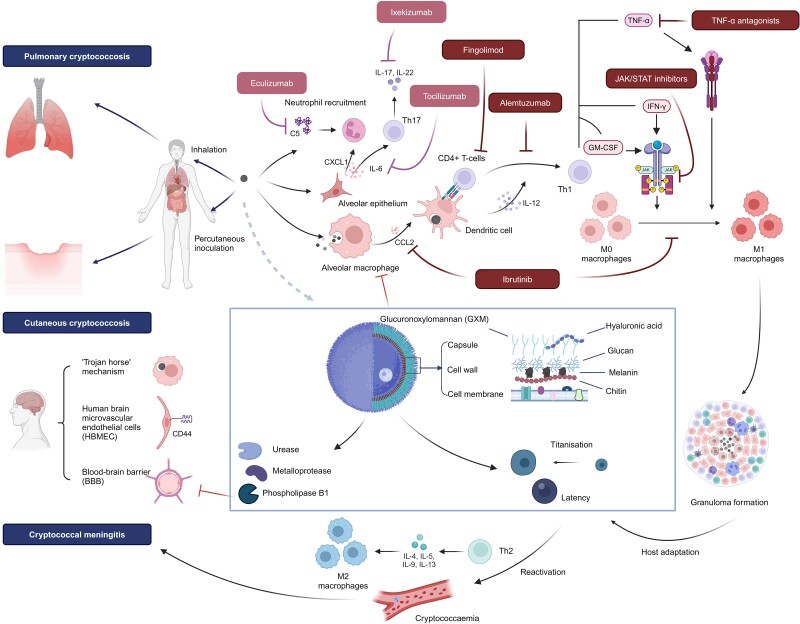
is an opportunistic fungal pathogen that can cause disseminated infection with predominant central nervous system involvement in patients with compromised immunity. Biologics are increasingly used in the treatment of neoplasms and autoimmune/inflammatory conditions and the prevention of transplant rejection, which may affect human defense mechanisms against cryptococcosis. In this review, we comprehensively investigate the association between cryptococcosis and various biologics, highlighting their risks of infection, clinical manifestations, and clinical outcomes. Clinicians should remain vigilant for the risk of cryptococcosis in patients receiving biologics that affect the Th1/macrophage activation pathways, such as tumor necrosis factor α antagonists, Bruton tyrosine kinase inhibitors, fingolimod, JAK/STAT inhibitors (Janus kinase/signal transducer and activator of transcription), and monoclonal antibody against CD52. Other risk factors-such as age, underlying condition, and concurrent immunosuppressants, especially corticosteroids-should also be taken into account during risk stratification.
是一种机会性真菌病原体,可在免疫功能受损的患者中引起播散性感染,并主要累及中枢神经系统。生物制剂越来越多地用于治疗肿瘤、自身免疫/炎症性疾病以及预防移植排斥反应,这可能会影响人体针对隐球菌病的防御机制。在本综述中,我们全面研究了隐球菌病与各种生物制剂之间的关联,重点介绍了它们的感染风险、临床表现和临床结局。临床医生应警惕接受影响Th1/巨噬细胞激活途径的生物制剂的患者发生隐球菌病的风险,如肿瘤坏死因子α拮抗剂、布鲁顿酪氨酸激酶抑制剂、芬戈莫德、JAK/STAT抑制剂(Janus激酶/信号转导和转录激活因子)以及抗CD52单克隆抗体。在进行风险分层时,还应考虑其他风险因素,如年龄、基础疾病和同时使用的免疫抑制剂,尤其是皮质类固醇。