Lu Lingmei, Ni Wenyu, Liu Yin, Sun Li, Li Fei
Department of Neurology, Qidong People's Hospital/Affiliated Qidong Hospital of Nantong University, Nantong, China.
Department of Endocrinology, Qidong People's Hospital/Affiliated Qidong Hospital of Nantong University, Nantong, China.
Front Neurol. 2024 Jun 14;15:1419372. doi: 10.3389/fneur.2024.1419372. eCollection 2024.
Vestibular migraine (VM), an intricate subtype of migraine, amalgamates the dual attributes of migraine and vestibular disorders. In clinical settings, individuals with VM frequently articulate concerns regarding the manifestation of subjective cognitive impairment. This cognitive dysfunction is intricately linked with diminished mobility, heightened susceptibility to falls, and increased absenteeism in afflicted patients. Consequently, comprehending the features of cognitive impairment in VM patients holds potential clinical significance. The pursuit of rapid and objective methods for detection and assessment is foundational and prerequisite for efficacious cognitive management of VM patients.
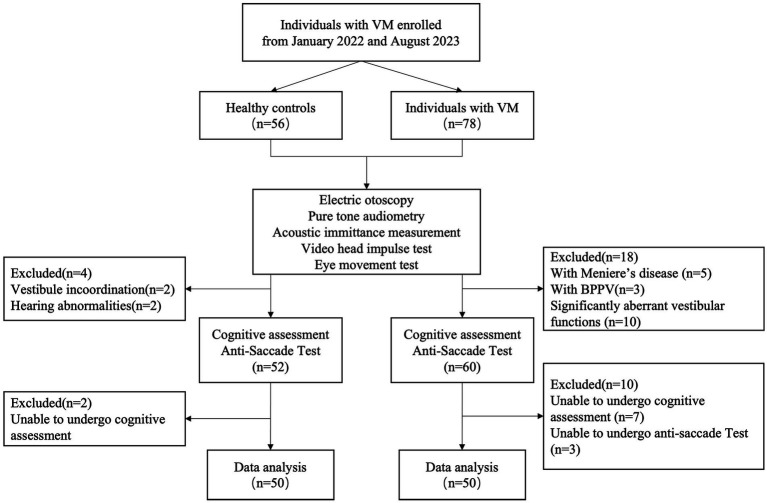
The study encompassed 50 patients diagnosed with vestibular migraine and recruited 50 age-sex matched healthy controls. All participants underwent anti-saccade tasks, and cognitive evaluation was performed using the MMSE and MoCA to assess overall cognitive function. Additionally, RBANS scales were employed to measure specific cognitive domains.
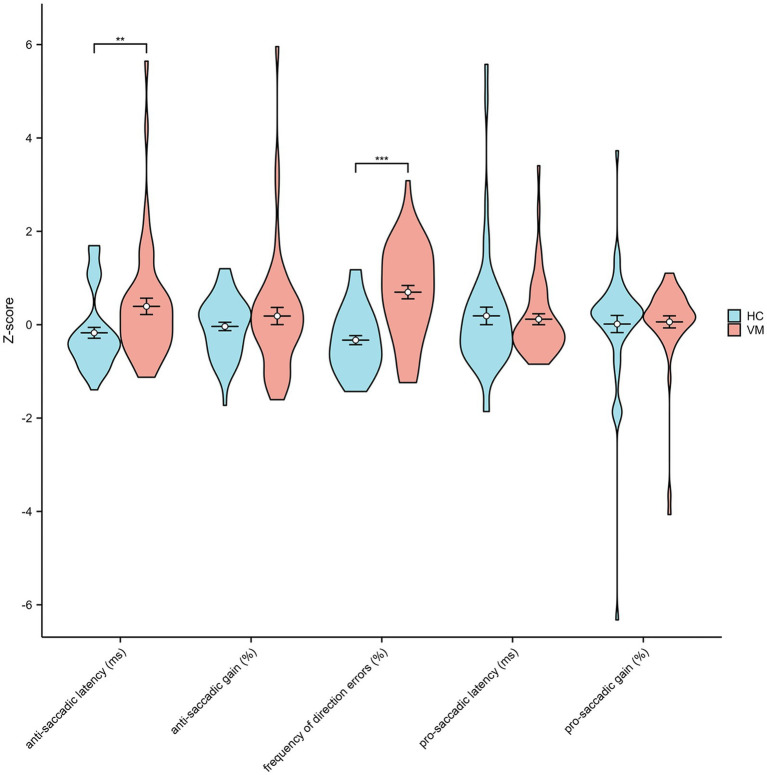
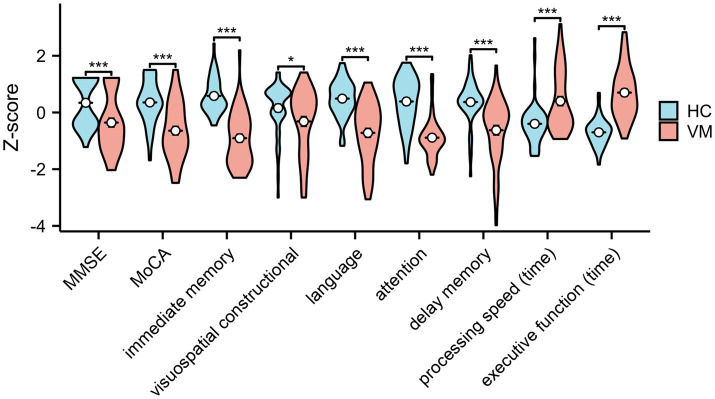
The VM patients and normal controls demonstrated statistical parity in terms of age, gender, education, weight, and BMI, with no significant differences observed. Analysis of cognitive scores divulged a marked increase in the incidence of Mild Cognitive Impairment (MCI) in VM patients compared to Healthy Controls (HCs). Both MMSE and MoCA scores were notably lower in VM patients compared to their healthy counterparts. The RBANS cognitive test indicated significant impairment in immediate memory, visuospatial construction, language, attention, and delayed memory among VM patients. Notably, the Trail Making Test and Stroop Color-Word Test revealed compromised processing speed and executive function cognitive domains. The anti-saccadic task highlighted significantly elevated anti-saccadic latency and frequency of direction errors in vestibular migraine patients. Symptom severity, illness duration, and episode frequency in VM patients positively correlated with counter-scanning errors and negatively correlated with cognitive performance across diverse cognitive domains.
VM patients exhibit cognitive decline across multiple cognitive domains during the interictal period. This cognitive impairment may not be fully reversible, underscoring its potential clinical significance for cognitive management in VM patients. The sensitivity of anti-saccade tasks to the cognitive status of VM patients positions them as promising objective indicators for diagnosis, intervention, and evaluation of cognitive impairment effects in VM in future applications.
前庭性偏头痛(VM)是偏头痛的一种复杂亚型,融合了偏头痛和前庭疾病的双重特征。在临床环境中,VM患者经常表达对主观认知障碍表现的担忧。这种认知功能障碍与行动能力下降、跌倒易感性增加以及患病患者旷工率上升密切相关。因此,了解VM患者认知障碍的特征具有潜在的临床意义。寻求快速、客观的检测和评估方法是对VM患者进行有效认知管理的基础和前提。
该研究纳入了50名被诊断为前庭性偏头痛的患者,并招募了50名年龄和性别匹配的健康对照者。所有参与者都进行了反扫视任务,并使用简易精神状态检查表(MMSE)和蒙特利尔认知评估量表(MoCA)进行认知评估,以评估整体认知功能。此外,使用重复成套神经心理状态测验(RBANS)量表来测量特定的认知领域。
VM患者和正常对照者在年龄、性别、教育程度、体重和体重指数方面具有统计学上的可比性,未观察到显著差异。对认知分数的分析表明,与健康对照者(HCs)相比,VM患者中轻度认知障碍(MCI)的发生率显著增加。VM患者的MMSE和MoCA分数均明显低于其健康对照者。RBANS认知测试表明,VM患者在即时记忆、视觉空间构建、语言、注意力和延迟记忆方面存在显著障碍。值得注意的是,连线测验和斯特鲁普颜色-文字测验显示处理速度和执行功能认知领域受损。反扫视任务突出显示前庭性偏头痛患者的反扫视潜伏期和方向错误频率显著升高。VM患者的症状严重程度、病程和发作频率与反向扫视错误呈正相关,与不同认知领域的认知表现呈负相关。
VM患者在发作间期多个认知领域存在认知衰退。这种认知障碍可能无法完全逆转,凸显了其对VM患者认知管理的潜在临床意义。反扫视任务对VM患者认知状态的敏感性使其成为未来应用中诊断、干预和评估VM认知障碍影响的有前景的客观指标。