Nurjadi Dennis, Chalin Arnaud, Hauswaldt Susanne, Olson Linus, Larsson Mattias, Östholm Åse, Velavan Thirumalaisamy P, Boutin Sébastien, Rupp Jan, Nilsson Lennart E, Hanberger Håkan
Department of Infectious Diseases and Microbiology, University of Lübeck and University Hospital Schleswig-Holstein Campus Lübeck, Ratzeburger Allee 160, 23562 Lübeck, Germany.
German Center for Infection Research (DZIF), Partner Site Hamburg-Lübeck-Borstel-Riems, Lübeck, Germany.
JAC Antimicrob Resist. 2024 Jul 3;6(4):dlae103. doi: 10.1093/jacamr/dlae103. eCollection 2024 Aug.
The rise of extended-spectrum β-lactamase-producing Enterobacterales (ESBL-E) in low- and middle-income countries limits treatment options, leading to the frequent use of broad-spectrum antibiotics. Reducing time-to-result for a urinary infection can facilitate correct antibiotic treatment and support antimicrobial and diagnostic stewardship measures. This study compared two simplified enrichment methods for detecting CTX-M directly from urine specimens.
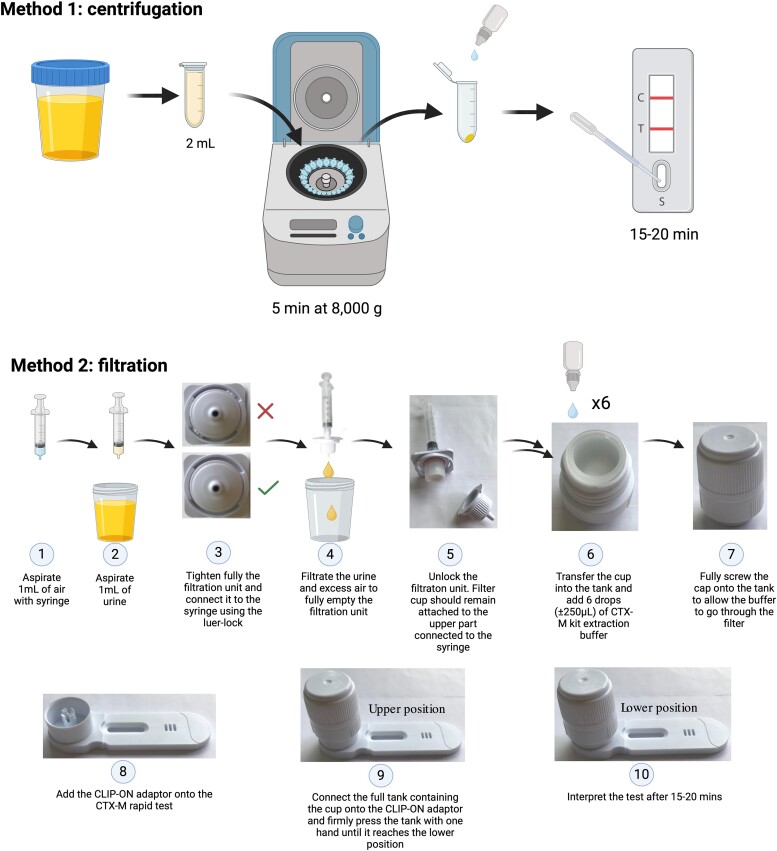
Two enrichment methods, namely centrifugation of 2 mL urine and filtration of 1 mL urine using the DirecTool adaptor, were compared using 20 culture-positive urine samples (20 suspected ESBL-E and 20 non-ESBL-E). CTX-M production was detected using a lateral flow assay (LFA), NG-Test CTX-MMULTI. The presence of genes was confirmed by whole-genome sequencing (WGS).
The results of both enrichment methods were identical, with a sensitivity of 87.5% and a specificity of 100%. In 19/20 (95%) of the urine samples, the results of the CTX-M LFA were identical with the phenotypic confirmation and WGS. Both methods could detect ESBL-E bacteriuria with ≥10 cfu/mL. All ESBL-E-negative samples were identified accurately. Both enrichment methods yielded negative results in one ESBL-E-positive (CTX-M-15) sample despite phenotypic and genotypic confirmation of ESBL production. High leukocyte count (>500 cells/µL), the presence of boric acid or polymicrobial samples did not appear to impact the performance of both enrichment methods.
Our study underscores the feasibility of directly detecting CTX-M in urine. Simplified enrichment methods, particularly with a filtration kit, enhance the assay's practicality, rendering it suitable for use in primary care, emergency departments or remote laboratories without sophisticated equipment.
在低收入和中等收入国家,产超广谱β-内酰胺酶肠杆菌科细菌(ESBL-E)的出现限制了治疗选择,导致广谱抗生素的频繁使用。缩短尿路感染的结果报告时间有助于正确的抗生素治疗,并支持抗菌和诊断管理措施。本研究比较了两种从尿液标本中直接检测CTX-M的简化富集方法。
使用20份培养阳性尿液样本(20份疑似ESBL-E和20份非ESBL-E)比较了两种富集方法,即2 mL尿液离心法和使用DirecTool适配器对1 mL尿液进行过滤法。使用侧向流动分析法(LFA)NG-Test CTX-M MULTI检测CTX-M的产生。通过全基因组测序(WGS)确认基因的存在。
两种富集方法的结果相同,灵敏度为87.5%,特异性为100%。在19/20(95%)的尿液样本中,CTX-M LFA的结果与表型确认和WGS一致。两种方法均可检测到≥10 cfu/mL的ESBL-E菌尿。所有ESBL-E阴性样本均被准确鉴定。尽管对ESBL产生进行了表型和基因型确认,但两种富集方法在一份ESBL-E阳性(CTX-M-15)样本中均得出阴性结果。高白细胞计数(>500个细胞/µL)、硼酸的存在或混合菌样本似乎均未影响两种富集方法的性能。
我们的研究强调了直接在尿液中检测CTX-M的可行性。简化的富集方法,特别是使用过滤试剂盒,提高了检测的实用性,使其适用于没有复杂设备的基层医疗、急诊科或远程实验室。