Department of Nephrology, Beijing Hospital, National Center of Gerontology, Institute of Geriatric Medicine, Chinese Academy of Medical Sciences, Beijing, People's Republic of China.
Department of Laboratory Medicine, Beijing Hospital, National Center of Gerontology; Institute of Geriatric Medicine, Chinese Academy of Medical Sciences, Beijing, People's Republic of China.
Clin Interv Aging. 2024 Jul 3;19:1217-1224. doi: 10.2147/CIA.S450388. eCollection 2024.
This study aims to investigate GFR decline in elderly subjects with varying physical conditions and analyze key risk factors impacting renal function changes.
We obtained data from patients between 2017 and 2019, and matched healthy elderly subjects based on gender and age. Data collected for all subjects included annual measurements of fast blood glucose (GLU), glycated hemoglobin (HbA1c), low-density lipoprotein cholesterol (LDL-c), blood albumin (ALB), blood uric acid (UA), urine protein (UP), and systolic blood pressure (SBP). Additionally, information on coexisting diseases was gathered. The Full Age Spectrum (FAS) equation was used to calculate eGFR.
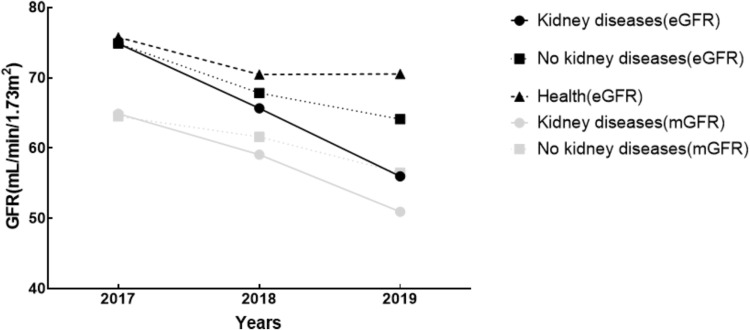
A total of 162 patients with complete 3-year renal dynamic imaging were included, including 84 patients in the kidney disease group (K group) and 78 patients in the non-kidney disease group (NK group). Ninety individuals were selected as the healthy group (H group). The annual decline rate in the K group was the fastest, which exceeded 5mL/min/1.73m ( < 0.05). Group (K group: β=-40.31, P<0.001; NK group: β=-26.96, P<0.001), ALB (β=-0.38, P=0.038) and HbA1c (β=1.36, P=0.029) had a significant negative impact on the eGFR changes. For participants who had negative proteinuria: K group had the most significant annual eGFR decline.
The presence of kidney disease, along with proteinuria nor not, can lead to a marked acceleration in kidney function decline in elderly. We categorize elderly individuals with an annual eGFR decline of more than 5 mL/min/1.73m as the "kidney accelerated aging" population.
本研究旨在探讨不同身体状况的老年患者的肾小球滤过率(GFR)下降情况,并分析影响肾功能变化的关键风险因素。
我们获取了 2017 年至 2019 年期间的患者数据,并根据性别和年龄与健康老年受试者进行匹配。所有受试者的数据包括每年的快速血糖(GLU)、糖化血红蛋白(HbA1c)、低密度脂蛋白胆固醇(LDL-c)、血白蛋白(ALB)、血尿酸(UA)、尿蛋白(UP)和收缩压(SBP)的测量值。此外,还收集了并存疾病的信息。使用全年龄谱(FAS)方程计算 eGFR。
共纳入 162 例完整的 3 年肾动态成像患者,其中肾病组(K 组)84 例,非肾病组(NK 组)78 例。90 例作为健康组(H 组)。K 组的年下降率最快,超过 5mL/min/1.73m(<0.05)。组(K 组:β=-40.31,P<0.001;NK 组:β=-26.96,P<0.001)、ALB(β=-0.38,P=0.038)和 HbA1c(β=1.36,P=0.029)对 eGFR 变化有显著的负向影响。对于蛋白尿阴性的患者:K 组的 eGFR 年下降幅度最大。
无论是否存在蛋白尿,肾病的存在都会导致老年患者肾功能明显加速下降。我们将每年 eGFR 下降超过 5mL/min/1.73m 的老年患者归类为“肾脏加速老化”人群。