Gershater Bernard, Bieber Katja, Vorobyev Artem, Ludwig Marlene A, Zirpel Henner, De Luca David A, Thaci Diamant, Kridin Khalaf, Ludwig Ralf J
Lübeck Institute of Experimental Dermatology, University of Lübeck, Lübeck, Germany.
Department of Dermatology, University Hospital Schleswig-Holstein Lübeck, Lübeck, Germany.
Front Med (Lausanne). 2024 Jun 21;11:1385491. doi: 10.3389/fmed.2024.1385491. eCollection 2024.
This study investigated psoriatic arthritis (PsA) risk across varied psoriasis manifestations, considering sex and ethnicity.
Using TriNetX, a federated database encompassing over 120 million electronic health records (EHRs), we performed global retrospective cohort studies. Psoriasis vulgaris (Pso), pustulosis palmoplantaris (PPP), and generalized pustular psoriasis (GPP) cohorts were retrieved using ICD-10 codes. Propensity score matching, incorporating age, sex, and ethnicity, was employed. An alternative propensity matching model additionally included established PsA risk factors.
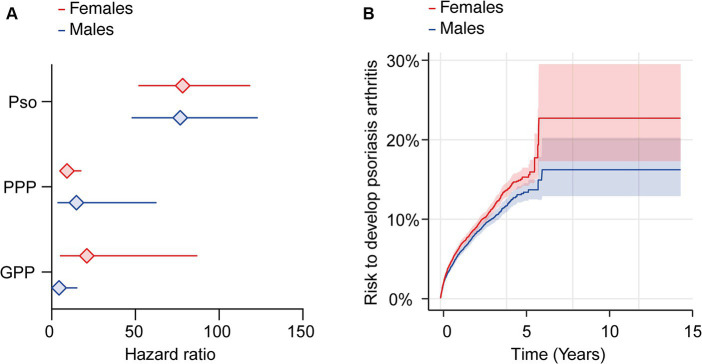
We retrieved data from 486 (Black or African American-stratified, GPP) to 35,281 (Pso) EHRs from the US Collaborative Network. Significant PsA risk variations emerged: Pso carried the highest risk [hazard ratio (HR) 87.7, confidence interval (CI) 63.4-121.1, < 0.001], followed by GPP (HR 26.8, CI 6.5-110.1, < 0.0001), and PPP (HR 15.3, CI 7.9-29.5, < 0.0001). Moreover, we identified significant sex- and ethnicity-specific disparities in PsA development. For instance, compared to male Pso patients, female Pso patients had an elevated PsA risk (HR 1.1, CI 1.1-1.2, = 0.002). Furthermore, White Pso patients had a higher likelihood of developing PsA compared to their Black or African American counterparts (HR 1.3, CI 1.04-1.7, = 0.0244). We validated key findings using alternative propensity matching strategies and independent databases.
This study delineates nuanced PsA risk profiles across psoriasis forms, highlighting the pivotal roles of sex and ethnicity. Integrating these factors into PsA risk assessments enables tailored monitoring and interventions, potentially impacting psoriasis patient care quality.
本研究调查了不同银屑病表现形式下的银屑病关节炎(PsA)风险,并考虑了性别和种族因素。
利用TriNetX(一个包含超过1.2亿份电子健康记录(EHR)的联合数据库),我们开展了全球回顾性队列研究。使用国际疾病分类第十版(ICD - 10)编码检索寻常型银屑病(Pso)、掌跖脓疱病(PPP)和泛发性脓疱型银屑病(GPP)队列。采用倾向得分匹配法,纳入年龄、性别和种族因素。另一种倾向匹配模型还纳入了已确定的PsA风险因素。
我们从美国协作网络中检索到486份(按黑人或非裔美国人分层,GPP)至35281份(Pso)EHR数据。出现了显著的PsA风险差异:Pso的风险最高[风险比(HR)87.7,置信区间(CI)63.4 - 121.1,P < 0.001],其次是GPP(HR 26.8,CI 6.5 - 110.1,P < 0.0001),以及PPP(HR 15.3,CI 7.9 - 29.5,P < 0.0001)。此外,我们还发现了PsA发病中显著的性别和种族差异。例如,与男性Pso患者相比,女性Pso患者患PsA的风险更高(HR 1.1,CI 1.1 - 1.2,P = 0.002)。此外,与黑人或非裔美国人相比,白人Pso患者患PsA的可能性更高(HR 1.3,CI 1.04 - 1.7,P = 0.0244)。我们使用替代倾向匹配策略和独立数据库验证了关键发现。
本研究描绘了不同银屑病形式下细微的PsA风险特征,突出了性别和种族的关键作用。将这些因素纳入PsA风险评估可实现针对性的监测和干预,可能影响银屑病患者的护理质量。