Wu Lili, Li Zhihui, Gao Na, Deng Hong, Zhao Qiyi, Hu Zhaoxia, Chen Junfeng, Lei Ziying, Zhao Jinhua, Lin Bingliang, Gao Zhiliang
Department of Infectious Diseases, the Third Affiliated Hospital of Sun Yat-sen University, Guangzhou, China.
Guangdong Provincial Key Laboratory of Liver Disease Research, the Third Affiliated Hospital of Sun Yat-sen University, Guangzhou, China.
Heliyon. 2024 Jun 11;10(12):e32730. doi: 10.1016/j.heliyon.2024.e32730. eCollection 2024 Jun 30.
The correlation between metabolic syndrome (MetS) and hepatitis B surface antigen (HBsAg) loss remains to be further elucidated, particularly in patients receiving pegylated interferon-α (PEG-IFN) treatment.
758 patients with low HBsAg quantification who had received nucleos(t)ide analog (NUC) therapy for at least one year and subsequently switched to or add on PEG-IFN therapy over an unfixed course were enrolled. 412 patients were obtained with baseline data matched. A total of 206 patients achieved HBsAg loss (cured group) within 48 weeks. Demographic and biochemical data associated with MetS were gathered for analysis. HepG2.2.15 cell line was used in vitro experiments to validate the efficacy of interferon-α (IFN-α).
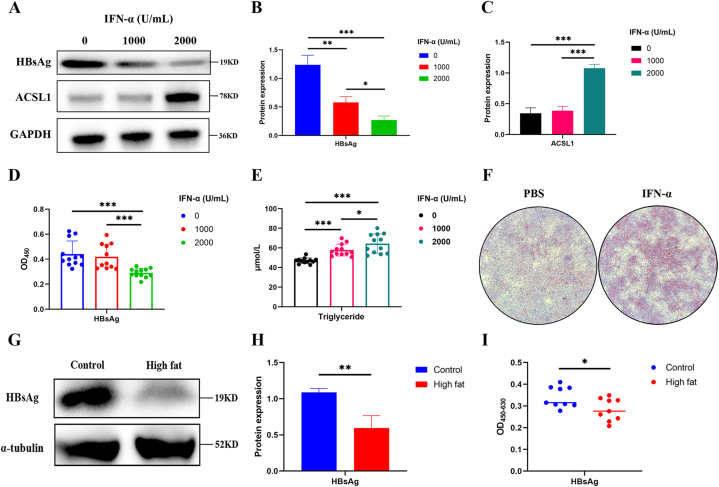
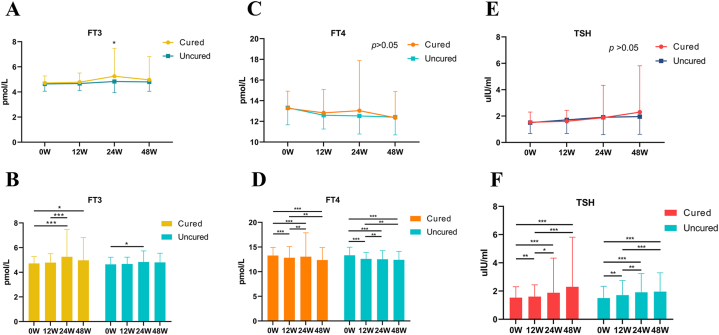
The proportion of patients with diabetes or hypertension in the uncured group was significantly higher than in the cured group. The levels of fasting blood glucose (FBG) and glycated albumin remained elevated in the uncured group over the 48 weeks. In contrast, the levels of blood lipids and uric acid remained higher in the cured group within 48 weeks. Triglycerides levels and liver steatosis of all patients increased after PEG-IFN therapy. Baseline elevated uric acid levels and hepatic steatosis may be beneficial for HBsAg loss. IFN-α could induce hepatic steatosis and indirectly promote HBsAg loss by increasing triglyceride level through upregulation of acyl-CoA synthetase long-chain family member 1(ACSL1).
IFN-α could induce liver steatosis to promote HBsAg loss by increasing triglyceride level through upregulation of ACSL1. Comorbid diabetes may be detrimental to obtaining HBsAg loss with PEG-IFN therapy in CHB patients.
代谢综合征(MetS)与乙肝表面抗原(HBsAg)消失之间的相关性仍有待进一步阐明,尤其是在接受聚乙二醇化干扰素-α(PEG-IFN)治疗的患者中。
纳入758例低HBsAg定量患者,这些患者接受核苷(酸)类似物(NUC)治疗至少1年,随后在不固定疗程中改用或加用PEG-IFN治疗。获得412例匹配基线数据的患者。共有206例患者在48周内实现HBsAg消失(治愈组)。收集与MetS相关的人口统计学和生化数据进行分析。使用HepG2.2.15细胞系进行体外实验,以验证干扰素-α(IFN-α)的疗效。
未治愈组中糖尿病或高血压患者的比例显著高于治愈组。在48周内,未治愈组的空腹血糖(FBG)和糖化白蛋白水平持续升高。相比之下,治愈组在48周内血脂和尿酸水平持续较高。PEG-IFN治疗后所有患者的甘油三酯水平和肝脏脂肪变性均增加。基线尿酸水平升高和肝脏脂肪变性可能有利于HBsAg消失。IFN-α可诱导肝脏脂肪变性,并通过上调酰基辅酶A合成酶长链家族成员1(ACSL1)增加甘油三酯水平,间接促进HBsAg消失。
IFN-α可通过上调ACSL1增加甘油三酯水平,诱导肝脏脂肪变性以促进HBsAg消失。合并糖尿病可能不利于慢性乙型肝炎患者通过PEG-IFN治疗实现HBsAg消失。