Department of Psychiatry, The Affiliated Brain Hospital of Nanjing Medical University, Nanjing, 210029, China.
School of Systems Biology, George Mason University, Fairfax, 22030, USA.
BMC Psychiatry. 2024 Jul 8;24(1):493. doi: 10.1186/s12888-024-05942-6.
Existing evidence suggests that alterations in the gut microbiome are closely associated with major depressive disorder (MDD). We aimed to reveal the causal relationships between MDD and various microbial taxa in the gut.
We used the two-sample Mendelian randomization (TSMR) to explore the bidirectional causal effects between gut microbiota and MDD. The genome-wide association studies summary results of gut microbiota were obtained from two large consortia, the MibioGen consortium and the Dutch Microbiome Project, which we analyzed separately.
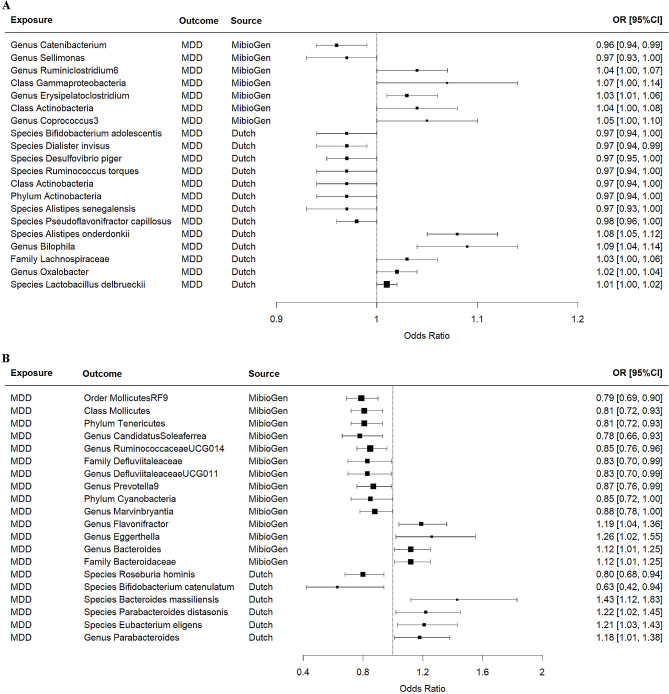
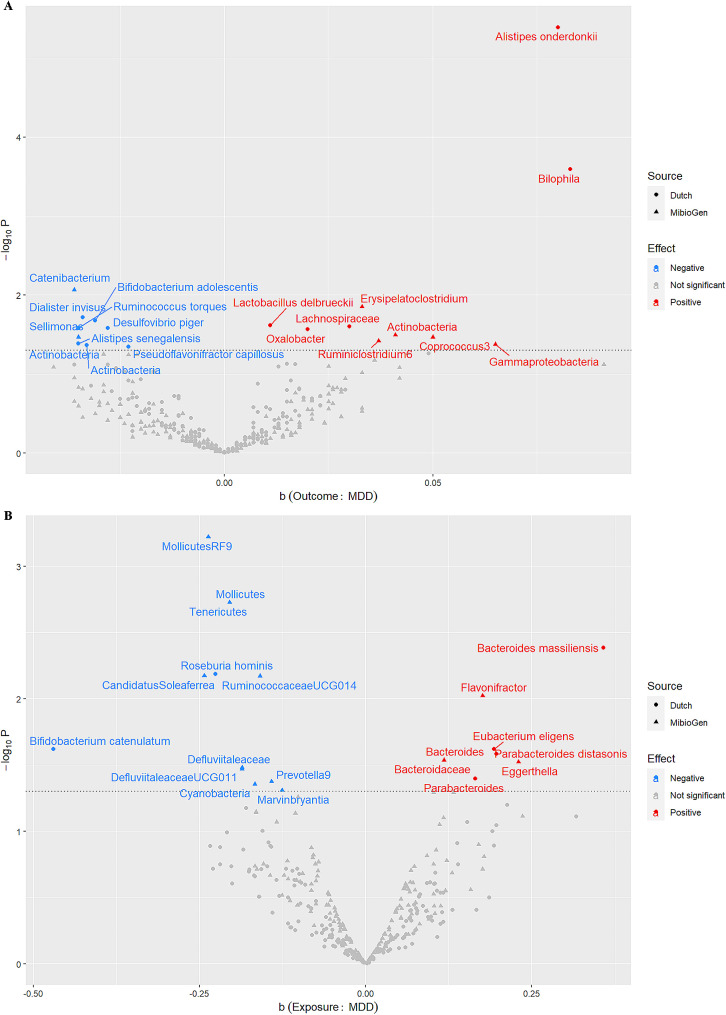
Our TSMR analysis identified 10 gut bacterial taxa that were protective against MDD, including phylum Actinobacteria, order Clostridiales, and family Bifidobacteriaceae (OR: 0.96 ∼ 0.98). Ten taxa were associated with an increased risk of MDD, including phyla Firmicutes and Proteobacteria, class Actinobacteria, and genus Alistipes (OR: 1.01 ∼ 1.09). On the other hand, MDD may decrease the abundance of 12 taxa, including phyla Actinobacteria and Firmicutes, families Bifidobacteriaceae and Defluviitaleaceae (OR: 0.63 ∼ 0.88). MDD may increase the abundance of 8 taxa, including phylum Bacteroidetes, genera Parabacteroides, and Bacteroides (OR: 1.12 ∼ 1.43).
Our study supports that there are mutual causal relationships between certain gut microbiota and the development of MDD suggesting that gut microbiota may be targeted in the treatment of MDD.
现有证据表明,肠道微生物组的改变与重度抑郁症(MDD)密切相关。我们旨在揭示 MDD 与肠道中各种微生物类群之间的因果关系。
我们使用两样本孟德尔随机化(TSMR)来探索肠道微生物群与 MDD 之间的双向因果关系。我们分别分析了两个大型联盟(MibioGen 联盟和荷兰微生物组计划)的肠道微生物组全基因组关联研究汇总结果。
我们的 TSMR 分析确定了 10 种对 MDD 具有保护作用的肠道细菌类群,包括门放线菌、目梭状芽孢杆菌和双歧杆菌科(OR:0.960.98)。有 10 种与 MDD 风险增加相关,包括门厚壁菌门和变形菌门、纲放线菌和属 Alistipes(OR:1.011.09)。另一方面,MDD 可能会降低 12 种细菌类群的丰度,包括门放线菌和厚壁菌门、双歧杆菌科和 Defluviitaleaceae 科(OR:0.630.88)。MDD 可能会增加 8 种细菌类群的丰度,包括门拟杆菌门、属 Parabacteroides 和 Bacteroides(OR:1.121.43)。
我们的研究支持某些肠道微生物群与 MDD 发展之间存在相互因果关系,这表明肠道微生物群可能是 MDD 治疗的靶点。