Kuan Garry, Sut Txi Mon Redee, Mat Salleh Fatin Nurfatehah, Wong Keng Yinn, Tan Huiyi, Kueh Yee Cheng
Exercise and Sports Science Programme, School of Health Science, Universiti Sains Malaysia, Kelantan, Malaysia.
Brain and Behaviour Cluster, School of Medical Sciences, Universiti Sains Malaysia, Kelantan, Malaysia.
Malays J Med Sci. 2024 Jun;31(3):241-251. doi: 10.21315/mjms2024.31.3.19. Epub 2024 Jun 27.
In the world of sports, motivation is an essential concept that can affect the sporting performance of athletes and help them accomplish their goals. The coach is regarded as an important individual with the ability to significantly influence the athlete's motivation. To assess the impact of the coach-athlete relationship on motivation, the objective of this study was to evaluate the psychometric properties of the Malay version of the Coach-Athlete Relationship Questionnaire (CART-Q) for coaches and athletes.
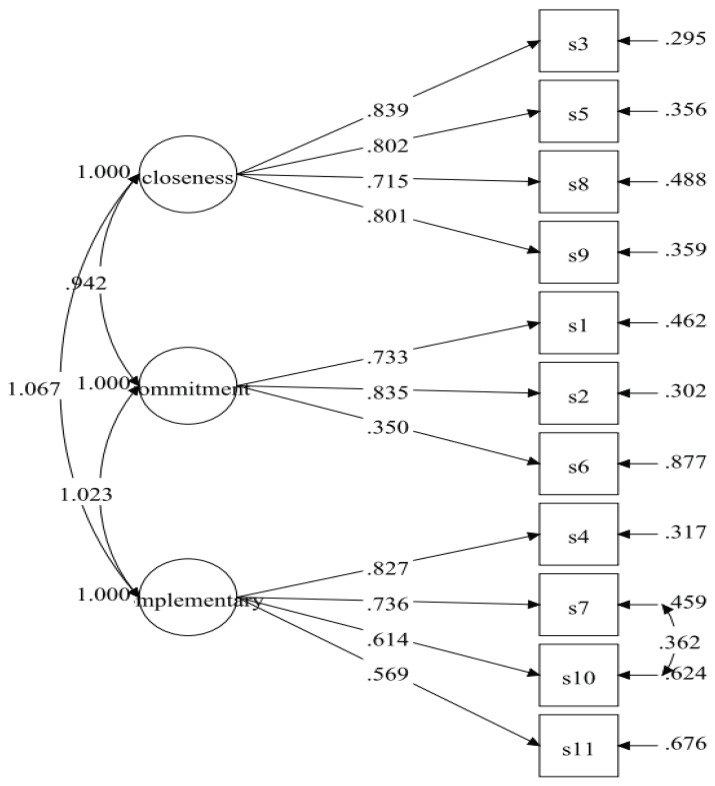
A cross-sectional survey was conducted among the coaches and athletes in Malaysia. Data were collected using a convenience sampling approach over a 6-month period. The study was carried out in two phases using two independent samples of coaches and athletes to assess the construct validity and internal consistency of the Malay version of the CART-Q. The CART-Q consisted of 11 items measuring three constructs: i) closeness (four items), ii) commitment (three items) and iii) complementarity (four items). In phase 1, the subjects consisted of 211 coaches (21 years old-65 years old) from both sexes and from individual and team sports, ranging from levels 1 to 5. In phase 2, the subjects consisted of 362 athletes (12 years old-39 years old), also from both sexes and from individual and team sports. The statistical analyses performed included confirmatory factor analysis (CFA) to validate the translated version scale, composite reliability (CR), average variance extracted (AVE) and internal consistency (Cronbach's alpha).
In phase 1, the sample of coaches, with 190 males (90.0%) and 21 females (10.0%), had a mean age of 38.6 (SD = 8.74) years old. The major sport type was archery (19.0%). The CFA revealed adequate fit indices with all 11 items retained (root mean square error of approximation [RMSEA] = 0.059, comparative fit index [CFI] = 0.964, Tucker and Lewis Index [TLI] = 0.950, standardised root mean square residual [SRMR] = 0.037). The CR values were closeness = 0.874, commitment = 0.566 and complementarity = 0.757. The AVE values were closeness = 0.357, commitment = 0.194 and complementarity = 0.275. The Cronbach's alpha values were closeness = 0.867, commitment = 0.553 and complementarity = 0.794. In phase 2, the sample of athletes, with 175 males (48.1%) and 189 females (51.9%), had a mean age of 20.2 (SD = 3.35) years old. The major sport type was archery (11.5%). The CFA revealed satisfactory fit indices with all 11 items retained (RMSEA = 0.092, CFI = 0.948, TLI = 0.924, SRMR =.038). The CR values were closeness = 0.893, commitment = 0.786 and complementarity = 0.949. The AVE values were closeness = 0.401, commitment = 0.253 and complementarity = 0.418. The Cronbach's alpha values were closeness = 0.900, commitment = 0.772 and complementarity = 0.900.
Overall, the study findings supported the conclusion that the Malay version of the CART-Q has adequate psychometric properties to assess the perceptions of coaches and athletes regarding their relationship.

在体育界,动机是一个至关重要的概念,它会影响运动员的运动表现,并帮助他们实现目标。教练被视为能够显著影响运动员动机的重要人物。为了评估教练与运动员关系对动机的影响,本研究的目的是评估马来语版教练-运动员关系问卷(CART-Q)对教练和运动员的心理测量特性。
在马来西亚的教练和运动员中进行了一项横断面调查。采用便利抽样方法,在6个月的时间内收集数据。该研究分两个阶段进行,使用教练和运动员的两个独立样本,以评估马来语版CART-Q的结构效度和内部一致性。CART-Q由11个项目组成,测量三个结构:i)亲密性(4个项目),ii)承诺(3个项目)和iii)互补性(4个项目)。在第一阶段,受试者包括211名教练(年龄在21岁至65岁之间),男女皆有,来自个人和团体运动项目,级别从1到5。在第二阶段,受试者包括362名运动员(年龄在12岁至39岁之间),同样男女皆有,来自个人和团体运动项目。进行的统计分析包括验证性因子分析(CFA)以验证翻译版本量表、组合信度(CR)、平均方差提取(AVE)和内部一致性(克朗巴哈系数)。
在第一阶段,教练样本中,男性190名(90.0%),女性21名(10.0%),平均年龄为38.6(标准差 = 8.74)岁。主要运动项目类型是射箭(19.0%)。CFA显示,保留所有11个项目时,拟合指数良好(近似均方根误差[RMSEA] = 0.059,比较拟合指数[CFI] = 0.964,塔克和刘易斯指数[TLI] = 0.950,标准化均方根残差[SRMR] = 0.037)。CR值分别为亲密性 = 0.874,承诺 = 0.566,互补性 = 0.757。AVE值分别为亲密性 = 0.357,承诺 = 0.194,互补性 = 0.275。克朗巴哈系数值分别为亲密性 = 0.867,承诺 = 0.553,互补性 = 0.794。在第二阶段,运动员样本中,男性175名(48.1%),女性189名(51.9%),平均年龄为20.2(标准差 = 3.35)岁。主要运动项目类型是射箭(11.5%)。CFA显示,保留所有11个项目时,拟合指数令人满意(RMSEA = 0.092,CFI = 0.948,TLI = 0.924, SRMR = 0.038)。CR值分别为亲密性 = 0.893,承诺 = 0.786,互补性 = 0.949。AVE值分别为亲密性 = 0.401,承诺 = 0.253,互补性 = 0.418。克朗巴哈系数值分别为亲密性 = 0.900,承诺 = 0.772,互补性 = 0.900。
总体而言,研究结果支持以下结论:马来语版CART-Q具有足够的心理测量特性,可用于评估教练和运动员对他们之间关系的看法。