Donders Institute for Brain, Cognition and Behaviour, Radboud University, Nijmegen, Netherlands.
MRC Cognition and Brain Sciences Unit, University of Cambridge, Cambridge, UK.
Nat Commun. 2024 Jul 10;15(1):5780. doi: 10.1038/s41467-024-48855-4.
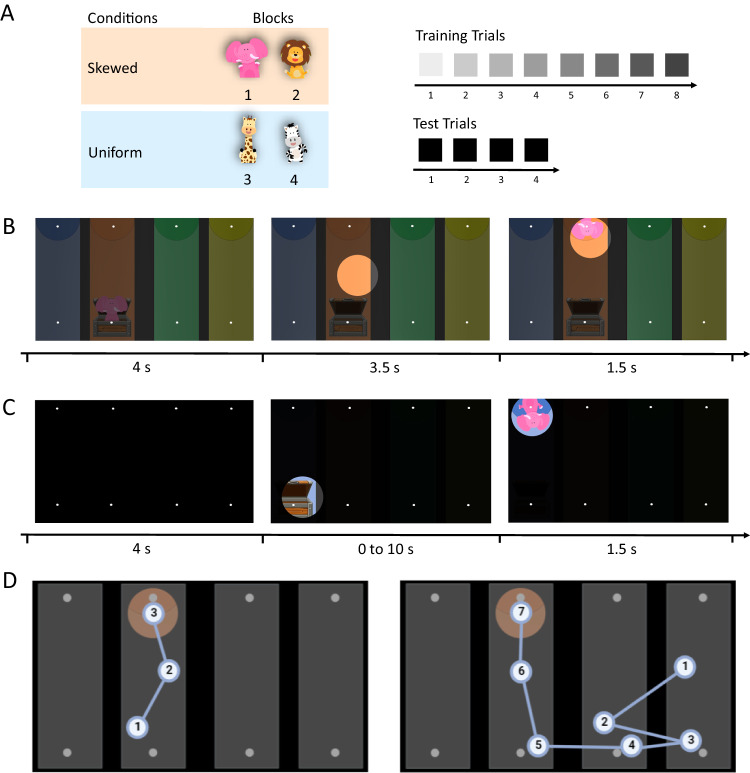
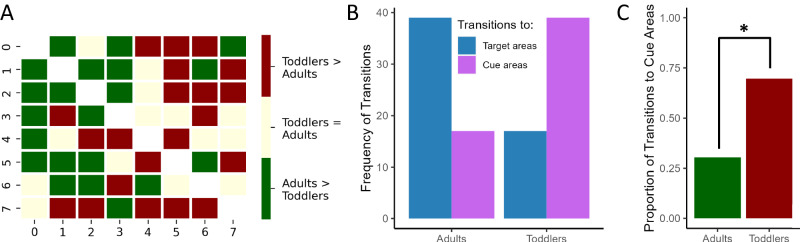
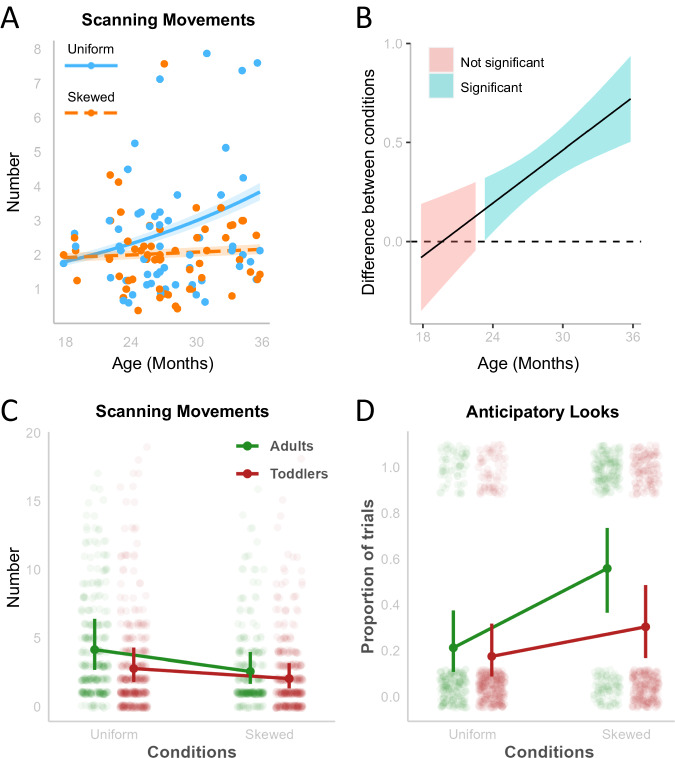
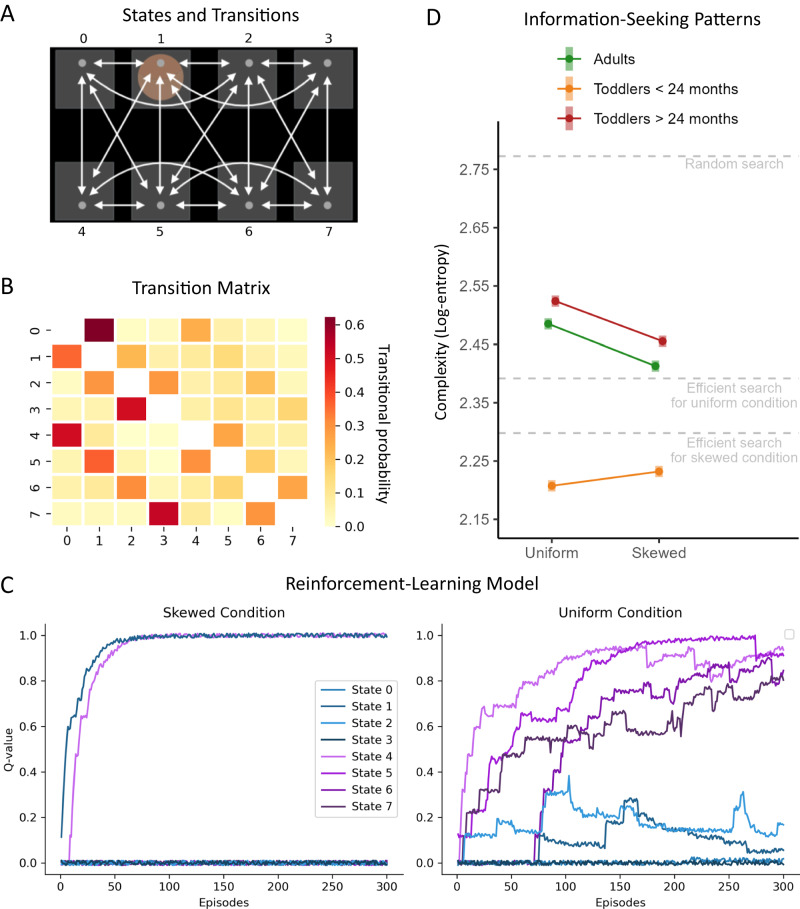
Adaptive information seeking is essential for humans to effectively navigate complex and dynamic environments. Here, we developed a gaze-contingent eye-tracking paradigm to examine the early emergence of adaptive information-seeking. Toddlers (N = 60, 18-36 months) and adults (N = 42) either learnt that an animal was equally likely to be found in any of four available locations, or that it was most likely to be found in one particular location. Afterwards, they were given control of a torchlight, which they could move with their eyes to explore the otherwise pitch-black task environment. Eye-movement data and Markov models show that, from 24 months of age, toddlers become more exploratory than adults, and start adapting their exploratory strategies to the information structure of the task. These results show that toddlers' search strategies are more sophisticated than previously thought, and identify the unique features that distinguish their information search from adults'.
自适应信息搜索对于人类在复杂和动态的环境中有效地进行导航至关重要。在这里,我们开发了一种基于注视的眼动追踪范式,以研究自适应信息搜索的早期出现。幼儿(N=60,18-36 个月)和成人(N=42)要么学习到动物在四个可用位置中出现的可能性相等,要么学习到动物最有可能出现在一个特定的位置。之后,他们可以使用手电筒来控制手电筒,并用眼睛移动手电筒以探索其他漆黑的任务环境。眼动数据和马尔可夫模型表明,从 24 个月开始,幼儿比成人更具探索性,并开始根据任务的信息结构调整他们的探索策略。这些结果表明,幼儿的搜索策略比以前认为的更为复杂,并确定了将他们的信息搜索与成人区分开来的独特特征。