Section of Bioinformatics, Division of Systems Medicine, Department of Metabolism, Digestion and Reproduction, Faculty of Medicine, Imperial College London, London W12 0NN, U.K.
Department of Mathematics, Imperial College London, London SW7 2AZ, U.K.
Anal Chem. 2024 Jul 23;96(29):11707-11715. doi: 10.1021/acs.analchem.4c00563. Epub 2024 Jul 11.
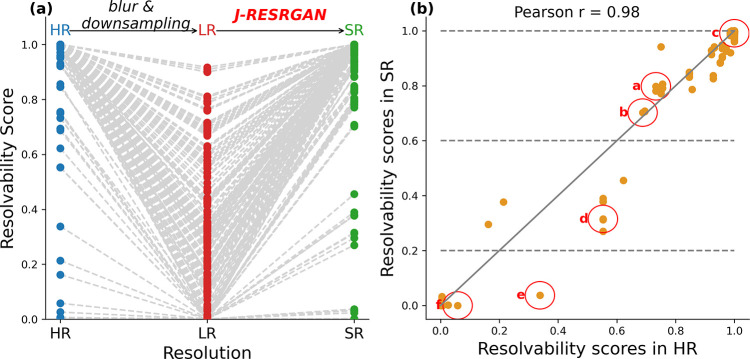
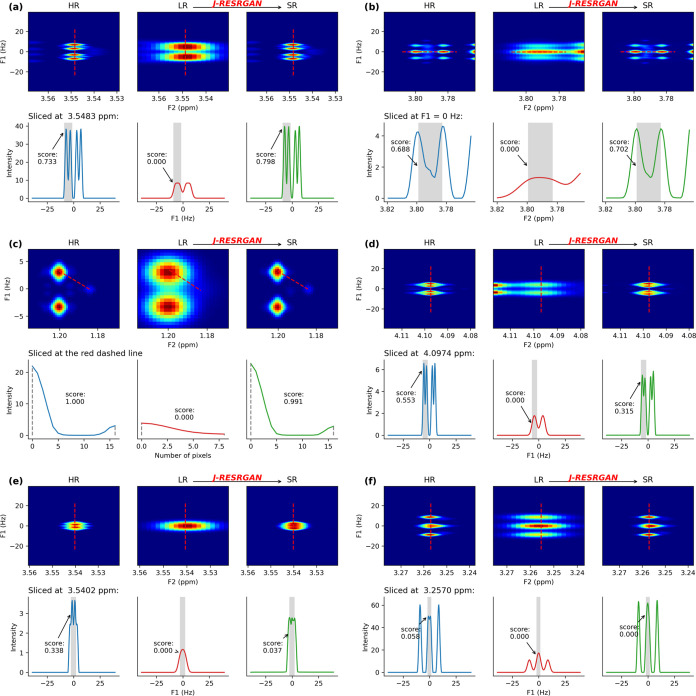
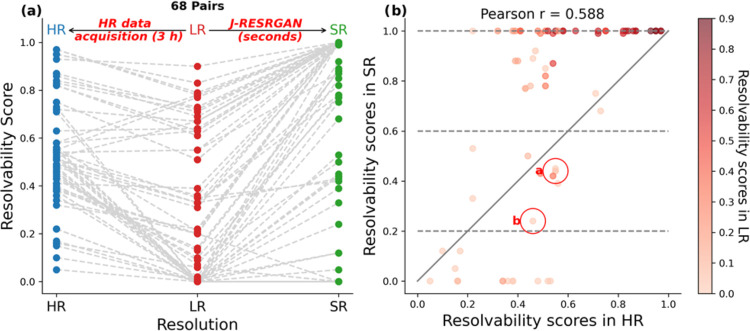
J-Resolved (J-Res) nuclear magnetic resonance (NMR) spectroscopy is pivotal in NMR-based metabolomics, but practitioners face a choice between time-consuming high-resolution (HR) experiments or shorter low-resolution (LR) experiments which exhibit significant peak overlap. Deep learning neural networks have been successfully used in many fields to enhance quality of natural images, especially with regard to resolution, and therefore offer the prospect of improving two-dimensional (2D) NMR data. Here, we introduce the J-RESRGAN, an adapted and modified generative adversarial network (GAN) for image super-resolution (SR), which we trained specifically for metabolomic J-Res spectra to enhance peak resolution. A novel symmetric loss function was introduced, exploiting the inherent vertical symmetry of J-Res NMR spectra. Model training used simulated high-resolution J-Res spectra of complex mixtures, with corresponding low-resolution spectra generated via blurring and down-sampling. Evaluation of peak pair resolvability on J-RESRGAN demonstrated remarkable improvement in resolution across a variety of samples. In simulated plasma data, 100% of peak pairs exhibited enhanced resolution in super-resolution spectra compared to their low-resolution counterparts. Similarly, enhanced resolution was observed in 80.8-100% of peak pairs in experimental plasma, 85.0-96.7% in urine, 94.4-98.9% in full fat milk, and 82.6-91.7% in orange juice. J-RESRGAN is not sample type, spectrometer or field strength dependent and improvements on previously acquired data can be seen in seconds on a standard desktop computer. We believe this demonstrates the promise of deep learning methods to enhance NMR metabolomic data, and in particular, the power of J-RESRGAN to elucidate overlapping peaks, advancing precision in a wide variety of NMR-based metabolomics studies. The model, J-RESRGAN, is openly accessible for download on GitHub at https://github.com/yanyan5420/J-RESRGAN.
J-Resolved(J-Res)核磁共振(NMR)光谱在基于 NMR 的代谢组学中至关重要,但从业者在耗时的高分辨率(HR)实验或较短的低分辨率(LR)实验之间面临选择,后者表现出明显的峰重叠。深度学习神经网络已成功应用于许多领域,以提高自然图像的质量,尤其是在分辨率方面,因此有望改善二维(2D)NMR 数据。在这里,我们介绍了 J-RESRGAN,这是一种专门为代谢组学 J-Res 光谱设计的、经过改编和修改的生成对抗网络(GAN),用于图像超分辨率(SR),以增强峰分辨率。引入了一种新颖的对称损失函数,利用 J-Res NMR 光谱的固有垂直对称性。模型训练使用复杂混合物的模拟高分辨率 J-Res 光谱,以及通过模糊和下采样生成的相应低分辨率光谱。在 J-RESRGAN 上评估峰对可分辨性,结果表明在各种样本中分辨率得到了显著提高。在模拟血浆数据中,与低分辨率谱相比,100%的峰对在超分辨率谱中显示出增强的分辨率。同样,在实验血浆中观察到 80.8-100%、尿液中 85.0-96.7%、全脂牛奶中 94.4-98.9%和橙汁中 82.6-91.7%的峰对分辨率得到增强。J-RESRGAN 不受样本类型、光谱仪或场强的影响,在标准台式计算机上,只需几秒钟即可在以前获取的数据上看到改进。我们相信,这证明了深度学习方法在增强 NMR 代谢组学数据方面的前景,特别是 J-RESRGAN 阐明重叠峰的能力,在各种基于 NMR 的代谢组学研究中提高了精度。该模型 J-RESRGAN 可在 GitHub 上公开下载,网址为 https://github.com/yanyan5420/J-RESRGAN。