Coelho Lara E, Luz Paula M, Pires Débora C, Jalil Emilia M, Perazzo Hugo, Torres Thiago S, Cardoso Sandra W, Peixoto Eduardo M, Nazer Sandro, Massad Eduardo, Carvalho Luiz Max, Réquia Weeberb J, Motta Fernando Couto, Siqueira Marilda Mendonça, Vasconcelos Ana T R, da Fonseca Guilherme C, Cavalcante Liliane T F, Costa Carlos A M, Amancio Rodrigo T, Villela Daniel A M, Pereira Tiago, Goedert Guilherme T, Santos Cleber V B D, Rodrigues Nadia C P, Bormann de Souza Filho Breno Augusto, Csillag Daniel, Grinsztejn Beatriz, Veloso Valdilea G, Struchiner Claudio J
Instituto Nacional de Infectologia Evandro Chagas, FIOCRUZ, Rio de Janeiro, Brazil.
Escola de Matemática Aplicada, Fundação Getulio Vargas, Rio de Janeiro, Brazil.
Lancet Reg Health Am. 2024 Jun 18;36:100824. doi: 10.1016/j.lana.2024.100824. eCollection 2024 Aug.
Household transmission studies seek to understand the transmission dynamics of a pathogen by estimating the risk of infection from household contacts and community exposures. We estimated within/extra-household SARS-CoV-2 infection risk and associated factors in a household cohort study in one of the most vulnerable neighbourhoods in Rio de Janeiro city.
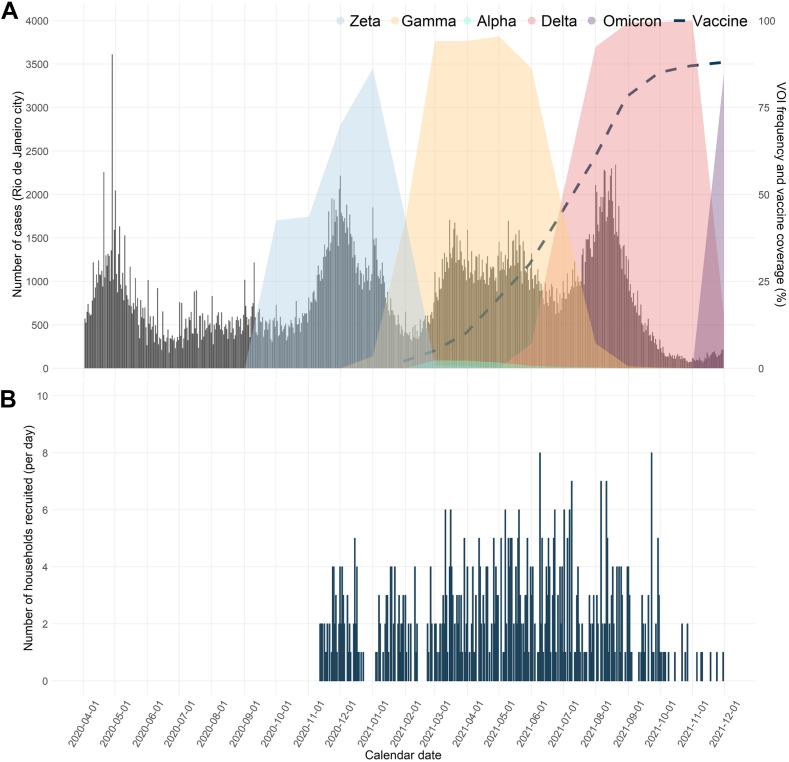
Individuals ≥1 years-old with suspected or confirmed COVID-19 in the past 30 days (index cases) and household members aged ≥1 year were enrolled and followed at 14 and 28 days (study period November/2020-December/2021). RT-PCR testing, COVID-19 symptoms, and SARS-CoV-2 serologies were ascertained in all visits. Chain binomial household transmission models were fitted using data from 2024 individuals (593 households).
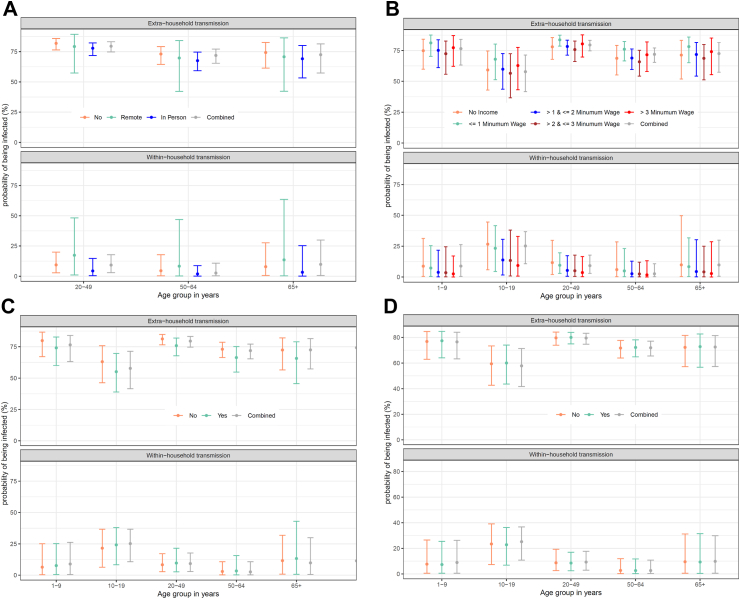
Extra-household infection risk was 74.2% (95% credible interval [CrI] 70.3-77.8), while within-household infection risk was 11.4% (95% CrI 5.7-17.2). Participants reporting having received two doses of a COVID-19 vaccine had lower extra-household (68.9%, 95% CrI 57.3-77.6) and within-household (4.1%, 95% CrI 0.4-16.6) infection risk. Within-household infection risk was higher among participants aged 10-19 years, from overcrowded households, and with low family income. Contrastingly, extra-household infection risk was higher among participants aged 20-29 years, unemployed, and public transportation users.
Our study provides important insights into COVID-19 household/community transmission in a vulnerable population that resided in overcrowded households and who struggled to adhere to lockdown policies and social distancing measures. The high extra-household infection risk highlights the extreme social vulnerability of this population. Prioritising vaccination of the most socially vulnerable could protect these individuals and reduce widespread community transmission.
Fundação Oswaldo Cruz, CNPq, FAPERJ, Royal Society, Instituto Serrapilheira, FAPESP.
家庭传播研究旨在通过估计家庭接触者和社区暴露导致感染的风险,来了解病原体的传播动态。我们在里约热内卢市最脆弱的社区之一开展了一项家庭队列研究,估计了家庭内/家庭外的新冠病毒感染风险及相关因素。
纳入过去30天内有疑似或确诊新冠病毒感染的1岁及以上个体(索引病例)及其1岁及以上的家庭成员,并在第14天和第28天进行随访(研究期为2020年11月至2021年12月)。在每次访视时确定逆转录聚合酶链反应检测结果、新冠病毒感染症状和新冠病毒血清学情况。使用来自2024名个体(593户家庭)的数据拟合链式二项式家庭传播模型。
家庭外感染风险为74.2%(95%可信区间[CrI]70.3 - 77.8),而家庭内感染风险为11.4%(95%CrI 5.7 - 17.2)。报告接种过两剂新冠病毒疫苗的参与者家庭外感染风险较低(68.9%,95%CrI 57.3 - 77.6),家庭内感染风险也较低(4.1%,95%CrI 0.4 - 16.6)。10 - 19岁的参与者、居住在过度拥挤家庭中的参与者以及家庭收入较低的参与者家庭内感染风险较高。相反,20 - 29岁的参与者、失业者和公共交通使用者家庭外感染风险较高。
我们的研究为居住在过度拥挤家庭且难以遵守封锁政策和社交距离措施的脆弱人群中的新冠病毒家庭/社区传播提供了重要见解。家庭外感染风险高凸显了该人群极端的社会脆弱性。优先为社会最脆弱人群接种疫苗可以保护这些个体并减少社区广泛传播。
奥斯瓦尔多·克鲁兹基金会、国家科学技术发展委员会、里约热内卢州研究资助基金会、英国皇家学会、塞拉皮莱拉研究所、圣保罗研究基金会。