Doi Yurika, Asaka Meiko, Born Richard T, Yanagihara Dai, Uchida Naoshige
Department of Molecular and Cellular Biology, Harvard University, Cambridge, MA, USA.
Program in Neuroscience, Harvard Medical School, Boston, MA, USA.
bioRxiv. 2025 Jan 27:2024.07.01.601478. doi: 10.1101/2024.07.01.601478.
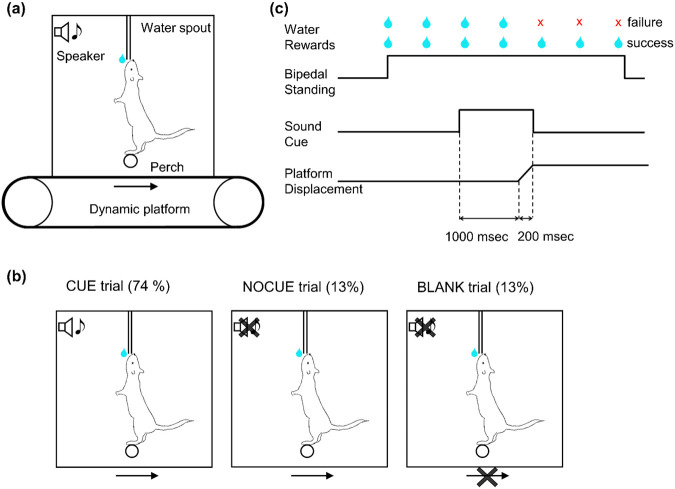
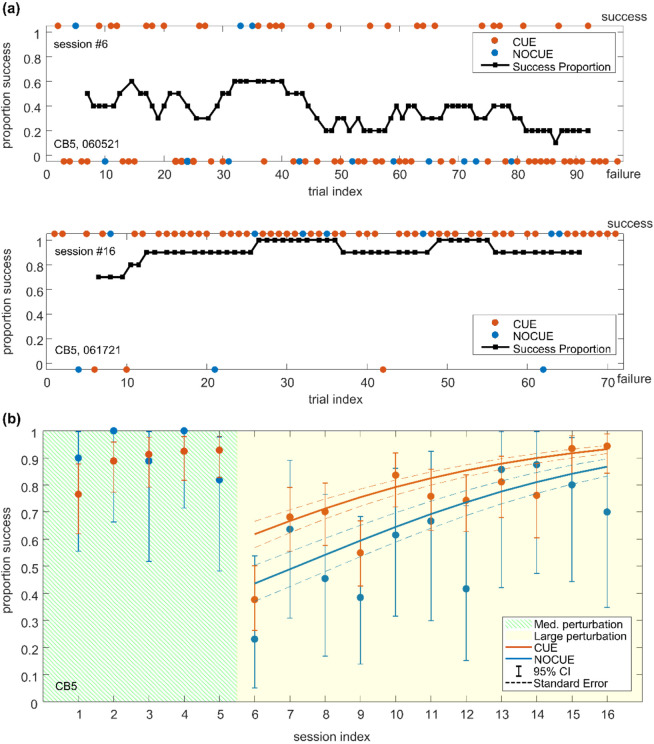
Postural control circuitry performs the essential function of maintaining balance and body position in response to perturbations that are either self-generated (e.g. reaching to pick up an object) or externally delivered (e.g. being pushed by another person). Human studies have shown that anticipation of predictable postural disturbances can modulate such responses. This indicates that postural control could involve higher-level neural structures associated with predictive functions, rather than being purely reactive. However, the underlying neural circuitry remains largely unknown. To enable studies of predictive postural control circuits, we developed a novel experimental paradigm for . In this paradigm, modeled after human studies, a dynamic platform generated reproducible translational perturbations. While mice stood bipedally atop a perch to receive water rewards, they experienced backward translations that were either unpredictable or preceded by an auditory cue. To validate the paradigm, we investigated the effect of the auditory cue on postural responses to perturbations across multiple days in three mice. These preliminary results serve to validate a new postural control experimental paradigm, opening the door to the types of neural recordings and circuit manipulations that are currently possible in mice.
姿势控制回路执行着维持平衡和身体姿势的基本功能,以应对自我产生的(例如伸手去拿一个物体)或外部施加的(例如被另一个人推搡)扰动。人体研究表明,对可预测的姿势干扰的预期可以调节这种反应。这表明姿势控制可能涉及与预测功能相关的高级神经结构,而不是纯粹的反应性。然而,潜在的神经回路在很大程度上仍然未知。为了能够研究预测性姿势控制回路,我们开发了一种新颖的实验范式。在这个范式中,模仿人体研究,一个动态平台产生可重复的平移扰动。当小鼠双足站立在栖木上以获得水奖励时,它们经历了不可预测的向后平移或在平移之前有一个听觉提示。为了验证该范式,我们在三只小鼠中研究了多天内听觉提示对扰动姿势反应的影响。这些初步结果有助于验证一种新的姿势控制实验范式,为目前在小鼠中可行的神经记录和回路操纵类型打开了大门。