Boe Ryan H, Triandafillou Catherine G, Lazcano Rossana, Wargo Jennifer A, Raj Arjun
Genetics and Epigenetics Program, Cell and Molecular Biology Graduate Group, Perelman School of Medicine, University of Pennsylvania, Philadelphia, PA.
Department of Bioengineering, School of Engineering and Applied Sciences, University of Pennsylvania, Philadelphia, PA.
bioRxiv. 2024 Jul 2:2024.06.30.601416. doi: 10.1101/2024.06.30.601416.
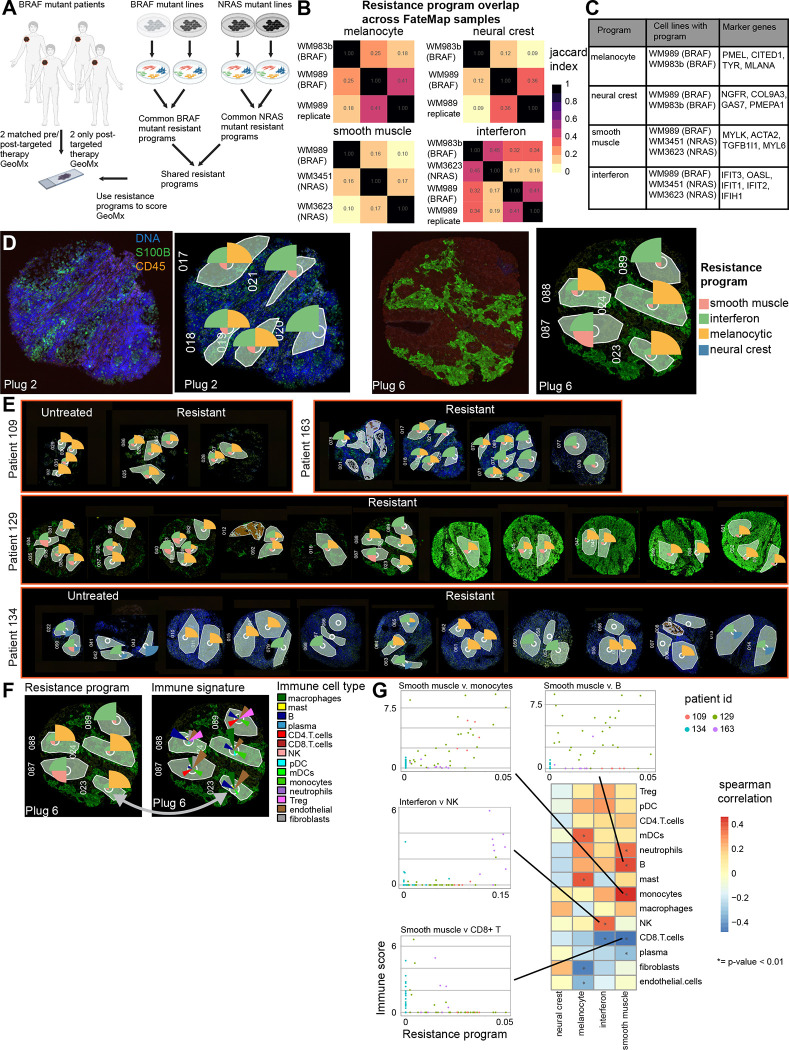
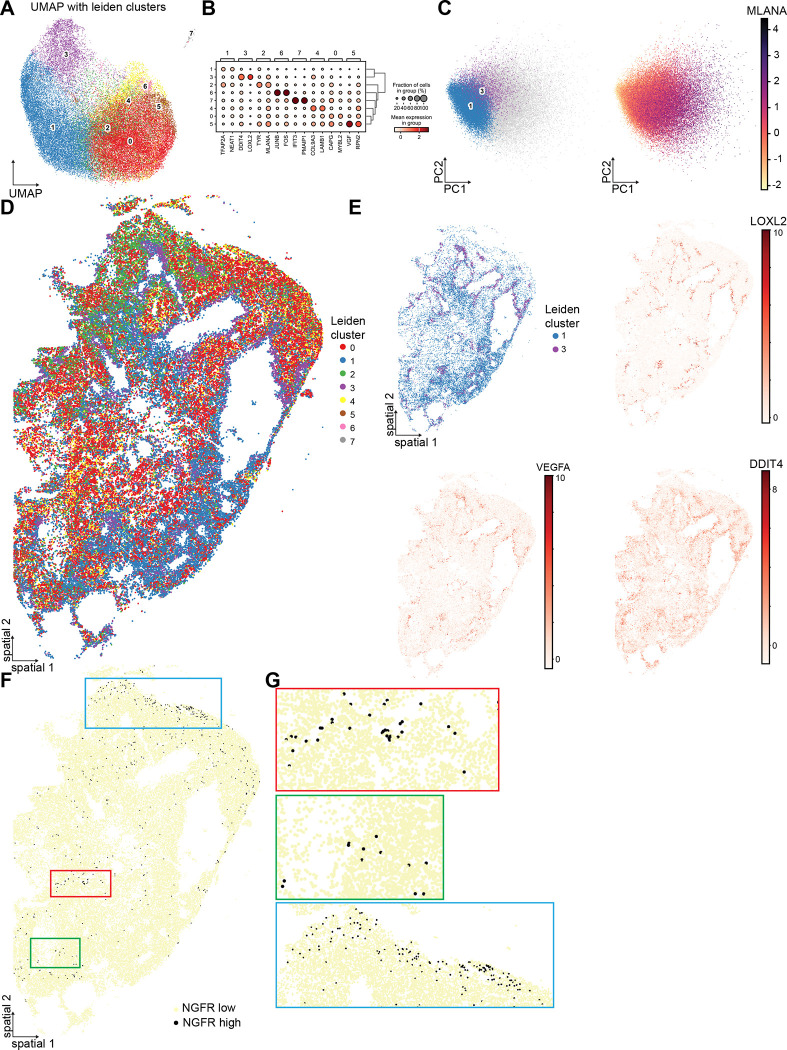
Resistance to cancer therapy is driven by both cell-intrinsic and microenvironmental factors. Previous work has revealed that multiple resistant cell fates emerge in melanoma following treatment with targeted therapy and that, , these resistant fates are determined by the transcriptional state of individual cells prior to exposure to treatment. What remains unclear is whether these resistant fates are shared across different genetic backgrounds and how, if at all, these resistant fates interact with the tumor microenvironment. Through spatial transcriptomics and single-cell RNA sequencing, we uncovered distinct resistance programs in melanoma cells shaped by both intrinsic cellular states and the tumor microenvironment. Consensus non-negative matrix factorization revealed shared intrinsic resistance programs across different cell lines, highlighting the presence of universal and unique resistance pathways. In patient samples, we demonstrated that these resistance programs coexist within individual tumors and associate with diverse immune signatures, suggesting that the tumor microenvironment and distribution of resistant fates are closely connected. Single-cell resolution spatial transcriptomics in xenograft models revealed both intrinsically determined and extrinsically influenced resistant fates. Overall, this work demonstrates that each therapy resistant fate coexists with a distinct immune microenvironment in tumors and that, , tissue features, such as regions of necrosis, can influence which resistant fate is adopted.
癌症治疗耐药性是由细胞内在因素和微环境因素共同驱动的。先前的研究表明,黑色素瘤在接受靶向治疗后会出现多种耐药细胞命运,而且,这些耐药命运是由单个细胞在接受治疗前的转录状态决定的。尚不清楚的是,这些耐药命运是否在不同的遗传背景中共享,以及这些耐药命运如何(如果有的话)与肿瘤微环境相互作用。通过空间转录组学和单细胞RNA测序,我们在黑色素瘤细胞中发现了由内在细胞状态和肿瘤微环境塑造的不同耐药程序。共识非负矩阵分解揭示了不同细胞系之间共享的内在耐药程序,突出了普遍和独特耐药途径的存在。在患者样本中,我们证明这些耐药程序在单个肿瘤中共存,并与不同的免疫特征相关,这表明肿瘤微环境和耐药命运的分布密切相关。异种移植模型中的单细胞分辨率空间转录组学揭示了内在决定和外在影响的耐药命运。总体而言,这项研究表明,每种治疗耐药命运都与肿瘤中独特的免疫微环境共存,而且,组织特征,如坏死区域,可影响采用哪种耐药命运。