Tsvik Lidiia, Zhang Shulin, O'Hare Danny, Haltrich Dietmar, Sützl Leander
Laboratory of Food Biotechnology, Department of Food Science and Technology, University of Natural Resources and Life Sciences, Muthgasse 11, Wien, Vienna A-1190, Austria.
Doctoral Programme 'Biomolecular Technology of Proteins (BioToP)', University of Natural Resources and Life Sciences, Muthgasse 18, Wien, Vienna A-1190, Austria.
ACS Omega. 2024 Jun 26;9(27):29442-29452. doi: 10.1021/acsomega.4c01897. eCollection 2024 Jul 9.
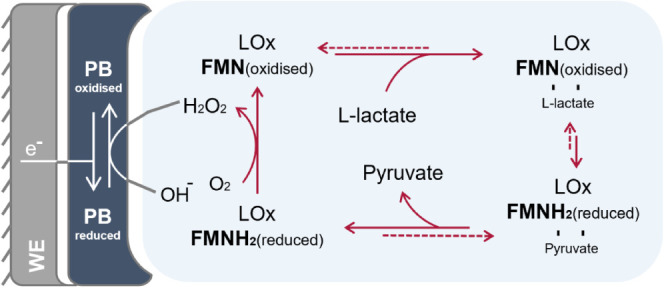
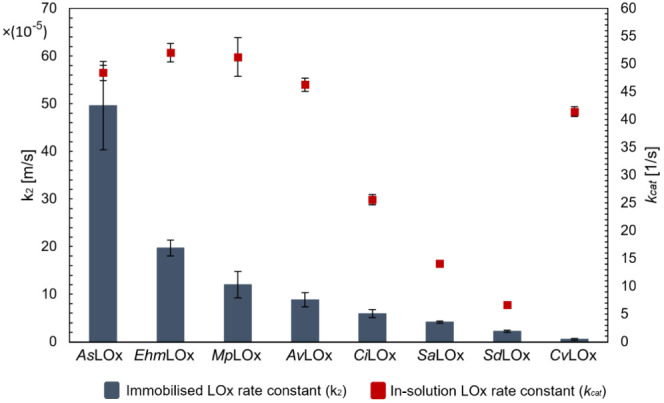
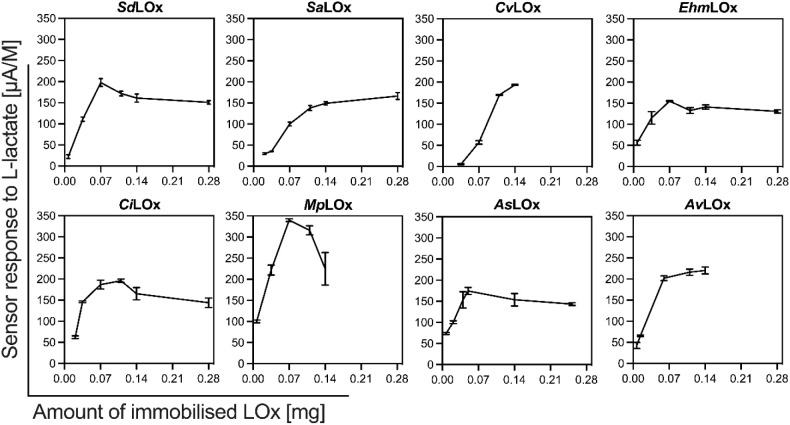
The α-hydroxy acid oxidoreductase (HAOx) family contains a diverse group of enzymes that can be applied in biosensors for L-lactate detection, most prominently lactate oxidase (LOx). The limited availability and a lack of diversity of L-lactate-oxidizing enzymes have currently hindered advancements in L-lactate biosensor development. Until now, the field has mostly relied on a single, commercially available enzyme, namely L-lactate oxidase (LOx). In this study, we present newly discovered alternative L-lactate oxidases that exhibit a narrow substrate specificity and varied kinetic efficiencies toward L-lactate, making them suitable for integration into existing biosensor configurations. Some of these FMN-dependent L-lactate oxidases could be obtained in substantial amounts from routine expression, potentially facilitating commercial production. Using electrochemical characterization with a mediated biosensor setup, we present 7 enzymes that perform comparable or even better than commercial LOx. Finally, we show that their electrochemical performance is not directly correlating with their biochemical performance, making predictions of the suitability of enzymes for biosensor applications extremely difficult. Our research emphasizes the significance of expanding the enzyme toolbox of L-lactate oxidases for the development of improved L-lactate biosensors.
α-羟基酸氧化还原酶(HAOx)家族包含多种酶,这些酶可应用于用于检测L-乳酸的生物传感器中,其中最突出的是乳酸氧化酶(LOx)。L-乳酸氧化酶的可用性有限且缺乏多样性,目前阻碍了L-乳酸生物传感器开发的进展。到目前为止,该领域主要依赖于一种市售酶,即L-乳酸氧化酶(LOx)。在本研究中,我们展示了新发现的替代L-乳酸氧化酶,它们对L-乳酸表现出狭窄的底物特异性和不同的动力学效率,使其适合整合到现有的生物传感器配置中。其中一些依赖黄素单核苷酸(FMN)的L-乳酸氧化酶可以通过常规表达大量获得,这可能有助于商业化生产。通过使用介导生物传感器设置的电化学表征,我们展示了7种酶,它们的性能与市售LOx相当甚至更好。最后,我们表明它们的电化学性能与生化性能没有直接关联,这使得预测酶在生物传感器应用中的适用性极其困难。我们的研究强调了扩展L-乳酸氧化酶的酶工具箱对于开发改进的L-乳酸生物传感器的重要性。