Sharma Avinash, Hazarika Mainu, Heisnam Punabati, Pandey Himanshu, Devadas Vadakkumcheri Akathoottu Subrahmanian Nampoothiri, Kesavan Ajith Kumar, Kumar Praveen, Singh Devendra, Vashishth Amit, Jha Rani, Misra Varucha, Kumar Rajeev
Faculty of Agricultural Sciences, Arunachal University of Studies, Namsai, Arunachal Pradesh 792103, India.
College of Agriculture, Central Agricultural University, Iroisemba, Manipur 795004, India.
ACS Omega. 2024 Jun 26;9(27):29114-29138. doi: 10.1021/acsomega.3c09060. eCollection 2024 Jul 9.
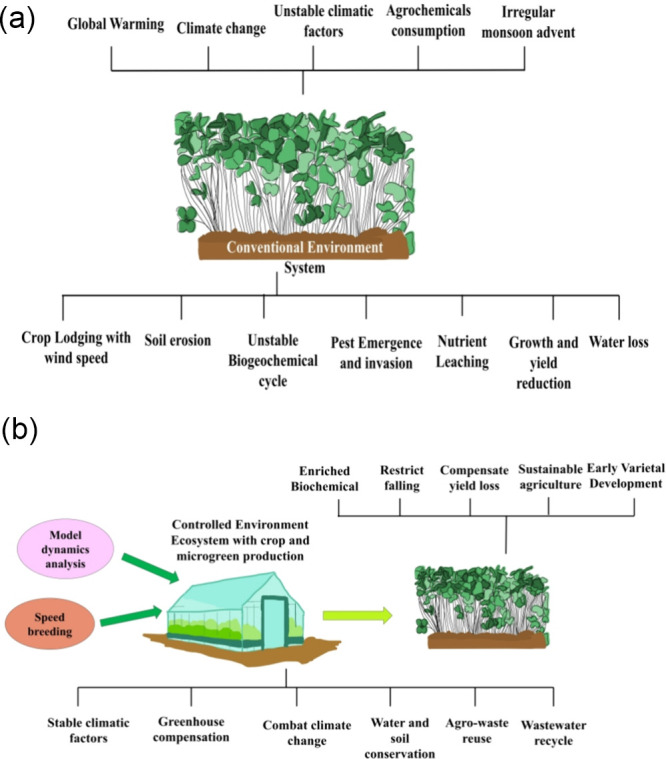
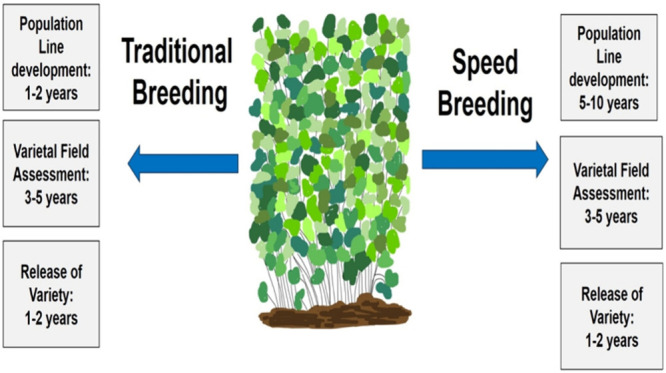
The controlled environment ecosystem is a meticulously designed plant growing chamber utilized for cultivating biofortified crops and microgreens, addressing hidden hunger and malnutrition prevalent in the growing population. The integration of speed breeding within such controlled environments effectively eradicates morphological disruptions encountered in traditional breeding methods such as inbreeding depression, male sterility, self-incompatibility, embryo abortion, and other unsuccessful attempts. In contrast to the unpredictable climate conditions that often prolong breeding cycles to 10-15 years in traditional breeding and 4-5 years in transgenic breeding within open ecosystems, speed breeding techniques expedite the achievement of breeding objectives and F1-F6 generations within 2-3 years under controlled growing conditions. In comparison, traditional breeding may take 5-10 years for plant population line creation, 3-5 years for field trials, and 1-2 years for variety release. The effectiveness of speed breeding in trait improvement and population line development varies across different crops, requiring approximately 4 generations in rice and groundnut, 5 generations in soybean, pea, and oat, 6 generations in sorghum, sp., and subterranean clover, 6-7 generations in bread wheat, durum wheat, and chickpea, 7 generations in broad bean, 8 generations in lentil, and 10 generations in annually within controlled environment ecosystems. Artificial intelligence leverages neural networks and algorithm models to screen phenotypic traits and assess their role in diverse crop species. Moreover, in controlled environment systems, mechanistic models combined with machine learning effectively regulate stable nutrient use efficiency, water use efficiency, photosynthetic assimilation product, metabolic use efficiency, climatic factors, greenhouse gas emissions, carbon sequestration, and carbon footprints. However, any negligence, even minor, in maintaining optimal photoperiodism, temperature, humidity, and controlling pests or diseases can lead to the deterioration of crop trials and speed breeding techniques within the controlled environment system. Further comparative studies are imperative to comprehend and justify the efficacy of climate management techniques in controlled environment ecosystems compared to natural environments, with or without soil.
可控环境生态系统是一个精心设计的植物种植室,用于培育生物强化作物和微型蔬菜,以解决不断增长的人口中普遍存在的隐性饥饿和营养不良问题。在这种可控环境中整合快速育种技术,有效地消除了传统育种方法中遇到的形态干扰,如近亲衰退、雄性不育、自交不亲和、胚胎败育以及其他不成功的尝试。与开放生态系统中传统育种通常将育种周期延长至10 - 15年、转基因育种延长至4 - 5年的不可预测气候条件相比,快速育种技术在可控生长条件下2 - 3年内就能加速实现育种目标并获得F1 - F6代。相比之下,传统育种创建植物群体品系可能需要5 - 10年,进行田间试验需要3 - 5年,发布品种需要1 - 2年。快速育种在性状改良和群体品系发育方面的有效性因作物而异,在可控环境生态系统中,水稻和花生大约需要4代,大豆、豌豆和燕麦需要5代,高粱、[物种名称未给出]和地下三叶草需要6代,面包小麦、硬粒小麦和鹰嘴豆需要6 - 7代,蚕豆需要7代,小扁豆需要8代,[物种名称未给出]需要10代。人工智能利用神经网络和算法模型来筛选表型性状并评估它们在不同作物物种中的作用。此外,在可控环境系统中,机理模型与机器学习相结合可有效调节稳定的养分利用效率、水分利用效率、光合同化产物、代谢利用效率、气候因素、温室气体排放、碳固存和碳足迹。然而,在维持最佳光周期、温度、湿度以及控制病虫害方面,哪怕是轻微的疏忽,都可能导致可控环境系统内作物试验和快速育种技术的恶化。与有或没有土壤的自然环境相比,进一步的比较研究对于理解和证明可控环境生态系统中气候管理技术的功效至关重要。