Di Gioia Francesco, Hong Jason C, Pisani Cristina, Petropoulos Spyridon A, Bai Jihne, Rosskopf Erin N
Department of Plant Science, The Pennsylvania State University, University Park, PA, United States.
U.S. Department of Agriculture (USDA), Agricultural Research Service (ARS), U.S. Horticultural Research Laboratory, Fort Pierce, FL, United States.
Front Plant Sci. 2023 Jul 20;14:1220691. doi: 10.3389/fpls.2023.1220691. eCollection 2023.
Originally regarded as garnish greens, microgreens are increasingly valued for their nutritional profile, including their mineral content.
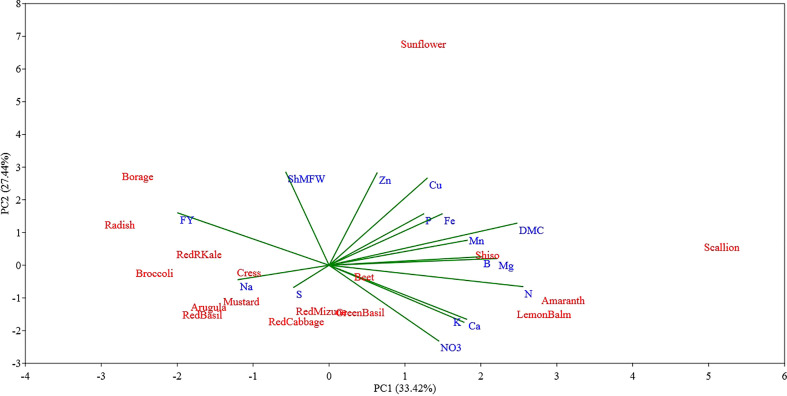
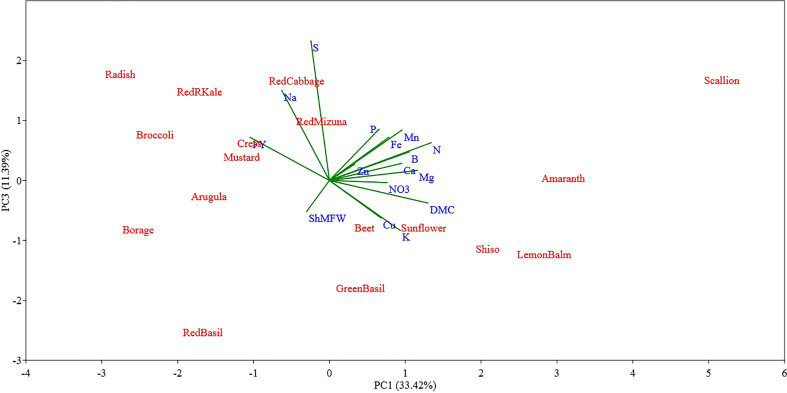
A study was conducted under controlled environmental conditions utilizing a selection of seventeen microgreen species belonging to seven different botanical families to investigate the genetic variation of macro- and micro-minerals and nitrate (NO ) content. Plants were grown in a soilless system using a natural fiber mat as the substrate. After germination, microgreens were fertigated with a modified half-strength Hoagland solution prepared using deionized water and without adding microelements. At harvest (10 to 19 days after sowing, based on the species), yield components were measured and dry tissue samples were analyzed for the concentration of total nitrogen (N), NO , P, K, Ca, Mg, S, Na, Fe, Zn, Mn, Cu, and B.
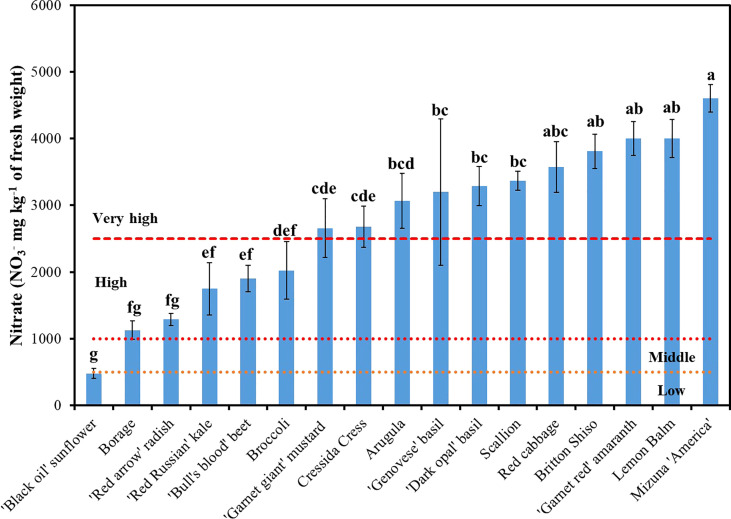
Genotypic variations were observed for all of the examined parameters. Nitrogen and K were the principal macronutrients accounting for 38.4% and 33.8% of the total macro-minerals concentration, respectively, followed in order by Ca, P, S, and Mg. Except for sunflower ( L.), all the tested species accumulated high (1,000-2,500 mg kg FW) or very high (>2,500 mg kg FW) NO levels. Eight of the studied species had a K concentration above 300 mg 100 g FW and could be considered as a good dietary source of K. On the other hand, scallion ( L.), red cabbage ( L. var. ), amaranth ( L.), and Genovese basil ( L.) microgreens were a good source of Ca. Among micro-minerals, the most abundant was Fe followed by Zn, Mn, B, and Cu. Sunflower, scallion, and shiso ( (L.) Britton) were a good source of Cu. Moreover, sunflower was a good source of Zn, whereas none of the other species examined could be considered a good source of Fe and Zn, suggesting that supplementary fertilization may be required to biofortify microgreens with essential microminerals. In conclusion, the tested microgreens can be a good source of minerals showing a high potential to address different dietary needs; however, their yield potential and mineral profile are largely determined by the genotype.
微 greens 最初被视为装饰性蔬菜,如今因其营养成分,包括矿物质含量,而越来越受到重视。
在可控环境条件下进行了一项研究,选用了属于七个不同植物科的十七种微 greens 品种,以研究常量和微量矿物质以及硝酸盐(NO)含量的遗传变异。植物在无土系统中生长,使用天然纤维垫作为基质。发芽后,用去离子水配制的改良半强度霍格兰溶液对微 greens 进行施肥,且不添加微量元素。收获时(播种后 10 至 19 天,取决于品种),测量产量构成要素,并分析干组织样本中总氮(N)、NO、P、K、Ca、Mg、S、Na、Fe、Zn、Mn、Cu 和 B 的浓度。
在所检测的所有参数中均观察到基因型变异。氮和钾是主要的常量营养素,分别占总常量矿物质浓度的 38.4%和 33.8%,其次依次是钙、磷、硫和镁。除向日葵(L.)外,所有测试品种积累的硝酸盐水平都很高(1000 - 2500 毫克/千克鲜重)或非常高(>2500 毫克/千克鲜重)。所研究的品种中有八个钾浓度高于 300 毫克/100 克鲜重,可被视为钾的良好膳食来源。另一方面,葱(L.)、红甘蓝(L. var.)、苋菜(L.)和意大利罗勒(L.)微 greens 是钙的良好来源。在微量矿物质中,最丰富的是铁,其次是锌、锰、硼和铜。向日葵、葱和紫苏((L.) Britton)是铜的良好来源。此外,向日葵是锌的良好来源,而所检测的其他品种均不能被视为铁和锌的良好来源,这表明可能需要补充施肥,以使微 greens 富含必需的微量矿物质。总之,所测试的微 greens 可以是矿物质良好来源,显示出满足不同膳食需求的巨大潜力;然而,它们的产量潜力和矿物质特征在很大程度上由基因型决定。